


Unlicensed Contractor Liability in California: Who Actually Pays
Unlicensed contractor liability in California does not stop at the person holding the drill. It travels up the invoice chain to whoever hired them, which on a commercial property usually means the management company or the ownership entity. Most managers assume the worst case is a bad repair. It isn’t. The worst case is a workers’ compensation claim with their name on it. If you want the enforcement side of this, what a CSLB sting actually looks like covers the criminal end. This post covers the civil end, where the money is.
Short answer: Any California job over $1,000 or needing a permit requires a licensed contractor. Hire someone unlicensed for it and liability lands on you, because Labor Code 2750.5 treats that worker as your employee. The Handy Geeks works the sub-$1,000, no-permit lane across Los Angeles and the Bay Area, carrying $2M general liability.
Last verified: September 2026
Comparing a handyman with a licensed contractor? See handyman vs contractor in California.
Not sure where the legal line sits? See can a handyman do electrical work.
What Is the $1,000 Rule in California, Exactly?
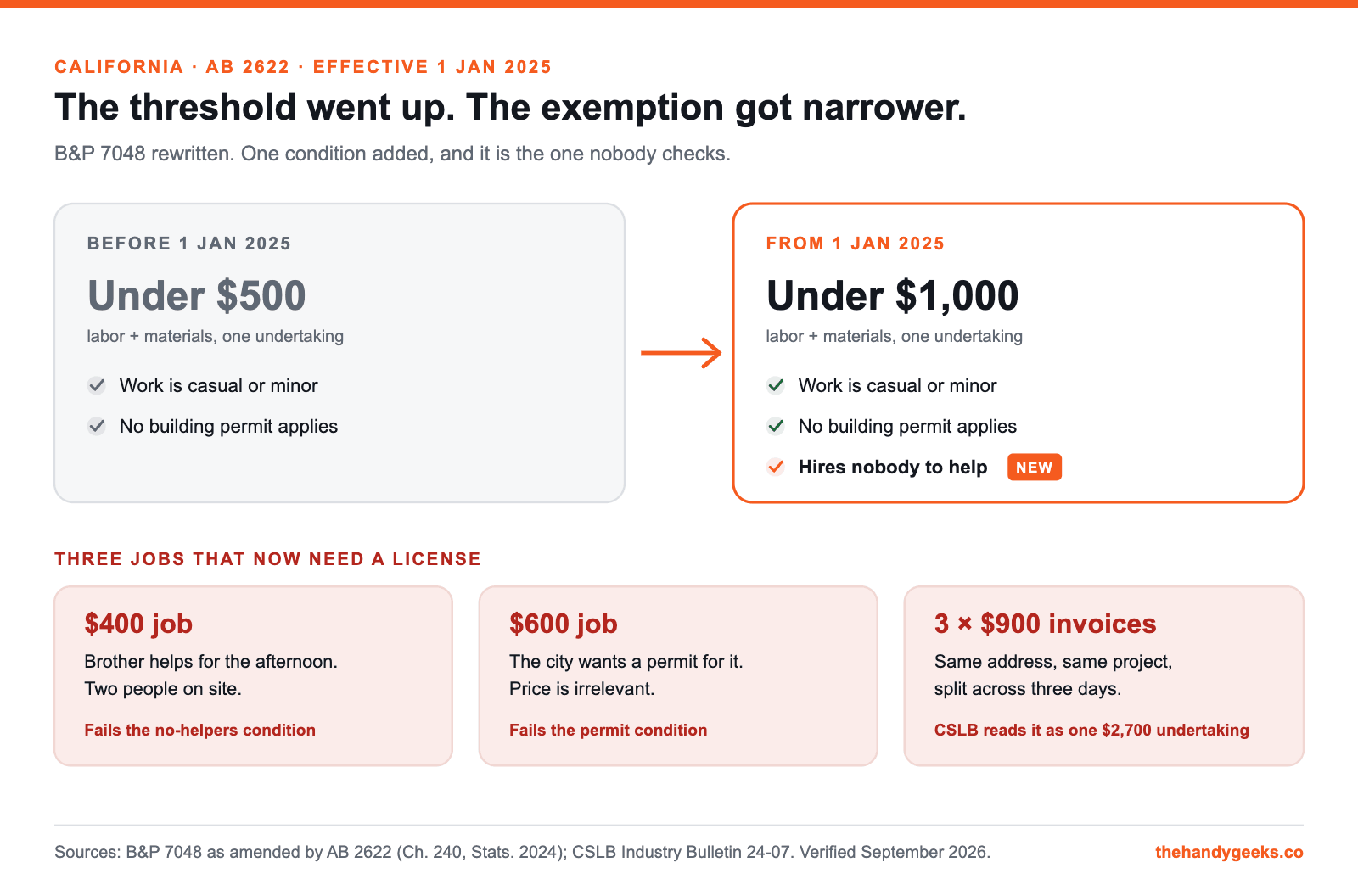
California exempts a job from licensing when four things hold at once. The total price for labor and materials comes to less than $1,000. The work is casual or minor. No building permit applies. And the person doing it hires nobody to help. Miss one condition and a license is required, however small the invoice.
That threshold moved recently, and plenty of published guidance still has the old number. AB 2622 (Carrillo, Chapter 240, Statutes of 2024) rewrote Business and Professions Code section 7048 and lifted the figure from $500 to $1,000 on 1 January 2025. CSLB spelled out the catch in Industry Bulletin 24-07. The dollar figure went up, but the exemption got narrower, because the no-helpers condition is new.
So a $400 job where the guy brings his brother for the afternoon now needs a license. A $600 job that triggers a permit needs one too. If you still see $500 quoted somewhere, nobody has updated that page since 2024.
Splitting is the other trap. Nobody can carve one project into three $900 work orders to stay under the line. CSLB reads “one undertaking or project” broadly, and separate invoices on separate days at the same address will not rescue it.
Where Does Unlicensed Contractor Liability Actually Land?
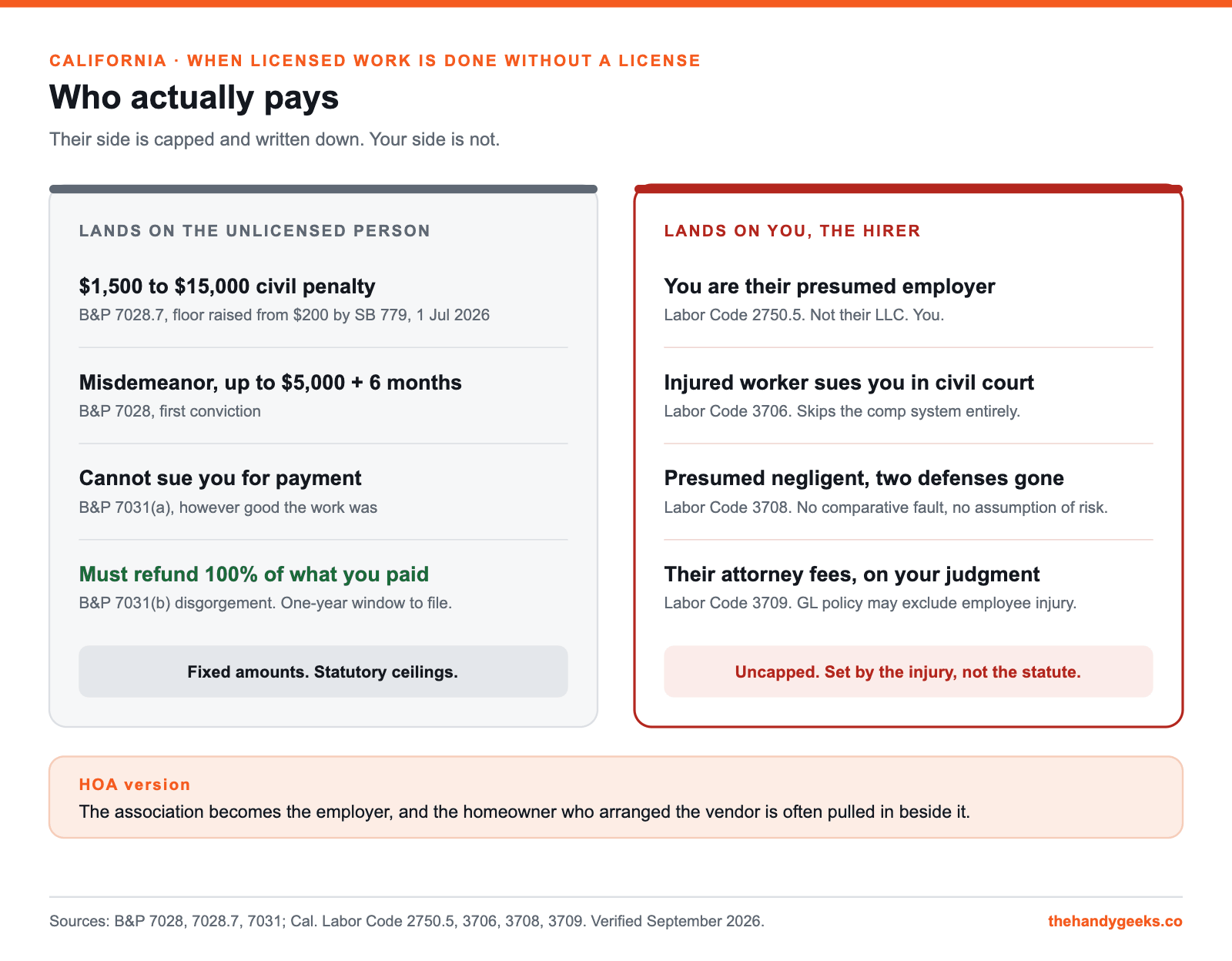
On you, in most versions of this. The exposure from hiring an unlicensed contractor is not split evenly, and California contractor license law is the reason. Labor Code section 2750.5 presumes that anyone doing licensed work without a license is an employee rather than an independent contractor. The employer in that arrangement is whoever hired them. Not their LLC. You.
That is where unlicensed contractor liability stops being theoretical, because the legislature wrote the follow-on statutes to punish exactly this arrangement. Labor Code 3706 lets a worker whose employer carried no workers’ compensation skip the comp system and sue you in civil court. Section 3708 then presumes you were negligent. It also strips out the two defenses you would normally reach for, comparative fault and assumption of risk. Section 3709 adds the plaintiff’s attorney fees.
Read those together and the shape is grim. You start out presumed negligent. Comparative fault and assumption of risk are both off the table. You pay their lawyer if you lose. Your general liability policy may well exclude the whole thing, since insurers treat employee injury as a workers’ comp exposure.
The HOA version surprises boards every time. An association that hires an unlicensed vendor can end up as the worker’s employer, and the individual homeowner who arranged the vendor sometimes gets pulled in next to the association.
Can You Get Your Money Back From an Unlicensed Contractor?
Yes, and this is the half of unlicensed contractor liability that runs in your favor. Business and Professions Code 7031 has two parts. Subdivision (a) bars an unlicensed contractor from suing you for payment, however good the work was. Subdivision (b) lets you claw back every dollar already paid.
Courts call the second one disgorgement and apply it without much sympathy. Work quality is beside the point. The California Supreme Court has confirmed it applies even where the owner knew about the licensing gap going in. Materials the contractor bought with your money do not offset the claim.
Two practical limits, though. The window is one year, generally running from completion or last payment, so this is not a remedy you sit on. Collecting a judgment from an operation that was never licensed is its own project.
We mention it mostly because of what it does to a negotiation. A vendor who understands 7031 knows their entire fee is recoverable if their paperwork has a gap in it, and that tends to make them very cooperative.
The Penalty Floor Moved on 1 July 2026
Most competing pages predate this one. SB 779 changed the arithmetic on unlicensed contractor liability for whoever is doing the work. Archuleta’s bill raised CSLB’s minimum civil penalty for unlicensed activity from $200 to $1,500, with the ceiling holding at $15,000, effective 1 July 2026. CSLB can also index those minimums to inflation every five years now.
The reasoning matters, because it tells you where enforcement is heading. Legislative analysis pointed out that a $200 minimum was cheaper than the $450 license application. Administrative law judges kept reducing citations to nominal amounts on appeal, so the deterrent did not deter. Raising the floor was the fix.
Criminal exposure sits on top of the civil penalty. Contracting without a license is a misdemeanor under B&P 7028, and a first conviction can carry up to $5,000 and six months in county jail.
| Consequence | Amount | Who it lands on | Authority |
|---|---|---|---|
| Minimum civil penalty | $1,500 (max $15,000) | The unlicensed person | B&P 7028.7, per SB 779, from 1 Jul 2026 |
| Criminal, first conviction | up to $5,000 + 6 months | The unlicensed person | B&P 7028 |
| Compensation refundable | 100% of sums paid | Recoverable by you | B&P 7031(b) |
| Workers’ comp and tort exposure | uncapped | The hirer | Labor Code 2750.5, 3706, 3708, 3709 |
Table: where each consequence lands when someone performs licensed work without a license. Statutory figures, current as of September 2026.
An Active License Today Says Nothing About Last Tuesday
Here is the failure mode that catches careful people. Under B&P 7125.2, a contractor’s license suspends automatically, by operation of law, on the date they were required to carry workers’ compensation and did not. No hearing. No notice to you. Nothing that shows up as a red flag when you glance at the license today.
Most unlicensed contractor liability starts with a license that looked fine at onboarding. Section 7031 asks whether the contractor held a license at all times during performance. One lapsed day inside a six-week project exposes the whole contract, and the courts read “substantial compliance” narrowly enough that it rarely rescues anybody.
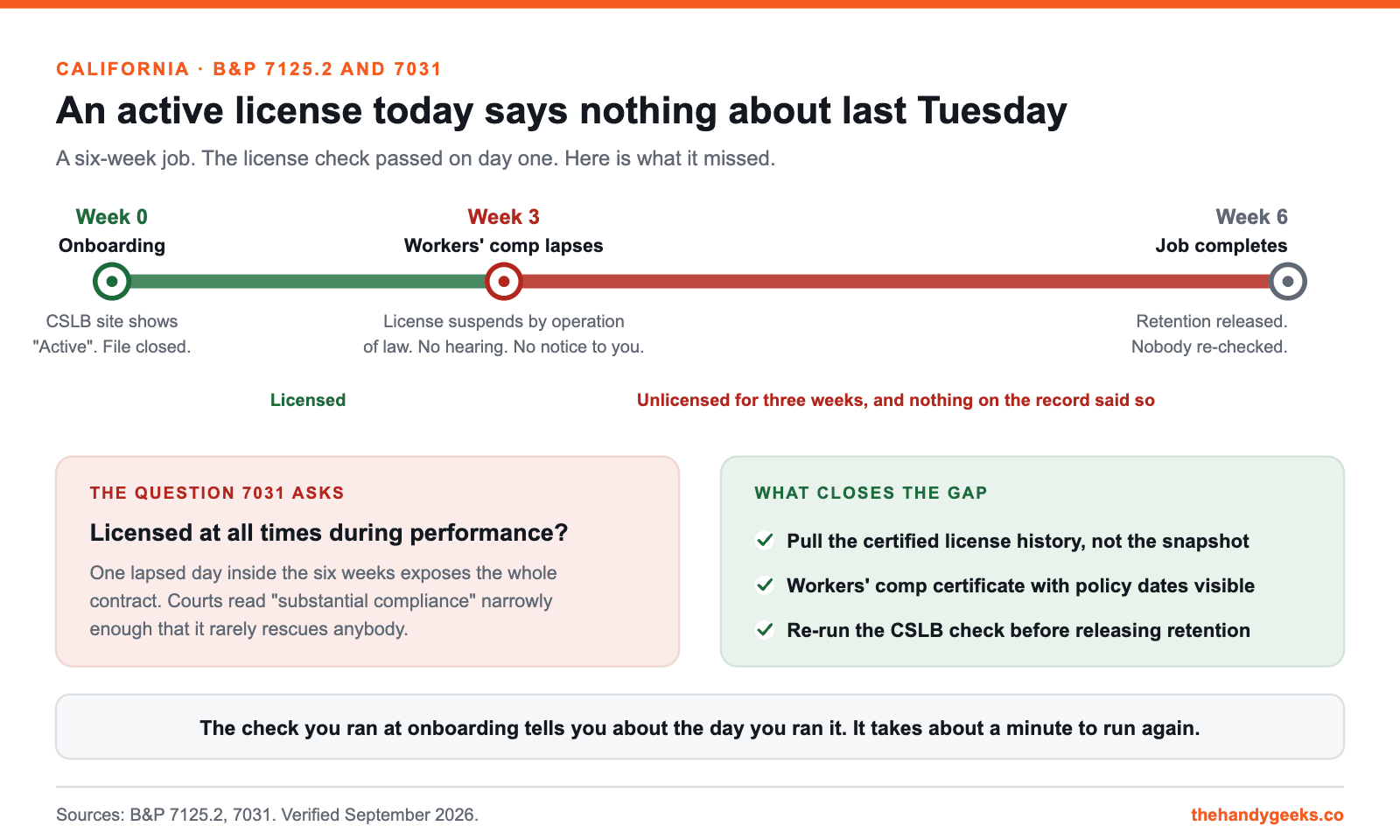
So the CSLB license check you ran at onboarding tells you about the day you ran it. For anything ongoing, pull the certified license history instead. Re-run the CSLB license check before you release retention on a long job. It takes about a minute.
How Do the Rules Change in Arizona and Nevada?
The dollar figure is identical in all three states we work, which fools people into thinking the rule is identical. It isn’t. California contractor license law, Arizona’s version and Nevada’s each attach different conditions to the same number, and Nevada is the outlier by a wide margin.
| State | Exemption limit (labor + materials) | Permit triggers license? | Trade carve-outs | Statute |
|---|---|---|---|---|
| California | Under $1,000 | Yes, any permit | None, but no helpers allowed | B&P 7048 |
| Arizona | Under $1,000 | Yes, any permit | Work must be casual or minor | A.R.S. 32-1121(A)(14) |
| Nevada | Under $1,000 | Yes, any permit | Plumbing, electrical, refrigeration, heating and air excluded at any price | NRS 624.031 |
Table: minor work exemption limits across the three states The Handy Geeks operates in. Statutory thresholds, current as of September 2026.
Nevada earns the bold type. The Nevada State Contractors Board treats the type of work as its own condition on the exemption. For those four trades, no dollar figure makes the work legal without a license. A $90 faucet swap in a Las Vegas retail unit is licensed work, full stop. Nevada also has no handyman license category to fall back on. Unlicensed contractor liability is not a California quirk, but the trade carve-outs really are state by state, and a vendor who tells you otherwise is wrong.
The Vendor File That Survives a Claim
None of this is hard to defend against. It just has to happen before the first work order rather than after the first incident. Here is what we hand property managers at onboarding, and what we suggest you demand from anyone:
- Certificate of insurance naming your entity as additional insured, not a generic COI. Ours runs to $2M general liability and we issue it on request.
- Workers’ compensation certificate, or a written exemption, with policy dates visible.
- CSLB license number, verified by you on the state site, never read off a business card or a truck door.
- Certified license history on anything running more than a few weeks.
- A written scope naming the dollar figure, so nobody has to argue the $1,000 question after the fact.
- Written confirmation of who is permitting, on any job where a permit is even arguable.
- W-9 and a city business license, which also catches the operations with no paper trail anywhere.
Where The Handy Geeks Sits in This
Worth saying plainly, since we are a vendor writing about vendors. In practice that means we scope to the sub-$1,000, no-permit lane, we say so up front, and we carry the $2M general liability that actually protects you when something goes wrong on your floor. Past that line we will tell you the job needs a licensed trade. Putting a client on the wrong side of Labor Code 2750.5 to win a $700 work order is a terrible trade for everyone involved. For work that does sit inside the lane, our California handyman crews cover Los Angeles, Long Beach, Pasadena and the San Fernando Valley.
Commercial rates through The Handy Geeks run $105 to $195 an hour across the Los Angeles metro and $120 to $220 in the Bay Area. That is the published range, current as of September 2026. A vendor quoting $45 an hour for commercial work in either market is telling you something about their insurance, and it is worth hearing.
Frequently Asked Questions
Does a handyman need a license for jobs under $1,000 in California?
No, provided the job needs no permit, the work is casual or minor, and the person performing it hires nobody to assist. All three conditions come from B&P 7048 and all three must hold at once.
Am I liable if an unlicensed worker is injured on my commercial property?
Very likely yes. Hiring an unlicensed contractor makes that worker your presumed employee under Labor Code 2750.5, and if you carried no workers’ compensation, Labor Code 3706 lets them sue you in civil court with a presumption of negligence attached.
Can I recover money I already paid an unlicensed contractor?
Yes. B&P 7031(b) allows you to sue for all compensation paid, even where the work came out perfectly. You generally have to file within one year of completion or last payment.
What is the CSLB fine for unlicensed work in 2026?
From 1 July 2026, SB 779 set the minimum civil penalty at $1,500, up from $200, with a $15,000 ceiling. Contracting without a license is also a misdemeanor under B&P 7028.
Does it matter if the license lapsed halfway through the job?
Yes, and this is the common version. B&P 7125.2 suspends a license automatically when workers’ compensation coverage lapses, and 7031 asks whether the contractor was licensed at all times during performance.
Can a handyman work on commercial property in Las Vegas without a license?
Only outside plumbing, electrical, refrigeration and heating or air conditioning. Nevada excludes those four trades from the minor work exemption at any dollar amount, and there is no separate handyman license category.
Licensing rules vary dramatically by state. Our commercial maintenance hub covers how this works for commercial jobs in California.
Final Thoughts
The rule people remember is the dollar figure, and the dollar figure is the least dangerous part of it. What actually costs money is the permit condition, the no-helpers condition, and a license that quietly suspended itself in week three because a workers’ comp premium went unpaid. All three are invisible unless somebody checks.
If you manage commercial property in California, the cheapest insurance available to you is four minutes on the CSLB site plus a COI in the file. Unlicensed contractor liability comes down to paperwork you either have on hand or you don’t. For the residential side of the same question, what renters can legally repair covers where tenant and landlord duties divide. Signing the permit yourself explains why owner-builder permits shift this same exposure onto the owner. And if you want a contrast, how Texas treats unlicensed remodeling is a genuinely different regime.
Anyway. If you want a COI and a written scope before you commit to anything, call us on +1 818-835-0556 or book online and we will send both.