


How to Winterize Your House: A California Checklist
Most guides on how to winterize your house were written for Minnesota. Insulate the attic hatch, drain the sprinkler lines. Fine advice where it stays below freezing for weeks.
California is a different problem. The danger here is a handful of unusually cold nights hitting a house built on the assumption they would not come. And the failures land in the places nobody heats: the garage, the crawlspace, the exterior wall where the washer sits.
Short answer: Winterizing a house means protecting pipes, sealing the envelope and keeping interior temperature above 55°F. Most plumbers and insurers treat 55°F as the floor that keeps pipe temperature above freezing. The Handy Geeks handles winter prep across Los Angeles and the Bay Area.
What Temperature Do Pipes Actually Freeze At?
Water freezes at 32°F, but pipes rarely burst the moment air hits that number. What matters is how long the cold holds, and whether the pipe sits in still, unheated air. So the figure plumbers and insurers actually use is not 32 but 55°F, kept as the indoor minimum. That leaves margin for a pipe running through an uninsulated wall.
The burst itself is not ice crushing the pipe. Water expands as it freezes and pushes a growing plug along the line. Pressure then builds between that plug and a closed tap, and the pipe splits at its weakest point, often nowhere near the ice. The damage shows up in a room that never felt cold.
That explains a pattern we see every January. The homeowner checks the pipes they can see and finds them fine. A week later the failure turns up behind drywall on the other side of the house.
The Insurance Rule Most Homeowners Miss
Here is the part that costs people real money, and almost no winterizing guide mentions it.
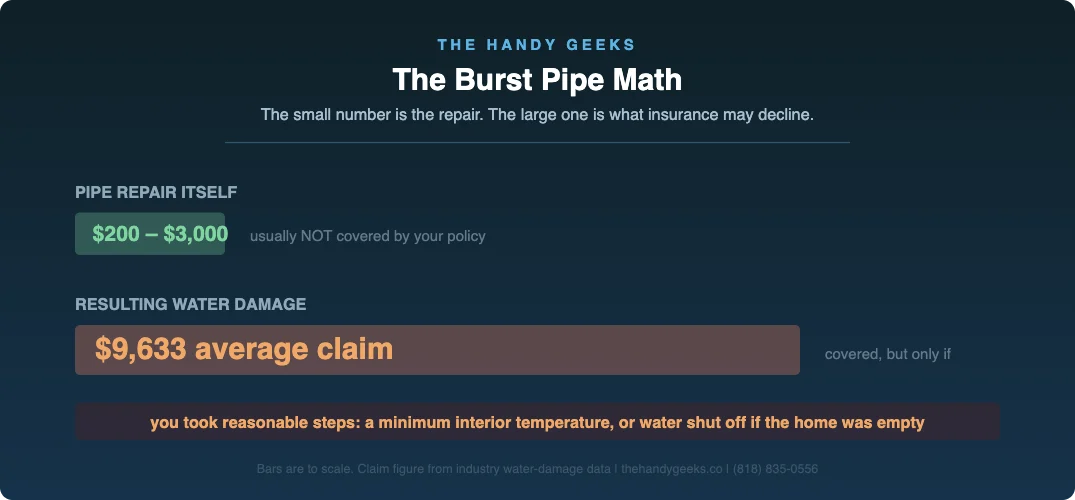
Homeowners policies generally cover the water damage that follows a burst pipe. They usually do not cover the pipe repair itself. More importantly, coverage is typically conditional on your having taken reasonable steps to prevent the freeze. As the National Association of Insurance Commissioners explains, most policies require a minimum interior temperature, or a shut-off if the property sits empty.
Skip both and the claim can be denied as preventable.
The sums are not trivial. Industry claims data puts the average water damage claim near $9,633. The burst pipe repair itself typically runs $200 to $3,000. So the repair is the small number. The water damage is the large one, and it is the part your policy may decline if the thermostat was off. The New Hampshire Insurance Department makes the same point about preventive steps.
Leaving town? Set the heat to 60 to 65°F rather than switching it off. A week of low heat costs a fraction of the deductible.
Where California Homes Actually Freeze
Coastal Los Angeles and the Bay Area rarely sustain a hard freeze, which is exactly why the housing stock is vulnerable. Pipes run through spaces a cold climate would never allow, and nobody insulates them.
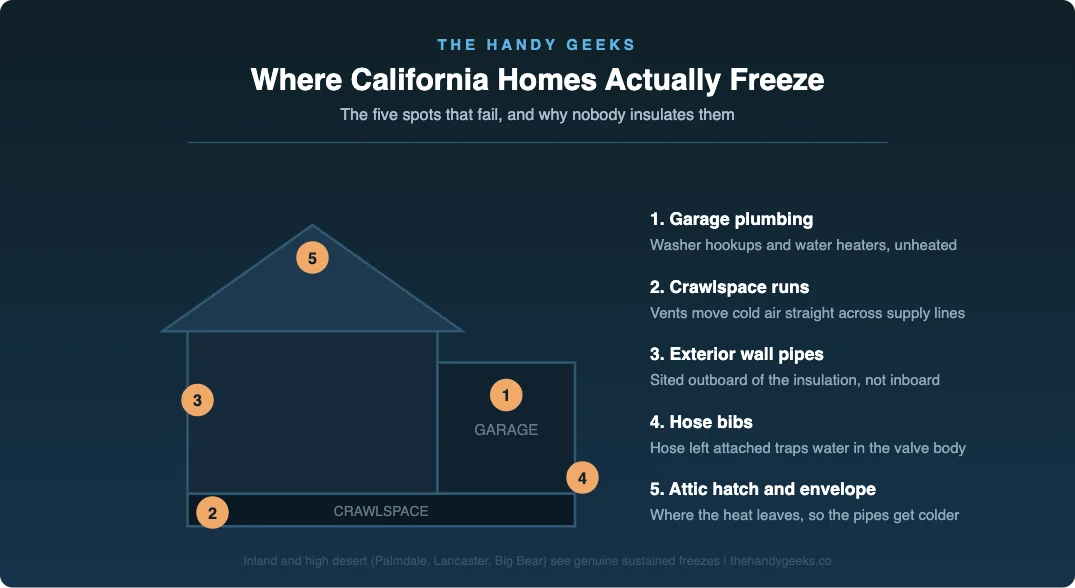
So knowing how to winterize your house here means knowing where your particular house is exposed. These are the recurring trouble spots:
- Garage plumbing. Washer hookups and water heaters in an unheated, uninsulated garage with a door that leaks air along its whole bottom edge. This is the single most common freeze point we find.
- Crawlspaces. Ventilated crawlspaces move cold air directly across the underside of the floor and any supply line running through it.
- Exterior wall runs. Kitchen sinks and laundry on outside walls, with the pipe sitting outboard of the insulation rather than inboard where it belongs.
- Hose bibs. An outdoor tap with the hose still attached traps water in the valve body, which then splits and leaks back inside the wall.
- Inland and high desert. Palmdale, Lancaster and Big Bear get sustained sub-freezing nights. Homes there are often built to the same mild-climate assumptions as coastal ones.
How Do You Winterize Pipes You Cannot Reach?
Insulate what you can see, and manage temperature for everything else. Tearing open a wall to sleeve a pipe is rarely worth it in a climate with a handful of cold nights.
For accessible runs in the garage, crawlspace or under sinks, foam pipe sleeves cost a few dollars a length and take minutes. Buy the size that matches the pipe diameter rather than stretching one size over everything. Then seal the seam, because a sleeve gapping open does very little.
For pipes inside walls you cannot open, you are managing the air around them. Keep the interior above 55°F. On the coldest nights, open the cabinet doors under sinks on exterior walls so heated room air reaches the pipe. A tap left at a slow drip relieves the pressure that splits the line, which is why it works even though the water still freezes.
Disconnect every garden hose before the first cold night and drain the bib. Frost-proof hose bibs only work with the hose removed, and that is the detail that catches people out.
Sealing the Envelope: Where the Heat Leaves
Pipes get the attention, but most of the winter bill is air simply leaving the building. The gaps are boring and cheap to close, which is why they stay open for years.
| Leak point | Typical fix | Difficulty |
|---|---|---|
| Under exterior doors | Door sweep replacement | Easy, 15 minutes |
| Around door frames | Adhesive or kerf weatherstripping | Easy |
| Window perimeter | Exterior caulk, interior backer rod where gaps are wide | Moderate |
| Garage door bottom seal | Replace the astragal strip | Easy |
| Attic hatch | Weatherstrip plus rigid insulation on the back | Moderate |
| Recessed lights into attic | Airtight-rated trim or sealed cans | Harder, may need an electrician |
Last verified: September 2026.
Doors and windows carry most of it. We have written separately about what door weatherstripping saves in LA and when window caulking is worth redoing. Both pay for themselves inside a season.
How Much Does It Cost to Winterize Your House?
Less than one burst pipe, which is the only comparison that matters.
Handled as a single visit, full winter prep on an average home runs two to four hours. Residential rates at The Handy Geeks are $70 to $160 an hour in the Los Angeles metro and $80 to $180 in the Bay Area. Materials for sleeves, sweeps, weatherstripping and a couple of tubes of caulk typically land under $150.
The Handy Geeks published residential ranges, current as of September 2026.
Doing it in one visit matters more than it sounds. Each job is fifteen minutes and a trip charge on its own, so bundling is where the saving comes from. October and early November are the sensible window. Once the first cold snap hits, everyone calls at once.
What If You Are Leaving the House Empty?
Then the rules change, and this is where most preventable losses happen. An occupied house gets noticed. An empty one drains a burst line into the floor for a week.
Knowing how to winterize your house for a vacancy is a different checklist. The order of operations:
- Shut off the main water supply at the valve.
- Open the lowest taps in the house and let the lines drain down.
- Leave the heat on at 60 to 65°F rather than switching it off, since some plumbing will still hold water.
- Drain and disconnect anything outdoors, including hoses and irrigation where you can.
- Ask someone to check the property. Most policies expect it, and a leak found on day two is a very different claim from one found on day ten.
Frequently Asked Questions
At What Temperature Should I Set My Thermostat in Winter?
Keep the interior at 55°F minimum to protect pipes, which is the floor most plumbers and insurers use. If you are away from the property, 60 to 65°F is the safer setting because it leaves margin for pipes running through unheated walls, garages and crawlspaces.
Does Homeowners Insurance Cover Burst Pipes?
Policies generally cover the resulting water damage but not the pipe repair itself. Coverage is usually conditional on reasonable preventive steps, which typically means maintaining a minimum interior temperature or shutting off the water if the home is vacant. Skipping both can be grounds for denying the claim.
Do Pipes Really Freeze in California?
Yes, though rarely the way cold-climate homes freeze. Failures happen in unheated garages, ventilated crawlspaces, exterior wall runs and outdoor hose bibs, because California housing stock is generally built without freeze protection in those spots. Inland and high desert areas like Palmdale, Lancaster and Big Bear see genuine sustained freezes.
Why Does Leaving a Tap Dripping Prevent Burst Pipes?
The burst comes from pressure building between an ice plug and a closed tap, not from ice crushing the pipe. An open tap relieves that pressure, so the line can freeze without splitting. That is why the drip needs to be on the run most at risk.
When Should I Winterize My Home?
October through early November in most of California. Doing it before the first cold snap matters for two reasons. The work stays preventive rather than emergency, and contractor availability tightens sharply once everyone calls in the same week.
How Much Does It Cost to Winterize a House?
Most homes need two to four hours of work plus under $150 in materials. At The Handy Geeks published residential rates that is $70 to $160 an hour in Los Angeles. Bundling the jobs into one visit avoids a separate trip charge for each fifteen-minute task.
Final Thoughts
Knowing how to winterize your house in a mild climate comes down to accepting that the risk is concentrated in a few unheated spots and a few unusual nights. You are not insulating against a Minnesota winter. You are making sure the garage plumbing, the crawlspace run and the hose bib survive the three or four nights a year that actually test them.
The part worth acting on today is the insurance condition, because it is the one with a deadline you cannot see. A policy that expects a minimum temperature or a shut-off valve will expect it on the night the pipe goes, not the week you get around to reading the document.
Why homeowners book winter prep with The Handy Geeks:
- Insured to $2M general liability, with a certificate available the same day
- All 5-star Google reviews across every market we serve
- One visit covers pipes, doors, windows and the garage rather than four separate call-outs
- We tell you which items actually matter for your house and which are cold-climate advice
- Straight answers about what needs a licensed contractor and what does not
If the rest of the house needs attention too, our guide to which interior repairs to tackle first sets the order, and ten upgrades that cut California energy bills covers the efficiency side. Full scope and booking is on our California handyman services page. Anyway, the pipes will not remind you.
Want your house winter-ready before the first cold night?