

Texas Repair Laws: Nobody Licensed Your Remodeler, and That’s Perfectly Legal (2026)
Texas repair laws contain a hole big enough to drive a work truck through, and most homeowners find it the hard way.
There is no state license for a residential remodeler in Texas. None. The guy who reframed your bathroom, the crew that rebuilt your fence after the last freeze, the outfit that redid your roof, not one of them needed a state credential to take your money. They didn’t skip a step or slip through a loophole. The step doesn’t exist.
So the interesting question in Texas isn’t “is he licensed.” It’s “where did the state put my protection instead,” because it did put it somewhere. Two places, actually, and both of them are pieces of paper with deadlines attached.
Short answer: Texas has no statewide license for residential general contractors or remodelers. Electricians, plumbers, and HVAC contractors are state-licensed. Your real protection sits in the written contract signed before work begins and in the 60-day certified notice Texas requires before you can sue over a defect.
For prices by job size, see our drywall repair cost guide.
For whole-house and per-room prices, see our interior painting cost guide.
The agency that was supposed to handle this is dead
Texas did try. The Texas Residential Construction Commission registered builders and remodelers, adopted warranty standards, and ran a mandatory inspection and dispute process that you had to clear before suing anyone.
Then it came up for sunset review in 2009. The Sunset Advisory Commission recommended killing it, finding the agency had never really worked as a regulator. The Legislature declined to pass the bill continuing it, and per the Sunset Commission’s own record, the commission was abolished and the Act expired on September 1, 2009. Its records went to the Comptroller.
Nothing replaced it. Seventeen years later, Texas home repair laws still have no state licensing body for the person doing general remodel or repair work on your house. Bills get filed. None pass.
That single fact explains almost everything else that follows.
So what actually is licensed in Texas?
The trades, and only the trades. Texas draws a hard line between “construction work” and “the three systems that kill people,” and it licenses the second group aggressively while ignoring the first.
| Who’s doing the work | State license required? | Who runs it |
|---|---|---|
| Remodeler, handyman, general contractor | No | Nobody (city registration may apply) |
| Roofer, painter, drywall, framing, fencing | No | Nobody |
| Electrician | Yes | TDLR, Occupations Code Ch. 1305 |
| Plumber | Yes | Texas State Board of Plumbing Examiners, Ch. 1301 |
| HVAC / refrigeration contractor | Yes | TDLR, Occupations Code Ch. 1302 |
| Fire alarm, sprinkler, extinguisher | Yes | State Fire Marshal, Insurance Code Ch. 6001–6003 |
Two things follow from that table. A remodeler in Texas can legally manage your whole kitchen job with no credential whatsoever, and the same remodeler commits an offense the moment he runs the new circuit himself instead of bringing in a licensed electrician.
You can check the trades in about two minutes. TDLR runs a free active license search covering electricians and HVAC, and plumbers show up through the plumbing board. There is nowhere to look up the general contractor, because there is nothing to look up.
Some cities fill the gap themselves. Houston, Dallas, San Antonio, and Fort Worth all run their own contractor registration programs, which means a remodeler can be perfectly legal in one Texas city and unregistered in the next one over.
Outside city limits, there may be no code at all
Here’s where Texas repair laws get genuinely strange, and it’s the part that surprises people who move here from a code-heavy state.
Inside a city, you’re covered. Section 214.212 of the Local Government Code adopts the International Residential Code as the municipal residential building code for every Texas city, and it reaches construction, remodeling, and repair alike. Cities amend it, enforce it, and inspect against it.
Step past the city limit line and the floor drops out. Counties in Texas have only limited, permissive authority to adopt residential building codes in unincorporated areas, and plenty of them decline. Tarrant County, wrapped around Fort Worth, states outright that it does not issue building permits or enforce building codes in unincorporated areas. McLennan County did adopt IRC provisions, and per the county’s own page, it has no inspection authority and cannot charge fees. Builders just file a notice form.
The Texas State Law Library keeps a plain-language rundown of which codes apply where, and it’s worth five minutes before you assume anyone is going to inspect your job.
So in a rural Texas county, an unlicensed remodeler can perform unpermitted, uninspected structural work on your house, and nobody has broken a single law. The only inspection that ever happens is the one your buyer’s inspector does in eight years.
The kitchen-table contract that can lien your homestead
This is the piece almost nobody explains to Texas homeowners, and it cuts both ways hard.
Because Texas protects the homestead from forced sale, a contractor can’t simply file a mechanic’s lien on your house the way he could in most states. To attach a lien to a Texas homestead, Property Code 53.254 requires a written contract that is executed before any labor is performed or material delivered, signed by both spouses if the owner is married, and filed with the county clerk. Miss any one of those and no valid lien attaches at all.
The Texas Constitution stacks more on top. Under Article XVI, Section 50(a)(5), a homestead repair or renovation contract of this kind has to be signed by the owner and spouse only at the office of a third-party lender, an attorney, or a title company. It must give you three days to rescind without penalty. And it can’t be signed until the fifth day after you apply for credit for the work, unless the repairs are genuinely urgent health or safety work and you say so in writing.
Read that again, because it’s the practical takeaway. A Texas homestead repair contract that creates a lien cannot legally be signed at your kitchen table.
So when a storm-chasing roofer shows up with a clipboard and wants signatures from you and your spouse today, one of two things is true. Either the paperwork gives him nothing, or he’s steering you toward a title company for reasons he hasn’t explained. Both are worth slowing down for. Our piece on handyman red flags covers the pressure tactics that usually ride along with this.
Can I just sue a Texas contractor over bad work?
No, and this catches people mid-argument. Texas makes you send a letter first and wait.
Chapter 27 of the Property Code, the Residential Construction Liability Act, governs essentially every residential construction defect claim in the state. It covers new builds and remodels, plus driveways, fences, pools, retaining walls, and detached structures. Before you file suit or start arbitration, you have to send the contractor written notice by certified mail, return receipt requested, describing the defects in reasonable detail. That notice has to go out at least 60 days ahead.
Then the contractor’s clock starts. He gets 35 days to request inspections, and since HB 2022 took effect in September 2023 he’s explicitly allowed up to three of them. He then has until the 60th day after receiving your notice to make a written settlement offer, which can be a repair, a cash figure, or both.
That 60-day offer deadline is worth flagging, because a startling number of Texas legal explainers still say 45 days. That was the old number. HB 2022 moved it.
There’s a small bonus buried in the statute. If your contract didn’t include the RCLA notice language the chapter requires, you can recover a $500 civil penalty on top of everything else.
The clock got shorter in 2023, and most people missed it
Texas ran a flat ten-year statute of repose on construction claims for roughly half a century. HB 2024, effective June 9, 2023, cut it to six years for detached one- and two-family homes and townhouses up to three stories, but only where the contractor supplied a written warranty covering one year on workmanship and materials, two years on plumbing, electrical, heating, and air-conditioning systems, and six years on major structural components.
No warranty, and the ten-year window still applies. Warranty, and you have six years from substantial completion to bring any defect claim, no matter when you discover the problem.
For a homeowner, that’s an odd trade. You gain a written warranty and lose four years of your ultimate deadline. Either way, the document your contractor hands you at closeout now decides how long you have, which makes it worth reading rather than filing.
What to actually do standing in your driveway
Since no license exists to check, the checks move elsewhere.
Ask who is doing the electrical, plumbing, and HVAC portions by name, then verify each one on TDLR or the plumbing board before work starts. That’s the only state-backed credential in the whole project, so use it.
Call your city’s building department, or your county if you’re outside city limits, and ask two questions: does this scope need a permit, and who has to pull it. A contractor pushing you to pull the permit yourself is moving liability onto your name, which we get into in why signing your own building permit backfires.
Get the scope, the price, and the change-order process in writing before any deposit moves. In a state with no licensing board to complain to, the contract is your enforcement mechanism. The Deceptive Trade Practices Act, Chapter 17 of the Business and Commerce Code, is the consumer statute the Texas Attorney General actually uses against home repair fraud, and it works far better when you have documents.
And keep every photo, invoice, and text message. If this ends up in an RCLA notice two years from now, that’s the evidence the statute requires you to hand over.
WHY US?
Unlike rest of the services in the market often looking to add hidden charges, WE offer extremely reliable, friendly, and quick services. And our all 5-star reviews are just another proof of that. Our clients never leave disappointed.
- Experienced Technicians: We always hire experienced and reliable people. Everyone on the staff is highly capable in the field and will ensure your work is done properly.
- Quick and Reliable: Your time is valuable. This is why we ensure everything goes smoothly and you get your work done right away.
- 24/7 Emergency Repairs: Emergencies can happen where you need us. And we will be there for you, on time.
- Tailored Solutions: Our team evaluates your space to recommend and install the perfect bed set up.
- 100% Satisfaction Guarantee: All of our clients have left a 5 star review so you know, you can trust us.

You can look at our other service forms here.
You should also check out our Google Maps page
And here’s our phone number : +1 818-835-0556.
Frequently Asked Questions
Do you need a license to be a handyman in Texas?
No. Texas has no statewide license for handymen, remodelers, or residential general contractors, and hasn’t since the Texas Residential Construction Commission was abolished in 2009. Some cities require local registration.
Who licenses electricians and plumbers in Texas?
Electricians and HVAC contractors are licensed by the Texas Department of Licensing and Regulation. Plumbers are licensed by the Texas State Board of Plumbing Examiners. Both maintain free public license searches.
Can a contractor put a lien on my house in Texas?
Only if strict conditions were met first. For a homestead, the contract must be written, executed before work began, signed by both spouses, and filed with the county clerk under Property Code 53.254.
Do I need a building permit outside city limits in Texas?
Often not. Texas counties have limited permissive authority over residential building codes in unincorporated areas, and many do not permit or inspect at all. Call your county before assuming either way.
How long do I have to sue over a construction defect in Texas?
Ten years from substantial completion by default. That drops to six years for houses and townhouses where the contractor gave a written warranty meeting the one-year, two-year, and six-year terms in HB 2024.
What is the 60-day letter in Texas repair law?
It’s the notice Chapter 27 of the Property Code requires you to send by certified mail at least 60 days before suing a contractor over a defect. Skip it and your case gets abated.
Where The Handy Geeks actually work
Being straight with you: we’re a California outfit, not a Texas one. This guide exists because Texas repair laws are the clearest example anywhere of what happens when a state stops licensing contractors, and the questions it raises are the ones our own clients ask constantly.
The Handy Geeks handle residential and commercial repair, maintenance, and remodel work across California. That covers Los Angeles, Long Beach, Irvine, Orange County, Pasadena, San Diego, San Francisco, Sacramento, and the Central Valley. Commercial and property-management work is a big share of what we do, and we carry $2 million in general liability coverage because retail environments require it. Our services page has the full list, and the portfolio shows the commercial side.
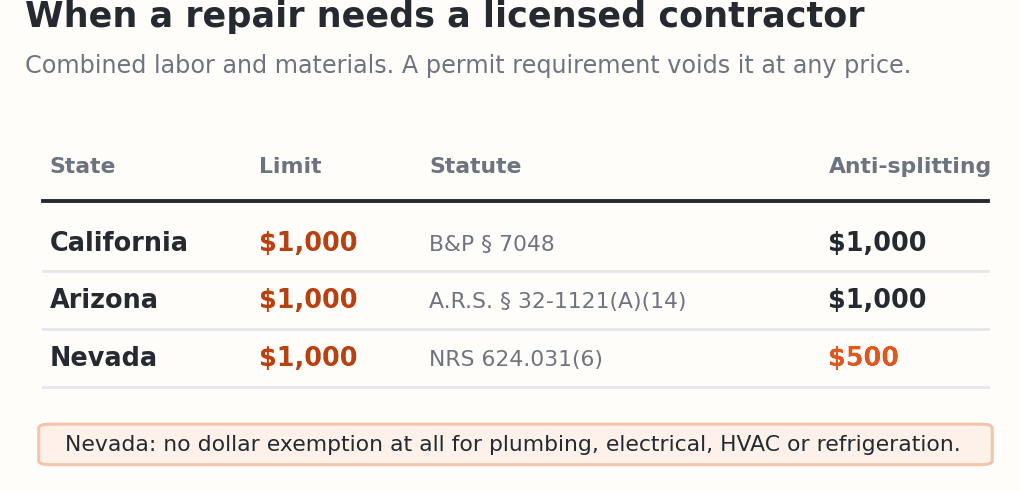
California runs the opposite experiment, for what it’s worth. Anything over $1,000 in combined labor and materials needs a CSLB-licensed contractor here, a threshold AB 2622 lifted from $500 in January 2025, which is roughly the regime Texas dismantled. If you manage property in both states, our landlord’s guide to reducing maintenance costs travels reasonably well.
If you’re in Texas, verify the trades on TDLR, call your city or county about permits, and get everything in writing. That’s the honest answer.
If You Remember One Thing
The absence of a license is not the real problem in Texas. Plenty of unlicensed Texas remodelers do excellent work, and a license has never stopped a bad contractor anywhere.
The problem is that homeowners keep looking for a credential that doesn’t exist, and while they’re looking, they skip the two things that actually carry weight here. What the contract says, and when the clock starts.
Texas isn’t unique here. Michigan runs on a similarly quiet dollar threshold, and California’s rules cut the other way entirely once a landlord is involved. If you want the enforcement side of this instead of the loophole side, here’s what happened to a crew of unlicensed contractors who got caught.
Anyways….
Want a crew you don’t have to second-guess? We at The Handy Geeks handle repairs and maintenance for homes, rentals, and commercial properties across California, insured, documented, and used to working around real businesses.
📞 Call us
Last verified: September 2026. California licensing threshold per Business and Professions Code section 7048, as amended by AB 2622 (Chapter 240, Statutes of 2024).