

Commercial Maintenance Repair Services for Business Buildings
Our commercial maintenance repair service fixes the doors, walls, ceilings, restrooms and exterior trim of occupied business buildings across Los Angeles, Southern California and the Bay Area, from $105 an hour in the LA metro. Commercial building repair is the work that keeps an occupied property safe, secure and open for business. That means doors that close and lock, walls and ceilings that look cared for, and small leaks caught before they turn into water damage. We handle that work for office buildings, retail stores, restaurants, medical suites, warehouses and light industrial spaces across Southern California and the Bay Area. (If you want to know which small problems get expensive fastest, start with our list of minor commercial repairs that cost thousands later.)
Short answer: The Handy Geeks provides commercial building repair across Los Angeles, Southern California and the Bay Area. Rates start at $105 an hour in the LA metro, with a $2M general liability certificate on request. We fix doors, drywall, ceilings, restroom hardware and exterior trim, and we tell you up front which repairs need a permit.
Last verified: September 2026
Request a repair quote. Send the address, a short punch list and any photos. We reply with a written scope and price, and a certificate of insurance if you need one. Prefer the phone? Call +1 818-835-0556.
Commercial Maintenance Repair: What We Fix
- Commercial doors, closers, hinges, locks and storefront hardware
- Drywall, ceilings, ceiling tiles and water-stain repairs
- Restroom partitions, fixtures, dispensers and grab bars
- Exterior trim, fascia, fences and gates
- Light fixtures and like-for-like electrical swaps under the $1,000 limit
- Flooring transitions, baseboards and wall protection
Service areas: Los Angeles, the San Fernando Valley, Long Beach, Pasadena and Torrance, plus the Bay Area.
Commercial Repair and Maintenance Work, Scheduled or On Call
Commercial repair and maintenance work comes in two forms, and most properties need both. On-call repairs fix what broke this week: a door that won’t lock, a leak stain on a ceiling tile, a partition hanging off one hinge. Scheduled maintenance visits catch the same problems earlier and bundle them, so you pay one minimum instead of five. After-hours work runs 1.25x to 1.6x the standard rate, so planned daytime visits are the cheapest way to keep a building in shape.
For multi-site retail, see our commercial building maintenance services. For a single Los Angeles property, our commercial maintenance company in Los Angeles page has local rates and permit rules.
What Counts as a Commercial Building Repair?
A commercial building repair is any fix that restores a damaged or worn part of a business property to working order. It differs from maintenance, which prevents failures, and from improvements, which add something new. Most calls are small and time sensitive, because commercial properties stay occupied while the work happens.
In practice we split the work into two groups, since the crew, the schedule and sometimes the permit rules differ between them.
Interior Repairs
- Door closers, hinges, panic hardware, strikes and locks on storefront and office doors
- Drywall patching and texture matching after impact or water damage
- Ceiling tile replacement once the leak above has been fixed
- Restroom partitions, grab bars, dispensers and mirrors
- Faucets, flush valves and shut-off valves
- Floor and wall tile, cove base and transition strips
- Shelving, fixtures, whiteboards and signage mounted to proper backing
- Interior painting and touch-ups once the repair underneath is done
Exterior Repairs
Outside, the list is shorter but the stakes are higher, because the building envelope is what keeps water out. We repair fascia, soffit, siding and exterior trim, and replace damaged fence sections and gates. We also remove graffiti, patch concrete trip hazards at entrances, and reseal failed caulk joints around windows and doors.
The Most Common Commercial Building Repairs
The most common commercial building repairs are roof and plumbing leaks, door and hardware failures, electrical faults, HVAC problems, damaged drywall and ceilings, and wear on the exterior envelope. Leaks sit at the top because water damage spreads quietly in commercial buildings, and the bill grows every week it goes unnoticed.
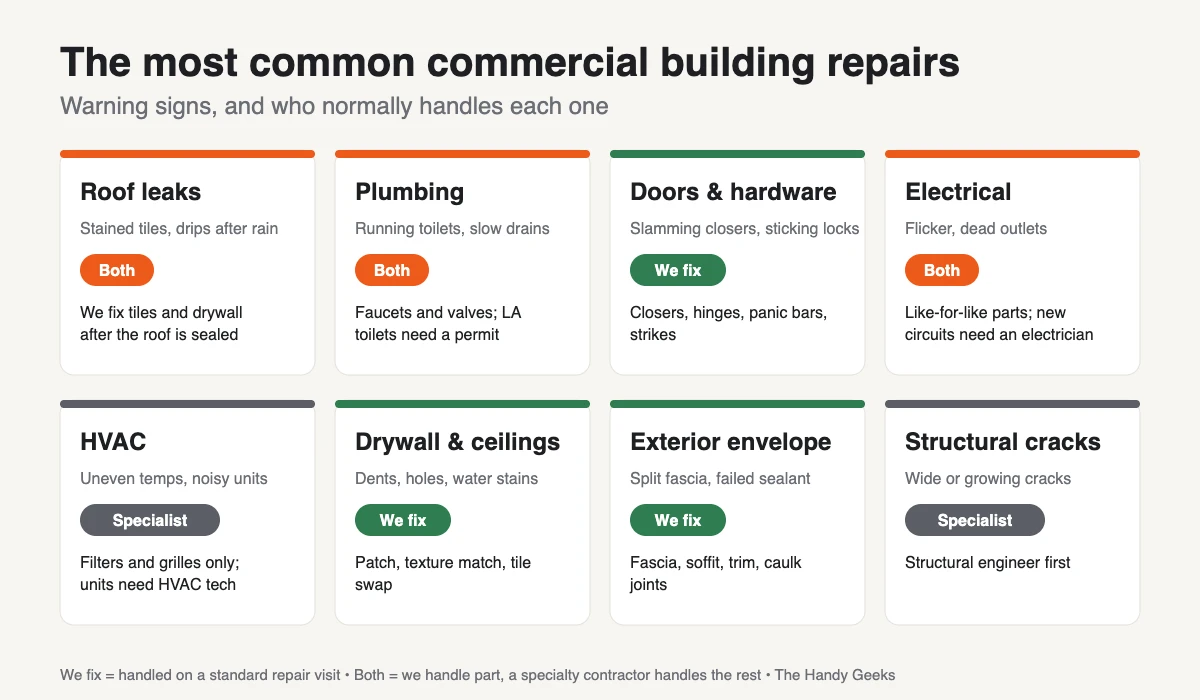
Here’s how each one usually shows up, and who normally handles it:
- Roof leaks. Stained ceiling tiles and drips after rain are the usual signs. Roof membrane work belongs to a roofing contractor, but we replace the stained tiles and damaged drywall once the roof is sealed.
- Plumbing leaks and failures. Running toilets, dripping faucets and slow drains waste water and rot cabinets. Faucet, valve and flush valve swaps are routine repairs, while replacing a commercial toilet in Los Angeles needs a plumbing permit.
- Doors and hardware. A closer that slams, a door that drags or a lock that sticks is a security problem and often an accessibility one. Federal ADA standards cap interior hinged doors at 5 pounds of opening force. California applies the same limit to exterior doors, which we cover in our guide to ADA storefront door requirements.
- Electrical faults. Flickering lights, dead outlets and warm switch plates. Like-for-like parts are simple swaps, but new circuits and panel work belong to an electrical contractor.
- HVAC problems. Uneven temperatures and noisy units need an HVAC technician, though we replace filters and damaged grilles.
- Drywall and ceilings. Cart dents, old fixture holes and water stains top the cosmetic list in any tenant space.
- Exterior wear and structural cracks. Peeling paint, split fascia, cracked masonry and failed sealant let water in. Wide or growing cracks can mean structural damage, so a structural engineer should see them first.
How Urgent Is the Repair?
Sort commercial repairs into three groups. Fix anything involving active water, security or blocked exits today. Fix anything that affects accessibility or looks neglected this week, and schedule everything cosmetic into a planned visit. That order protects people first, then the building, then the brand.
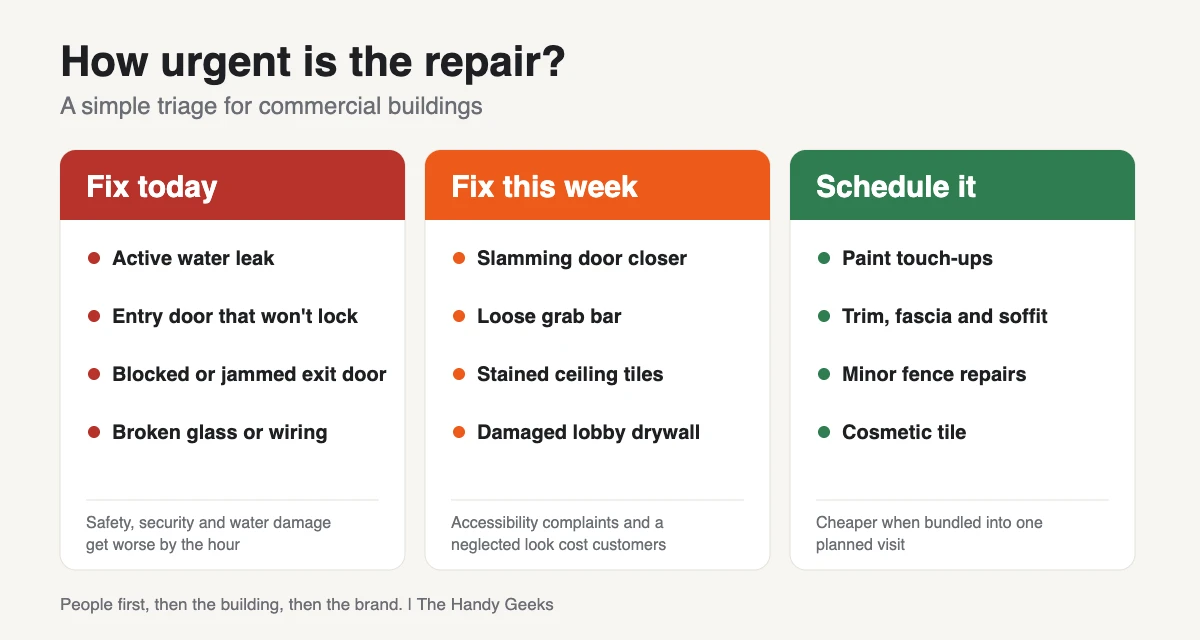
| Priority | Examples | Why it can’t wait |
|---|---|---|
| Fix today | Active leak, entry door that won’t lock, blocked or jammed exit door, exposed wiring, broken glass | Safety, security and water damage all get worse by the hour |
| Fix this week | Slamming door closer, loose grab bar, stained ceiling tiles after a repaired leak, damaged drywall in public areas | Accessibility complaints and a neglected look cost customers |
| Schedule it | Paint touch-ups, trim, fascia and soffit, minor fence repairs, cosmetic tile | Cheaper when bundled into one planned visit |
How Much Do Commercial Repairs Cost?
The Handy Geeks charges $105 to $195 an hour for commercial building repair in the Los Angeles metro, with a $110 to $210 minimum per visit. Most single repairs, such as a door closer or a drywall patch, land between $85 and $500. Exterior carpentry like fascia replacement runs higher because of access and materials.
| Repair | Typical range ($) | Unit | Source |
|---|---|---|---|
| Standard labor, LA metro | $105 to $195/hr | Per hour | THG published |
| Minimum service charge | $110 to $210 | Per visit | THG published |
| Door closer replacement | $120 to $280 | Per door | THG published |
| Drywall patch and paint | $85 to $250 | Per area | THG published |
| Restroom hardware repair | $90 to $200 | Per repair | THG published |
| Fascia repair or replacement | $500 to $2,400 | Per job | HomeGuide national data |
| Fence repair, standard | $300 to $900 | Per job | HomeGuide national data |
THG rows: The Handy Geeks published range, Los Angeles metro, current as of September 2026. Market rows: HomeGuide’s 2026 cost data puts fascia repair at $500 to $2,400, and its fence repair data puts standard repairs at $300 to $900, both national residential figures.
After-hours work runs 1.25x to 1.6x the standard rate and emergency calls 1.4x to 1.75x, which is our standard policy.
Which Commercial Repairs Need a Permit or a License?
Small like-for-like repairs usually need no permit. In California, a job that reaches $1,000 including materials, or any job that needs a building permit, falls outside the small-job exemption, whatever the price.
| State | Small-job threshold | What voids the exemption | Never exempt |
|---|---|---|---|
| California | Under $1,000 | Any permit, employing workers on the job, splitting a job to stay under | No trade carve-out, but the permit rule catches most trade work |
Source: CSLB Industry Bulletin 24-07 (B&P § 7048). Last verified September 2026.
Permits are set by the city, not the state. In the City of Los Angeles, swapping a faucet or a light driver needs no permit. Replacing a toilet, water heater or complete light fixture in a commercial space does. Our Los Angeles commercial handyman page lists every trigger with its code section.
Who Pays for Repairs, Landlord or Tenant?
The lease decides who pays for repairs in a commercial property. Under a triple-net (NNN) lease, the tenant usually covers interior repairs and pays a share of building costs. Under a gross lease, the landlord usually handles the roof, structure, building systems and common areas. Read the repair and maintenance clause before you call anyone.
A few patterns hold across most leases. Tenants typically own damage they cause and normal wear and tear inside their suite, such as doors, drywall, fixtures and flooring. Landlords typically own the roof, foundation, exterior walls and shared systems, and they recover part of that cost through common area maintenance (CAM) charges. Nolo’s guide to commercial tenancy repairs walks through the common clause types.
We invoice whoever orders the work, and we can split one visit into separate landlord and tenant line items when a punch list crosses both. This is general information rather than legal advice, so check anything unusual with your attorney or property manager.
Preventive Maintenance That Cuts Repair Calls
Preventive maintenance cuts commercial building repair calls by catching small failures before they escalate into costly repairs. Regular inspections pay off most on doors, roofs and plumbing. A monthly walkthrough by someone who knows what to look for costs far less than one emergency visit. It also turns surprise repairs into a maintenance plan you can budget for.
Commercial Building Preventive Maintenance Checklist
This is the commercial building maintenance schedule we suggest to most business owners and property managers.
- Monthly: test door closers and panic hardware, check restrooms for running toilets and loose grab bars, and look up for new ceiling stains.
- Quarterly: inspect exterior sealant and caulk joints, check fascia, soffit and gutters, and walk the parking area for trip hazards.
- Twice a year: have the roof inspected before and after the rainy season, and clean or replace HVAC filters on the manufacturer’s schedule.
- Annually: book full building inspections, update your repair log, and plan the next year’s budget around what you found.
How We Handle Commercial Repairs
Every new commercial property account starts with paperwork, then a walkthrough, then a written estimate with a not-to-exceed amount. We schedule the work around your tenants to keep disruption and downtime low, whether that means before opening, after close or on a weekend. Billing is net-30, with every repair listed line by line.
Insurance is usually the first document a facilities team asks for. We carry $2M in general liability coverage and issue a certificate naming your company, landlord or management company as additional insured, usually the same day. Urgent calls on set-up accounts get a scheduling confirmation within two to four hours.
For retail chains and shopping centers, our retail store maintenance service covers multi-site punch lists and after-hours fixture work. The broader picture of what a commercial handyman covers is in our guide to commercial handyman services.
Areas We Serve
Our repair services in Southern California cover Los Angeles, the San Fernando Valley, Long Beach, Pasadena and Torrance, and we also serve the Bay Area.
Frequently Asked Questions
What Is Considered a Commercial Building Repair?
A commercial building repair restores a damaged or worn part of a business property to working order, such as a door closer, drywall, ceiling tiles, restroom hardware or exterior trim. Maintenance prevents failures, and improvements add something new.
Who Pays for Repairs Under a Commercial Lease?
The lease decides. Under a triple-net lease tenants usually cover interior repairs, while under a gross lease landlords usually cover the roof, structure, building systems and common areas.
How Much Does Commercial Building Repair Cost?
The Handy Geeks charges $105 to $195 an hour in the Los Angeles metro with a $110 to $210 minimum per visit. Common single repairs such as a door closer or drywall patch run $85 to $280.
Do Commercial Repairs Need a Permit?
Small like-for-like repairs usually do not. Replacing a toilet, water heater or complete light fixture in a City of Los Angeles commercial space does, and any job needing a permit also needs a licensed contractor.
How Often Should a Commercial Building Be Inspected?
A practical schedule is a monthly walkthrough, a quarterly exterior check, roof inspections twice a year and a full building inspection once a year.
Can Repairs Be Done After Hours?
Yes. We schedule before opening, after close or on weekends, billed at 1.25x to 1.6x the standard rate.
Final Thoughts
Most commercial building repair bills start small. A door closer that slams, a stained ceiling tile or a split fascia board is cheap to fix this month. After a season of rain or a tenant complaint, it costs a lot more.
If you’ve got a list of repairs piling up, send it over and we’ll price every line before we start.
Call +1 818-835-0556 or Book Online