

ADA Storefront Door Requirements and the 5-Pound Rule
Most summaries of ADA storefront door requirements will tell you an exterior door has to open with 8.5 pounds of force or less. That number is not in the ADA. It is not in the 2010 Standards, and it is not in Section 404. Quoting it as federal law is the fastest way to fix the wrong thing on your entrance. The real rule is narrower, and in California it is stricter. If your closer has started slamming, the mechanical side of that is covered in our guide to why a door closer starts slamming.
Short answer: ADA storefront door requirements cap interior hinged doors at 5 pounds of opening force under Section 404.2.9. No federal maximum exists for exterior hinged doors. California sets one at 5 pounds. The Handy Geeks services storefront doors across Los Angeles, Phoenix and Las Vegas.
If a door is sticking or won’t latch, our guide on how to fix a door that won’t close walks through each cause.
What Force Should a Storefront Door Take to Open?
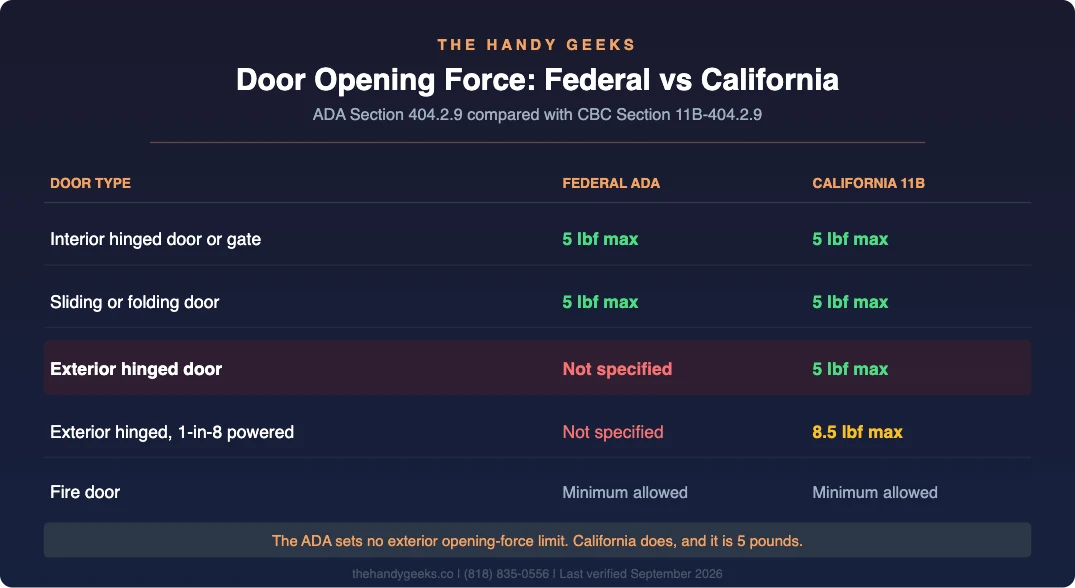
Five pounds, for any interior hinged door or gate, and for sliding or folding doors. That is the entire federal limit. The US Access Board’s published ADA Standards say so in Section 404.2.9. Fire doors get separate treatment, needing the minimum force the local authority will allow.
Two qualifiers in that section matter more than the number. Almost nobody repeats them.
The first is what the measurement covers. According to the Access Board’s advisory note, the maximum applies to “the continuous application of force necessary to fully open a door, not the initial force needed to overcome the inertia of the door.” So a heavy door that takes a firm initial push, then swings freely, gets measured on the swing rather than the shove.
Second comes the latch. Those limits explicitly do not apply to the force needed to retract latch bolts. Is your entrance stiff because the latch binds against a misaligned strike? That is worth fixing, but it is not what Section 404.2.9 measures.
The Exterior Door Gap Almost Everyone Gets Wrong
Read the section again and notice what is missing. Interior hinged doors appear. Sliding and folding doors appear. Exterior hinged doors are not listed at all.
That omission is deliberate. Exterior doors face wind loading and pressure differentials. Because a closer weak enough to hit 5 pounds on a windy storefront might not reliably close and latch the door, the Justice Department’s 2010 Standards leave exterior hinged doors unspecified rather than set a number unworkable in half the country.
So where does 8.5 pounds come from? It is a widely used industry convention, and it appears in some state and model codes as a ceiling. As a practical target it is genuinely useful. What it is not is a federal requirement.
This matters commercially. When a state adopts the federal standard unamended, your exterior entrance has no numeric opening-force limit at all. So money spent chasing 8.5 pounds might be better spent on clear width or hardware. In California the opposite applies, and the number you were given is too generous.
What California Requires That Federal Rules Do Not
California writes its own accessibility chapter, CBC Chapter 11B. So the ADA storefront door requirements that bind a Los Angeles retailer are stricter than the federal baseline. Section 11B-404.2.9 sets a 5 pound maximum for exterior hinged doors, closing the gap the ADA leaves open.
One exception exists, and it explains why 8.5 survives in California conversation. Where one of every eight exterior door leafs at a single location is a powered door, the remaining exterior doors serving that same interior space may reach 8.5 pounds. No powered door in that ratio means no 8.5 pound allowance.
That is hard to hit on a real storefront with a closer strong enough to latch. Which is exactly why powered operators appear on so many California retail entrances. They are often not a luxury. They are the mechanism making the rest of the frontage compliant.
| Door type | Federal ADA (2010 Standards) | California CBC 11B |
|---|---|---|
| Interior hinged door or gate | 5 lbf maximum | 5 lbf maximum |
| Sliding or folding door | 5 lbf maximum | 5 lbf maximum |
| Exterior hinged door | Not specified | 5 lbf maximum |
| Exterior hinged, 1-in-8 powered | Not specified | 8.5 lbf maximum |
| Fire door | Minimum the authority allows | Minimum the authority allows |
Source: ADA Standards Section 404.2.9, US Access Board; California Building Code Section 11B-404.2.9. Last verified: September 2026.
How Do You Check a Door Without a Gauge?
You cannot measure pounds of force by feel. A door pressure gauge is the only way to get a defensible number, and it is the first thing we bring to a compliance call.
There is a useful rough screen first. Open the door with two fingers at handle height, using steady pressure rather than a shove. If two fingers cannot move it through the full swing, the door is likely over 5 pounds. But that only tells you whether to investigate, not whether you comply.
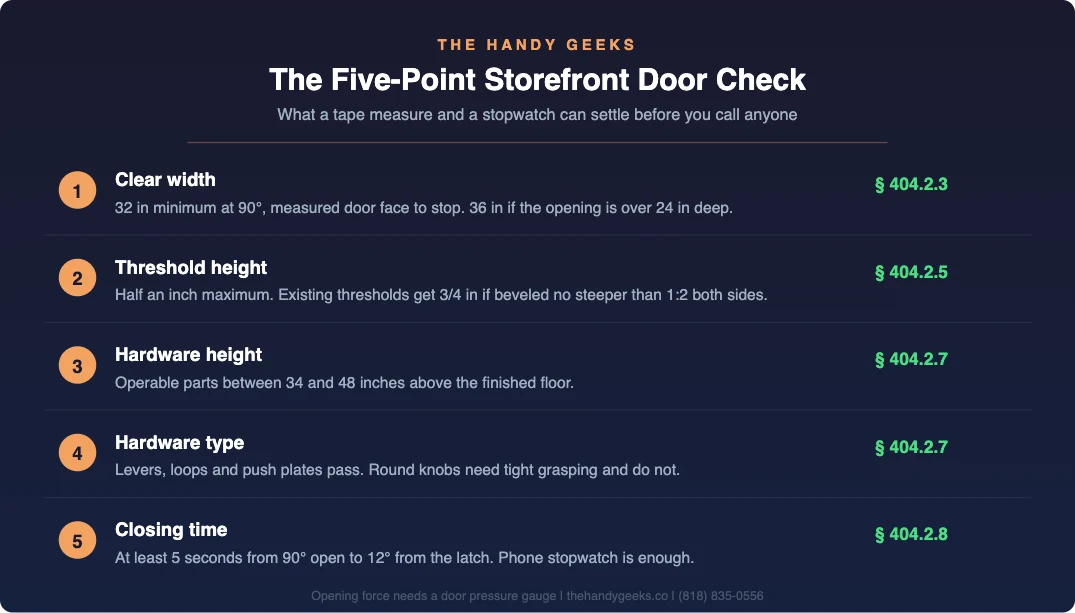
While you are there, check the ADA storefront door requirements a tape measure can settle:
- Clear width. Open to 90 degrees and measure between the door face and the stop. Section 404.2.3 requires 32 inches minimum, and 36 inches where the opening exceeds 24 inches deep.
- Threshold height. Half an inch maximum under Section 404.2.5. Existing or altered thresholds get three quarters of an inch if both sides are beveled no steeper than 1:2.
- Hardware height. Operable parts between 34 and 48 inches above the floor, per Section 404.2.7.
- Hardware type. Levers, loops and push plates pass. Anything needing tight grasping, pinching or wrist twisting does not, which rules out the round knob.
- Closing time. Covered next, and it needs nothing but a phone stopwatch.
Why Closing Speed Fails Inspection as Often as Force
Opening force gets the attention. But closing speed sits inside the ADA storefront door requirements too, and it fails just as often. Checking it costs nothing.
Section 404.2.8.1 requires that from 90 degrees open, a closer take at least 5 seconds to bring the door to 12 degrees from the latch. Note the direction of that limit. It sets a minimum time, not a maximum. The hazard being managed is a door closing fast enough to knock over someone using a walker. Spring hinges get their own rule under 404.2.8.2, needing at least 1.5 seconds from 70 degrees open.
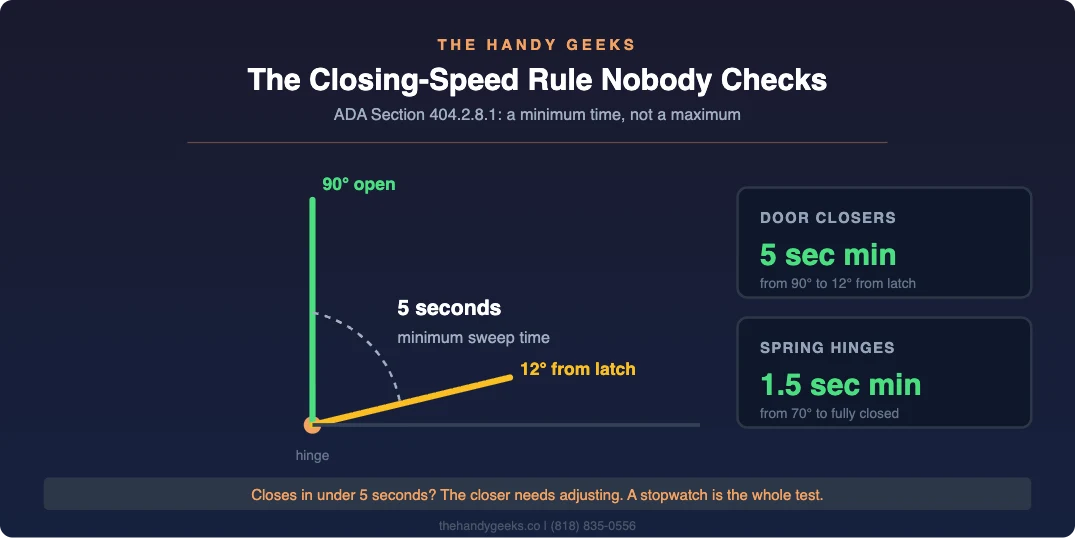
Stand at your entrance with a stopwatch. Open the door to a right angle, let go, and count. Under five seconds means the closer needs adjusting.
This is usually the cheapest finding on the list. Most commercial closers have separate valves for sweep speed, latch speed and backcheck. A sweep that has drifted fast is a screwdriver fix rather than a replacement. Closers drift as hydraulic fluid ages and seasons change the oil viscosity, so a door that passed two years ago may fail today.
What Does It Cost to Bring a Storefront Door Into Spec?
Less than most facilities managers expect, once adjustment rather than replacement will do. Meeting the ADA storefront door requirements on a drifted closer is often a single short visit. In California that generally lands inside the minimum service charge of $110 to $210.
Commercial work in the Los Angeles metro runs $105 to $195 an hour at The Handy Geeks published rates. Phoenix and Scottsdale run $85 to $165, and Las Vegas $80 to $160. A multi-door frontage surveyed and adjusted in a single visit costs far less per door than handling them one complaint at a time. That is the main argument for measuring all of them at once.
The Handy Geeks published commercial ranges, current as of September 2026.
When Adjustment Will Not Be Enough
Replacement is a different conversation. A leaking closer, a door out of square, or a California exterior door that cannot reach 5 pounds without a powered operator all move you into hardware cost. Sometimes electrical scope follows. We tell you which category you are in before work starts. Where scope crosses into licensed trade work, we say so rather than proceed.
What Happens If You Get a Demand Letter?
Fix it quickly, because in California repair speed changes the settlement figure.
Under California’s Unruh Civil Rights Act, statutory damages in construction-related accessibility claims start at $4,000 for each occasion access was denied. California produces roughly 42 percent of all ADA litigation nationwide. And in 2024, about 88 percent of construction-related access complaints were filed in state court under Unruh rather than federal court.
What most owners do not know is that damages are reducible. Correct the violation within 30 to 60 days of being served, and California law allows statutory damages to drop to $2,000 or $1,000 depending on circumstances. So a closer brought back inside the ADA storefront door requirements within that window is unusually cheap risk reduction.
None of this is legal advice, and a demand letter should reach your attorney the day it arrives. But the repair clock and the legal clock run together, and the repair is the part you can start now. Our commercial and retail maintenance service covers door and hardware work across four markets. For single-site jobs, our California handyman services page covers scope and booking.
Frequently Asked Questions
Does the ADA Require Exterior Doors to Open With 8.5 Pounds of Force?
No. The 2010 ADA Standards set no maximum opening force for exterior hinged doors. Section 404.2.9 specifies 5 pounds maximum for interior hinged doors and for sliding or folding doors only. The 8.5 pound figure is an industry convention and appears in some state codes, but it is not a federal ADA requirement.
What Is the Maximum Opening Force for a Storefront Door in California?
Five pounds. California Building Code Section 11B-404.2.9 applies the 5 pound limit to exterior hinged doors, which the federal standard leaves unspecified. The exception is where one of every eight exterior door leafs at that location is a powered door, in which case the remaining doors serving the same interior space may go up to 8.5 pounds.
How Slowly Does an ADA Door Closer Have to Close?
From 90 degrees open, a door closer must take at least 5 seconds to move the door to 12 degrees from the latch, under Section 404.2.8.1. Spring hinges must take at least 1.5 seconds to close from 70 degrees open. These are minimum times, because the hazard being managed is a door closing too fast.
Can a Handyman Adjust a Door Closer for ADA Compliance?
Yes, in most cases. Adjusting the sweep, latch and backcheck valves on a commercial closer is general maintenance work and sits within the minor-work exemption in California and Arizona. Installing a powered door operator is different, because it usually involves electrical scope and may require a licensed contractor depending on the state.
Do ADA Storefront Door Requirements Apply to the Latch?
No. Section 404.2.9 states that the force limits do not apply to the force required to retract latch bolts or disengage other devices holding the door closed. A door that is hard to open because of a binding latch or misaligned strike is still worth fixing, but that resistance is not what the standard measures.
How Often Should Storefront Doors Be Checked?
Annually for most retail frontages, and more often on high-traffic mall entrances. Closer hydraulic fluid ages and changes viscosity with temperature, so a door that measured correctly last year can drift out of spec without anything visibly breaking. Doors in hot markets like Phoenix and Las Vegas drift faster.
Final Thoughts
Getting ADA storefront door requirements right matters because the commonly repeated version sends people after the wrong number. An exterior door in Texas has no federal opening-force limit. The same door in Los Angeles faces a 5 pound limit that is difficult to meet without a powered operator in the ratio. Those are opposite situations, and the 8.5 pound rule of thumb describes neither.
If you manage retail frontage, measure every door once with a gauge and keep the readings. A dated set of measurements is worth having on file. It also turns compliance from an annual worry into a maintenance line item. Deferred small repairs have a way of getting expensive, which we covered in our list of small commercial repairs that cost thousands later.
Why retail and facilities clients work with The Handy Geeks:
- Insured to $2M general liability, with a certificate available the same day
- All 5-star Google reviews across every market we serve
- We measure and document rather than guess, and you keep the readings
- Single visits covering an entire multi-door frontage, not one door per call-out
- Straight answers about which work needs a licensed contractor and which does not
More on what we handle for commercial clients sits on our commercial handyman services guide. Anyway, if your entrance needs measuring, that part is easy to arrange.
Need your storefront doors checked?