

Always Hire a Licensed Handyman: 14 Arrests, $174K Gone
If you want to hire a licensed handyman and actually verify it, the good news is that it takes about four minutes. The bad news is what happened in 2026 to the people who skipped those four minutes.
In April, detectives in Pasco County, Florida spent four days pretending to be homeowners. They posted fake job leads, waited, and arrested fourteen people who showed up to quote and perform work they weren’t licensed to do. One of them was operating as a handyman services LLC. A registered company name, an actual business entity, and no license behind it.
That’s the part worth sitting with. Every one of those fourteen looked, to the homeowner on the other end of the phone, like somebody who does this for a living.
tldr; To hire a licensed handyman safely, verify the license number on the state board’s website yourself, confirm the name on that license matches the person standing in front of you, keep any single job over $1,000 in the hands of a licensed contractor, and never hand over more than $1,000 or 10% of the contract price up front. In California, that deposit cap is state law, not a preference.
Detectives Posed as Homeowners. Fourteen People Showed Up.
The Pasco sting ran April 20 through 23. Detectives from the county’s Economic Crimes Unit used fake job leads to draw in unlicensed operators, and the services on offer included plumbing, air conditioning installation, and marine contracting. All fourteen agreed to work they had no license for, according to the Sheriff’s Office account of the operation.
Worth being precise here: those are arrests, not convictions, and everyone named is entitled to a defense. What the sting proves isn’t that fourteen specific people are guilty of something. It’s that a county could bait a trap with nothing but a fake listing and catch fourteen operators in four days without trying very hard.
Pasco has run this play repeatedly. Twenty arrests in one earlier operation, twelve in another after hurricane damage hit the Gulf Harbors area. The supply of people willing to take unlicensed work is deep enough that investigators can go fishing whenever they want and come back full.
The $100,000 Version: Somebody Else’s License Number
Mesa, Arizona, March 2026. Police arrested Edward Carr, 45, and accused him of defrauding homeowners of more than $100,000. He’s charged with fraudulent schemes, theft, forgery, and contracting without a license.
The method is the part you need to know about, because it defeats a careless license check completely.
Carr allegedly worked under fictitious business names and answered homeowners who posted on social media looking for help with projects. Then, according to Mesa police, he recruited subcontractors at local stores and warehouses and used their Registrar of Contractors license numbers to look legitimate. Real license numbers. Active, verifiable, belonging to actual licensed tradespeople. Just not to him.
Once work started, investigators say he told homeowners more repairs were needed and demanded more money. One homeowner had posted on Facebook looking for someone to build a back porch, and court documents show she ultimately paid more than $233,000, ending up with damaged AC lines, wrong flooring, and a dumpster in the driveway nobody had paid for. Police also spoke with nine subcontractors and found six of them were owed a combined $67,000 or more.
So the lesson isn’t “check the license.” It’s check whose license. A number that comes back valid tells you a licensed person exists somewhere. It doesn’t tell you they’re the one holding your key.
Look up the number yourself on the state board’s site, then check the name and business on the record against the name on the contract, the invoice, and the truck. If those don’t line up, stop.
Where Handyman Work Legally Stops
Here’s the threshold most homeowners get wrong, and it’s the one that turns a cheap favor into a five-figure repair.
In The Villages, Florida, a homeowner hired a man running a business called Jerry’s Handyman Services to renovate two bathrooms, which included moving light switches and adding a light fixture. He wasn’t a licensed electrician, though he had presented himself as one on Facebook. State investigators found floating wires wrapped in nothing but electrical tape, no proper junction box connection, wires unprotected against metal studs, and no ground fault receptacles. Then he drywalled over it.
She had paid $3,800. He walked off. She hired a licensed contractor to tear it out and do it again, and he was ordered to pay $10,000 in restitution with a chance to avoid prosecution if he completes probation.
Nobody looking at those finished bathrooms would have seen a problem. That’s the thing about electrical work behind drywall.
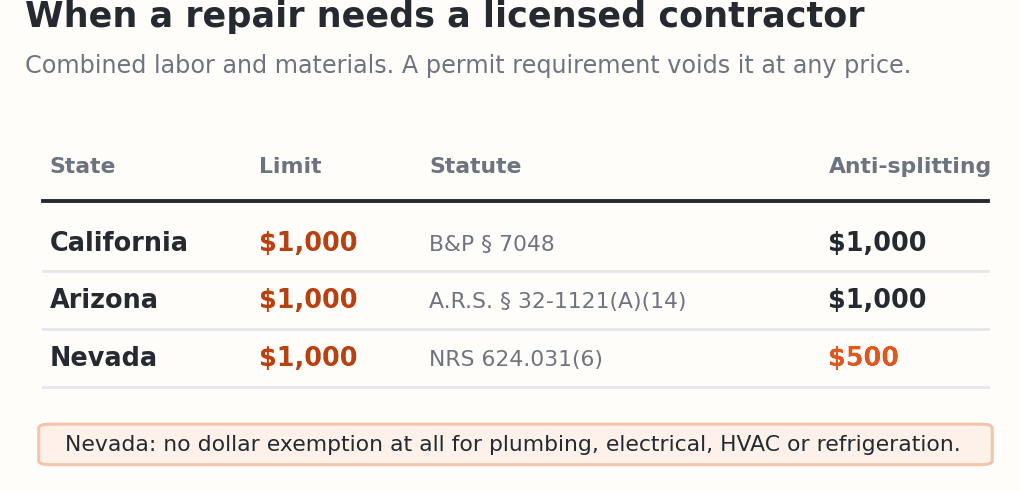
California’s actual rule, updated: the license threshold went from $500 to $1,000 on January 1, 2025, under AB 2622. An unlicensed person can legally handle a project up to $1,000 total, counting labor and materials together, but only if they hire no workers and the job needs no building permit. The second a permit or an employee enters the picture, a license in the matching classification is required no matter how small the invoice is. Plenty of articles still quote the old $500 figure, so this is worth knowing before somebody quotes you $900 for a job that needs a permit.
Handyman work covers a genuinely wide range: mounting, assembly, drywall patching, painting, hardware, doors, fixtures, punch lists. What it doesn’t cover is the moment your project crosses into licensed-trade territory. Rewiring a circuit, moving plumbing, touching anything structural. That line exists because of what’s hiding behind the drywall afterward.
Never Pay It All Upfront, and in California You Legally Can’t Be Asked To
In October 2023, a Hollywood, Florida homeowner whose house had burned hired Cornelius Sentell Osborne for restoration work. Crews did demolition, insulation removal, cleanup. The homeowner paid him about $174,000.
Then, according to Florida’s Department of Financial Services, he abandoned the project and left the house uninhabitable. Osborne, 45, was arrested in March 2026 and has pleaded not guilty to first-degree grand theft and acting as an unlicensed contractor. The state’s CFO put it bluntly, saying the man had offered a homeowner hope and left them holding the bag.
Fire and flood victims get targeted specifically, because insurance settlements arrive as large checks and the people receiving them are exhausted and displaced. If that’s your situation, the money moving in one lump is the risk.
California law limits this directly. Per the Contractors State License Board, a contractor doing home improvement work cannot take a down payment over $1,000 or 10% of the contract price, whichever is less. Not whichever is more. On a $60,000 remodel, the legal maximum before work begins is $1,000. Every payment after that can’t exceed the value of work already completed or materials already delivered, which CSLB has spelled out to contractors directly.
Calling it a materials deposit or a mobilization fee changes nothing. If someone asks for 30% up front on a California home improvement job, they’re either unaware of the law that governs their own trade or counting on you being unaware of it.
How to Verify a Handyman’s License in About Four Minutes
Do this before the deposit, not after.
- Get the license number in writing, along with the exact legal business name.
- Look it up at cslb.ca.gov in California, or your own state board. Arizona homeowners use the Registrar of Contractors, which also publishes a wanted list and an unlicensed-violators file.
- Compare the name and business on the license record against the contract, the invoice, and the person actually running your job. This is the step that catches the borrowed-number trick.
- Confirm the classification matches your work. A general license doesn’t authorize a panel upgrade.
- Ask for the certificate of insurance and workers’ comp, and get it emailed from the carrier rather than photographed.
- Check whether your job needs a permit, and settle who’s pulling it in writing.
Two things that should make you slow down regardless of what the license says: pressure to decide today, and a request for payment structured around anything other than completed work.
Red Flags in the Ads and the DMs
The Mesa and Villages cases both started the same way, on social media, and that’s the channel worth extra suspicion.
Somebody replying to your public post about a project has selected themselves in. You didn’t find them, check reviews, or get a referral from a neighbor. In Florida, a man built an entire business identity on Facebook as a licensed electrician he wasn’t. Advertising a licensed trade title you don’t hold is itself an enforcement trigger in most states.
A few patterns worth noticing: a quote that’s dramatically under everyone else’s, a business name that doesn’t match the name on the license or the bank details, an unwillingness to put a scope in writing, and cash-only pricing framed as a discount. Our earlier piece on handyman red flags and the questions to ask goes deeper on the behavioral tells, which is the other half of this.
What to Do If You’ve Already Been Scammed
Start documenting before you do anything else. Estimates, texts, photos of the work, bank and card records, the business name and any license number you were given, plus the vehicle and plate if you have it.
Then file where it counts. In California, complaints go to CSLB, and unlicensed operators fall under its Statewide Investigative Fraud Team. Report the theft to local police as well, because license boards handle licensing matters while the money is a criminal matter. If you paid by card or financed the work, dispute it. In the Pasco cases, investigators specifically asked people to hold on to written estimates and messages, since homeowner documentation is what makes these cases prosecutable.
One thing not to do is let embarrassment stop you. Mesa police went looking for additional victims because people who get taken this way usually assume they’re the only one. They almost never are.
Why We Run It the Way We Do
We’ve had to earn our way into properties tied to names like Pandora, Macy’s, Chanel, and Nordstrom, and we carry $2 million in general liability coverage. Neither of those makes anyone good with a drill. What they do is answer the question underneath all of this, which is who pays when something goes wrong in your building.
We’d rather you verify us than take our word for it. Ask for the license, ask for the certificate of insurance, and check both. Anyone who gets annoyed at that request has told you something useful.
You can see the range of what we handle on our services page, look through finished work in the portfolio, and if you manage rentals, our landlord’s guide to reducing maintenance costs covers how we approach recurring work. Business owners might want our piece on small commercial repairs that get expensive later.
Where We Work
We’re based at 6020 S La Brea Ave in Los Angeles, and you can find us on Google Maps.
We take on residential and commercial work across Los Angeles, Long Beach, Irvine, and the wider Orange County area, plus Pasadena, Glendale, Burbank, Woodland Hills, West Hills, Canoga Park, Calabasas, Topanga, and the Hollywood Hills. If you’re outside those and not sure whether we cover you, call and ask.

You can look at our other service forms here.
You should also check out our Google Maps page
And here’s our phone number : +1 818-835-0556.
Frequently Asked Questions
How do I check if a handyman is licensed in California?
Search the license number at cslb.ca.gov, then compare the name and business on that record against your contract and invoice. Verifying the number alone isn’t enough, because borrowed license numbers come back valid.
Can a handyman legally work without a license in California?
Only on jobs totaling under $1,000 including labor and materials, with no employees and no permit required. The threshold rose from $500 in January 2025. Anything needing a permit requires a licensed contractor regardless of price.
How much can a contractor ask for upfront in California?
For home improvement work, no more than $1,000 or 10% of the contract price, whichever is less. Later payments can’t exceed the value of work already done or materials already delivered.
Is it illegal to hire an unlicensed handyman?
The legal exposure mostly lands on the unlicensed worker, but you absorb the practical damage: insurance claim denials, unpermitted work surfacing during a sale, and paying twice when a licensed contractor has to redo it.
What if a handyman offers a much cheaper cash price?
Treat it as information rather than a bargain. Cash-only pricing often signals no license, no insurance, and no paper trail, which is exactly what you’d need if the job goes wrong.
Do I need a permit for small electrical or plumbing work?
Usually yes for anything beyond replacing a fixture in place. Since a permit requirement means a license requirement, confirm it before hiring rather than after inspection.
Worth Remembering
Fourteen arrests in four days in one Florida county. A Mesa homeowner out more than $233,000 after a Facebook reply. A Villages homeowner who paid $3,800 and got wires taped together behind new drywall. A fire victim who handed over $174,000 and got a house he couldn’t live in.
None of those people were careless. They were busy, or displaced, or dealing with someone who was good at seeming legitimate. The four minutes it takes to hire a licensed handyman properly is the cheapest insurance in home improvement, and almost nobody spends it.
The legal gap that makes this possible isn’t unique to Florida. Texas has no state remodeler license at all, Michigan draws its own line at $600, and California homeowners who sign their own permit run into a related version of the same problem.
Anyways….
Want a crew you can actually verify before you hand over a key? We at The Handy Geeks handle repairs, maintenance, and remodels for homes, rentals, and commercial properties across California, insured to $2 million, and used to working around real businesses.
📞 Call us 💻 Book Online