

Outdoor Kitchens in Los Angeles and San Diego: Permits, Cost and Safety
Most outdoor kitchen builders in Los Angeles and San Diego sell the finished look: stone, stainless and a big grill. Very few explain the parts that decide whether the island passes inspection or becomes a hazard. The gas line needs a permit in both cities. An insulated grill jacket protects less than most people think. And San Diego’s new Zone 0 rules can rule out a wood-framed island next to the house entirely. This guide covers what to know before you hire a builder.
Short answer: Outdoor kitchens in Los Angeles and San Diego usually cost $15,000 to $55,000, and more for luxury builds. A gas line needs a plumbing permit in both cities, and electrical circuits need GFCI protection. In fire zones, framing near the house may have to be noncombustible. The Handy Geeks reviews these points before any build.
Last verified: September 2026. Zone 0 rules are still changing, so check your city and parcel before you design.
Planning a slab or pavers? Find out do you need a permit for a patio in California.
How Much Do Outdoor Kitchens Cost in Los Angeles and San Diego?
Local builders publish similar tiers in both cities. A basic island with a grill and some counter space starts around $15,000 to $25,000. A mid-range kitchen with a sink, refrigerator and more appliances runs about $25,000 to $55,000. Large custom kitchens with covers, pizza ovens and bars reach $55,000 to $95,000 or more.
| Component | Typical cost | Notes |
|---|---|---|
| Island framing | $200 to $700 per linear ft | Steel stud and cement board, block, or prefab modules |
| Countertops | $40 to $200 per sq ft | Granite, porcelain and concrete hold up best in sun |
| Gas line | $12 to $25 per ft | Plus the plumbing permit |
| Outdoor GFCI outlet | $180 to $350 each | Plus the electrical permit |
| Water line to a sink | $450 to $800 per fixture | The drain must reach the sewer, not the yard |
| San Diego gas permit | $264.25 | City fee for the first 5 gas outlets |
| San Diego circuit permit | $176.57 | City fee for the first 5 circuits, 15 to 45 amps |
Component ranges from HomeGuide; San Diego fees from City of San Diego Information Bulletin 103 (May 2026). LA fees vary by scope; use the LADBS fee estimator.
So the appliances aren’t the only big line. Gas runs, circuits and countertops add up quickly, and permit fees are small by comparison. Skipping them is where the real cost shows up, usually at resale.
Do You Need a Permit for an Outdoor Kitchen?
Almost always, for the utilities. The Los Angeles Department of Building and Safety requires a plumbing permit for any new gas piping except a run under 6 feet from an existing outlet in the same room, which no backyard island meets. San Diego says a gas barbecue itself may not need a building permit, but the gas and electrical work still do.
| Item | City of Los Angeles (LADBS) | City of San Diego (DSD) |
|---|---|---|
| Gas line to the island | Plumbing permit | Plumbing/gas permit |
| New circuits or outlets | Electrical permit | Electrical permit |
| The island itself | Depends on size, height and any cover | A barbecue may be exempt; a new pad or cover can trigger review |
| Fast track | Over-the-counter for simple trade permits | Simple no-plan permits, usually issued in about 2 business days |
| Fire zone rules | State WUI code; LA’s Zone 0 approach still pending | Zone 0 standard in force for new structures |
Sources: LADBS plumbing permit FAQ, San Diego IB-201, San Diego simple plumbing permits.
A pergola or patio cover over the kitchen brings its own permit rules. Our gazebo and pergola permit guide has the city-by-city limits.
Who Can Legally Build an Outdoor Kitchen in California?
Running a gas line from the meter to an island takes a licensed contractor, typically a C-36 plumbing contractor or a B general contractor managing the trades. California’s minor-work exemption covers only jobs under $1,000 that need no permit, and a gas line always needs one, so no handyman exemption applies. Unlicensed gas work also blocks permit sign-off.
Gas, electrical and permitted structural work on an outdoor kitchen is outside our scope. We handle planning and non-permit work such as setting prefab island modules, and we’ll tell you plainly which parts need a license.
When you interview outdoor kitchen builders in Los Angeles or San Diego, ask four things:
- What is your CSLB license number and classification? Check it on the CSLB site.
- Who pulls the gas and electrical permits, and are they in the quote?
- What clearances does the grill manual require, and how does the frame meet them?
- Is the parcel in a fire hazard zone, and how does the design handle it?
What Does an Insulated Grill Jacket Actually Protect?
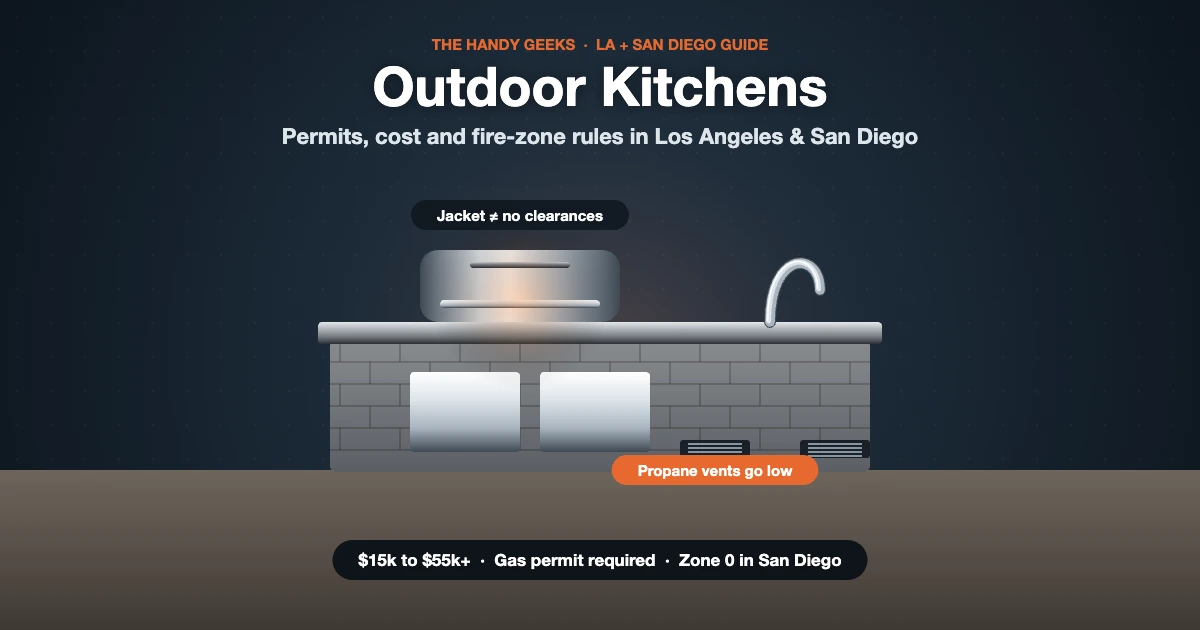
Less than most people assume. An insulated jacket is a double-walled stainless liner that lets a built-in grill sit in a cutout framed with combustible material. It protects the framing below and around the grill body. It does not remove the grill maker’s clearances to combustibles behind, beside or above the cooking surface.
Blaze’s jacket instructions say the jacket protects combustibles below the cooking surface only, and they rule out rubber gas hose in favor of stainless flex line. So a wood-framed island still needs the rear and overhead clearances from the grill manual. Those are often a foot or more behind the grill and several feet above it to a wood pergola or ceiling, unless a listed outdoor hood is used.
One more trap: tile over plywood behind a grill is not a noncombustible wall. Tile conducts heat to the wood behind it, and repeated heating can char framing over time. If the grill sits near a wall, the wall needs to be built noncombustible, not just faced with tile.
Why Do Outdoor Kitchen Islands Need Vents?
Because leaking gas collects inside a closed island. Propane is about 1.5 times heavier than air, so it sinks and pools at the bottom of the cabinet. Natural gas is about half as heavy as air, so it rises and collects under the countertop. Either one can build up until a spark from an igniter or a refrigerator compressor sets it off.
Grill makers typically call for at least two vents on opposite sides of the island, commonly about 20 square inches each. Place them near the floor for propane and near the top for natural gas, and follow your grill’s manual for the exact size and position. This breakdown of outdoor kitchen explosions from RTA Outdoor Living shows how small leaks turn into real incidents.
Outdoor Kitchens in Fire Zones: Zone 0 and the New WUI Code
If your home is in a Very High Fire Hazard Severity Zone, the fire rules may matter more than the permit. On January 1, 2026, California’s wildfire construction rules moved from Building Code Chapter 7A into the new California Wildland-Urban Interface Code. San Diego also enforces its own Zone 0 standard for the first 5 feet around structures.
San Diego’s standard applies to new structures in the highest-hazard zone with permit applications from February 28, 2026, according to San Diego Fire-Rescue Standard D-2. Existing structures phase in from 2027 to 2029. For an outdoor kitchen, the practical rule is simple: within 5 feet of the house, build it noncombustible.
- Framing: galvanized steel studs or concrete block, not wood.
- Sheathing: cement board rather than plywood.
- Counters: porcelain, granite or concrete.
- Trim: no exterior wood within the 5-foot zone.
- Covers: a wood pergola over the kitchen near the house is a problem in Zone 0.
Statewide, the Board of Forestry pulled its Zone 0 rules back from final review in early September 2026, so Los Angeles is still waiting on a state framework. Check your parcel on the state fire hazard map before you finalize a layout.
Can an Outdoor Kitchen Sink Drain Into the Yard?
No. California’s graywater rules exclude kitchen sink water, so an outdoor kitchen sink can’t drain to landscaping, a French drain or a dry well. Food waste, grease and bacteria are the reason. The sink has to connect to the home’s sanitary sewer with a trap and a proper vent, sloped at about ¼ inch per foot.
That drain run is often the most expensive surprise in an outdoor kitchen, especially when the island sits far from the house. If the sewer connection isn’t practical, many homeowners drop the sink or use a prep area without one.
Outdoor Kitchen Electrical: GFCI and Circuits
Outdoor outlets and equipment need GFCI protection. The 2025 California Electrical Code, based on the 2023 NEC, extends that requirement under section 210.8(F) to outdoor outlets rated up to 50 amps. That includes circuits feeding built-in electric griddles, 240-volt pizza ovens and hardwired outdoor refrigerators, not just the standard receptacles.
Plan the circuits early. A refrigerator, lighting and a rotisserie outlet usually need their own runs, and weatherproof in-use covers are required on outdoor receptacles. Our handyman electrician guide explains which small electrical jobs need a licensed electrician.
Outdoor Kitchen Design in San Diego and Los Angeles
Good outdoor kitchen design in San Diego starts with the coast. Salt air pits cheap stainless, so use 304 stainless at minimum and 316 near the water. Quartz is a poor outdoor choice because UV can discolor it, and some quartz makers exclude outdoor use from their standard warranties. Granite, porcelain slabs and sealed concrete hold up better.
In Los Angeles, inland heat and sun matter more than salt. Shade the prep area, keep dark counters out of full afternoon sun, and leave room for a cover if you’ll cook in summer. In both cities, place the grill so smoke clears the house and the neighbors.
Outdoor Kitchens in Carmel Valley
San Diego’s Carmel Valley (ZIP 92130) is mostly newer tract and planned-community homes, so HOA approval usually comes before the city permit. Some lots near canyon edges fall into high fire hazard zones, which brings the Zone 0 material rules into play. Carmel Valley Village in Monterey County is a different place with different rules.
Why Clients Call The Handy Geeks
- We check permits, fire zone and grill clearances before anyone prices appliances.
- We tell you which work needs a licensed trade, so you can hire one for it.
- We set prefab island modules square and level, with vents placed for your fuel.
- Insured to $2M in general liability, with the certificate sent before the first visit.
- Crews across Los Angeles and the Bay Area.
See our construction services, all services, or recent projects. For labor rates, see our handyman hourly rate guide. Call +1 818-835-0556.
Frequently Asked Questions
How much does an outdoor kitchen cost in Los Angeles?
Most run $15,000 to $55,000, with luxury builds reaching $95,000 or more. Gas lines, electrical circuits and countertops are the biggest costs after appliances.
Do I need a permit for an outdoor kitchen in San Diego?
You need permits for the gas line and electrical circuits even if the barbecue island itself is exempt. San Diego issues simple no-plan trade permits in about 2 business days.
Can a handyman install a gas line for an outdoor kitchen?
No. A gas line needs a permit, so California requires a licensed contractor, typically a C-36 plumbing or B general contractor, at any price.
Does an insulated grill jacket eliminate clearance requirements?
No. It protects combustible framing below the grill, but the grill maker’s clearances behind, beside and above the cooking surface still apply.
Where should vents go on a propane outdoor kitchen island?
Near the floor on opposite sides of the island, because propane is heavier than air. Natural gas islands need vents near the top instead.
Can an outdoor kitchen sink drain into my garden?
No. Kitchen sink water is excluded from California’s graywater rules, so it has to drain to the sanitary sewer.
Final Thoughts
The best outdoor kitchens in Los Angeles and San Diego are planned from the utilities and fire rules outward, not from the appliance catalog in. Settle the gas route, the drain, the circuits and the fire zone first, then pick the finishes. It saves money and it passes inspection.
Anyway. Send us your address and a rough layout, and we’ll tell you what the permits and fire rules look like before you commit to a builder.