

Ceiling Fan Installation in California: Permits, Code and Cost
Ceiling fan installation looks like a one-hour swap, and sometimes it is. The trouble starts when the fan goes onto a box that was only ever meant to hold a light, or gets wired to a dimmer that slowly cooks the motor. On top of that, the permit rules change from city to city: El Cajon’s electrical code doesn’t exempt fan installs at all, while most homeowners assume nobody checks. We install fans across Southern California and the Bay Area, and this guide covers what actually decides the job.
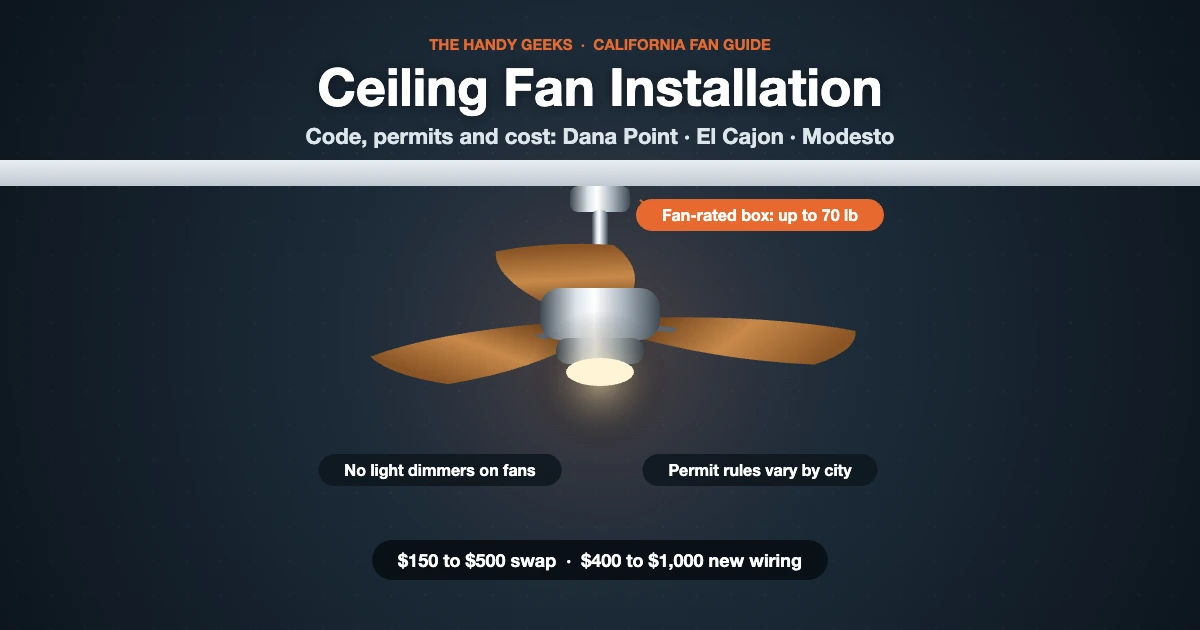
Short answer: Ceiling fan installation in California usually runs $150 to $500 for a swap and $400 to $1,000 with new wiring. The box must be fan-rated, the control must be a fan control rather than a light dimmer, and some cities, including El Cajon, require a permit. The Handy Geeks checks all three first.
Last verified: September 2026.
If you’re in Los Angeles, our LA ceiling fan cost breakdown goes line by line through local pricing.
How Much Does Ceiling Fan Installation Cost?
Most ceiling fan installation jobs fall into three tiers. Replacing an existing fan on a fan-rated box is the cheapest. Converting a light fixture to a fan costs more because the box usually has to be upgraded. A brand-new location with new wiring and a wall switch costs the most, and in most cities it needs a permit.
| Job | Typical installed cost ($) | What drives the price |
|---|---|---|
| Fan-for-fan replacement | $150 to $300 | Height, fan weight, remote pairing |
| Light fixture to fan | $200 to $500 | Whether the box must be replaced with a fan-rated brace |
| New location with new wiring | $400 to $1,000 | Attic access, wall switch, permit |
| Vaulted or 12 ft+ ceiling | Add $50 to $200 | Scaffold or tall ladder, angle adapter, downrod |
Market ranges from HomeGuide’s cost data; Angi reports a national average of $253 across 9,729 projects. The Handy Geeks published range is $70 to $160 an hour in the Los Angeles metro and $80 to $180 in the Bay Area, with a $110 to $210 minimum in California.
So the brand of fan rarely moves the bill much. The box and the wiring do. That’s why we ask for a photo of the existing box before quoting a light-to-fan conversion.
Why Does a Ceiling Fan Need a Fan-Rated Box?
A spinning fan puts a moving, twisting load on the box that a light fixture never does. The electrical code, in NEC section 314.27(C), says a box used as the only support for a ceiling fan must be listed and marked for fan support. A fan-rated box can carry up to 70 pounds, and one rated over 35 pounds must be marked with its maximum weight.
The failure we see most is the shallow “pancake” box held up by two small screws. Light boxes only have to support a 50-pound static fixture. A fan that’s even slightly off balance works those screws back and forth thousands of times an hour until the threads strip or the ears crack. Fan-rated boxes use heavier #10-24 screws into a steel hub or brace, which is why they hold.
Since the 2023 edition of the code, ceiling boxes in habitable rooms placed where a fan could go must be fan-rated or give access to framing that can support one. Older homes won’t have that, so plan on a box upgrade for any light-to-fan conversion. The code text for 314.27(C) is worth a look if you want the exact wording.
No Attic Access? Use a Spreader Bar
Without attic access, the standard retrofit is an expandable steel brace that slides through the ceiling hole and screws out until its teeth bite into the joists on both sides. Our field check is that the prongs are set at least 3/16 inch into the wood before the box goes on. Plastic “old work” boxes are not rated for fans and shouldn’t be used, whatever the packaging implies.
Can You Put a Ceiling Fan on a Dimmer Switch?
No. A standard light dimmer controls brightness by chopping up the power waveform, and a fan motor handles that badly. The usual result is a constant hum, extra heat inside the motor, and a shorter motor life. Use a control made for fans, or the fan’s own remote or wall control.
This isn’t just advice from installers. Federal efficiency rules for ceiling fans require separate controls for the fan and the light, more than one fan speed, and a reverse function on most indoor fans, according to the Department of Energy’s ceiling fan standard. It’s why modern fans ship with a receiver and remote, and why the old dimmer on the wall should come out.
Fan speed controls step the speed down in clean increments instead of chopping the power. If you want wall control, buy one labeled for ceiling fans and matched to your fan’s motor type; many DC-motor fans only work with the maker’s own control.
Do You Need a Permit to Install a Ceiling Fan in California?
It depends on the city and the job. California’s baseline code exempts only minor repairs, replacing bulbs and plugging in portable equipment, so new wiring or a new box usually needs an electrical permit. A like-for-like fan replacement is treated differently by different cities, and some, like El Cajon, list no exemption for it.
That matters for more than paperwork. Under California’s licensing law, any job that needs a permit has to be done by a licensed contractor, whatever it costs. For fans, that means a licensed C-10 electrician. Permit-required fan work is outside our scope.
Ceiling Fan Installation in Dana Point
Dana Point adopted the 2025 California Electrical Code in September 2025, and its permit rules follow the state building and residential codes. Salt air is the bigger practical issue. Fans on covered patios near the harbor should be damp-rated at minimum, and fans exposed to rain must be wet-rated under the code. We recommend wet-rated fans with stainless hardware and composite blades anywhere within sight of the ocean, because wood blades take on moisture, droop and throw the fan out of balance.
Ceiling Fan Installation in El Cajon
El Cajon’s municipal code, section 15.24.010, requires an electrical permit before installing or altering any wiring, devices or equipment. The only exemptions are minor repairs to switches, fuses, sockets and receptacles, replacing bulbs, and plugging in portable appliances. Read literally, installing a fan needs a permit, so ask the building department before you book. The El Cajon ordinance is short and worth reading. Inland heat regularly tops 100°F, so pick a fan with a well-ventilated motor housing.
Ceiling Fan Installation in Modesto
Modesto doesn’t publish an exemption list for fan work, but it issues minor residential electrical permits over the counter. Call the building division at 209-577-5232 with your job details before you start. Modesto sits in the Central Valley’s long cooling season, where a fan in every bedroom earns its keep, and summer attic heat is hard on sealed electronic motor controllers. Fans with vented canopies tend to last longer there.
What Size Ceiling Fan Do You Need?
Match the blade span to the room. ENERGY STAR’s sizing guidance, based on American Lighting Association data, puts a 36-inch or smaller fan in rooms up to 75 square feet, 36 to 42 inches up to 144 square feet, about 44 inches up to 225 square feet, and 50 to 54 inches up to 400 square feet. Larger rooms need a bigger fan or two.
- Blades at least 7 feet above the floor, ideally 8 to 9 feet.
- Blade tips at least 18 inches from walls and sloped ceilings.
- A 6-inch downrod on a 9 ft ceiling, 12 inches on 10 ft, and about 24 inches on 12 ft.
- An angle adapter on vaulted ceilings, checked against the fan’s maximum slope.
- Hugger mounts only where the ceiling is under 8 feet.
The ENERGY STAR ceiling fan guide also notes that certified fans move air about 20% more efficiently than standard models.
Does a Fan Light Kit Have to Meet Title 24?
No, and this trips up a lot of installers. California’s energy code, Title 24 Part 6, requires most new residential light fixtures to use JA8-certified high-efficacy sources. Light kits that come built into a ceiling fan are exempt from that JA8 requirement, because ceiling fan light kits are covered by federal appliance standards instead.
The practical takeaway: if you replace a light fixture with a fan that has an integrated light kit, the kit doesn’t need a JA8 label to pass. If you replace a fan with a standalone light fixture, the fixture does. The exemption appears as exception 1 to section 150.0(k)1A of the California Energy Code.
Check Ceiling Fan Recalls Before You Install
Check before you hang it. On August 13, 2026, the CPSC announced a recall of about 9,460 Hampton Bay Halwin 52-inch indoor/outdoor ceiling fans, models AK396H-MBK and AK396H-BN, because the blades can separate from the motor flywheel. They were sold at The Home Depot from January 2023 through October 2025.
The UPCs are 840059614922 and 840059615370, printed on the box and on the label inside the mounting plate. Owners should stop using the fan and contact Youngo for a refund, per the CPSC recall notice (26-702). We won’t install a fan on an active recall list, and you can search others on the CPSC site.
Why Clients Call The Handy Geeks for Ceiling Fan Installation
- We check the box rating before we quote, from a photo if you send one.
- We confirm your city’s permit rule for the job, not just the state’s.
- We match the control to the motor, so no dimmers on fans.
- We check the model against CPSC recalls before installation.
- Insured to $2M in general liability, with the certificate sent before the first visit.
For more on where handyman electrical work ends, see our handyman electrician guide, and if a fan is already wobbling, read the signs a ceiling fan is unsafe. Our handyman services in California page covers scheduled visits. Call +1 818-835-0556.
Frequently Asked Questions
How much does ceiling fan installation cost in California?
Usually $150 to $300 to replace an existing fan, $200 to $500 to convert a light fixture, and $400 to $1,000 for a new location with new wiring. A box upgrade or a tall ceiling adds to the total.
Can I install a ceiling fan on a regular light box?
No. NEC 314.27(C) requires a box listed and marked for fan support when the box holds the fan, rated up to 70 pounds.
Why does my ceiling fan hum?
The most common cause is a standard light dimmer on the fan circuit. Replace it with a control made for ceiling fans, then check that the canopy and blades are tight.
Do I need a permit to install a ceiling fan in El Cajon?
Likely yes. El Cajon’s code requires an electrical permit for installing or altering wiring and devices, with exemptions only for minor repairs, bulbs and portable appliances.
What size ceiling fan do I need for a bedroom?
For a typical 10×12 to 12×12 bedroom, a fan of about 42 to 44 inches. Keep the blades at least 7 feet above the floor.
Does a ceiling fan light kit need a JA8 label in California?
No. Title 24 exempts integrated ceiling fan light kits from the JA8 requirement because they fall under federal appliance standards.
Final Thoughts
Good ceiling fan installation comes down to three checks: the box, the control and the permit. Get those right and the fan runs quiet for years. Get one wrong and you’re chasing a wobble, a hum or an inspection problem. For wider electrical questions, our guide to electrical repairs and upgrades in California is a good next read.
Anyway. Send us a photo of the box and the fan you’ve picked, and we’ll tell you what the job involves.