

Door Closer Replacement Cost: $120 to $280 per Door
Door closer replacement cost in Los Angeles usually lands between $120 and $280 per door, parts and labor included. That assumes a plain swap on a door in good shape. It climbs when the door has sagged, the frame is out of square or the opening has a fire rating.
That is the range we publish for commercial customers, and this page explains what sits behind it. It is part of our wider guide to commercial handyman services. If your closer slams rather than dies, start with why a door closer keeps slamming. A quick valve adjustment can save the whole bill.
Short answer: The Handy Geeks charges $120 to $280 per door to replace a door closer in the Los Angeles metro, parts and labor included. A fire rating or an after-hours visit pushes the price up, and a concealed closer sits in a higher tier. We confirm the final price in writing before work starts.
Last verified: October 2026.
What Does a Door Closer Replacement Cost in Los Angeles?
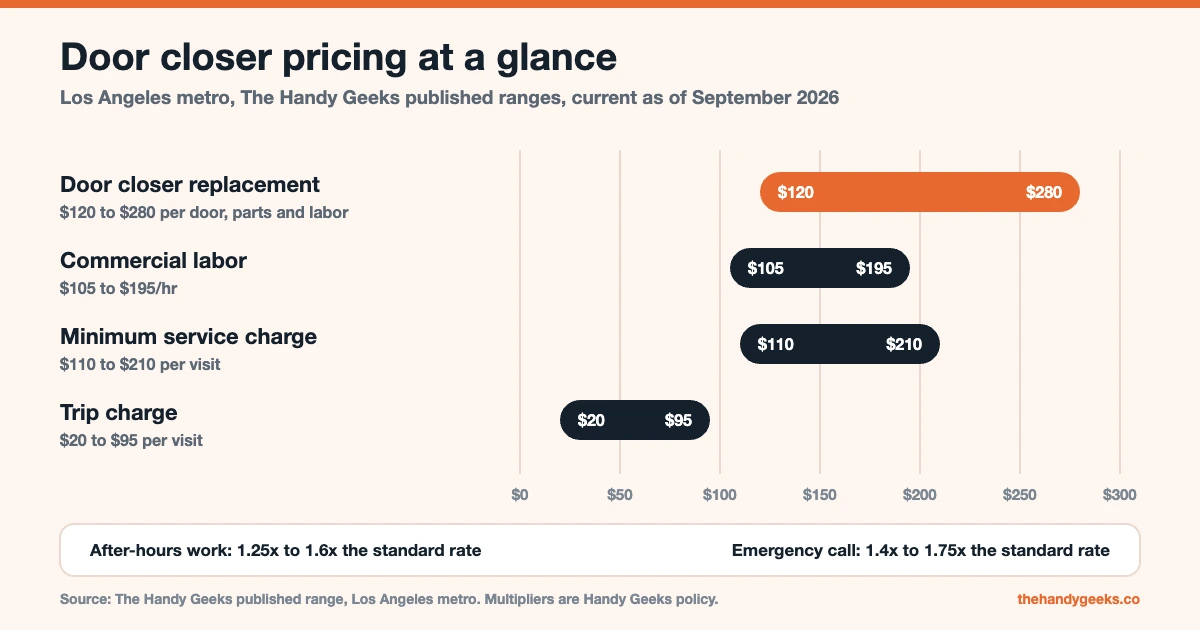
Our published door closer replacement cost in the Los Angeles metro is $120 to $280 per door, parts and labor. Anything around the closer, such as a worn hinge or a loose strike, bills at our hourly rate on top. Here is how that sits next to the rest of our commercial price list.
| Charge | Los Angeles rate | How it applies |
|---|---|---|
| Door closer replacement | $120 to $280 per door | Parts and labor |
| Commercial labor | $105 to $195/hr | Hinge, strike and frame work around the closer |
| Minimum service charge | $110 to $210 per visit | Covers short calls |
| Trip charge | $20 to $95 per visit | Built into the written quote |
| After-hours work | 1.25x to 1.6x standard rate | Evenings and weekends |
| Emergency call | 1.4x to 1.75x standard rate | Same-day urgent repairs |
The Handy Geeks published range, Los Angeles metro, current as of September 2026. After-hours and emergency multipliers are Handy Geeks policy.
People also search for door closer installation cost or the cost to install a door closer, and they usually mean the same job. Our published range covers replacement. A door that has never had a closer gets priced from a photo of the door and frame.
Concealed overhead closers, the kind hidden in the header of an aluminum storefront door, sit in a different price tier. Auto Door and Hardware, a door hardware dealer, estimates $900 to $1,500 or more for a professional concealed closer job. It puts the average at $1,000 to $1,200, with the closer itself costing the service company $450 to $750. That is a vendor’s figure, not ours. It still shows why you should know which closer you own before budgeting.
What Drives the Price of a Door Closer Swap
Six things move door closer replacement cost. Those are the closer, the door, the mounting, any fire rating, the door’s condition and the access. Two doors that look identical from the sidewalk can land at opposite ends of the range.
- Closer type and grade. A surface-mounted closer (the body on the door or frame, with an arm) is the common, lower-cost type. Concealed overhead and floor-spring closers cost several times more. Grade matters too. ANSI/BHMA A156.4 rates closers from 1 to 3 for durability, and Grade 1 suits a busy entrance, where a commercial door closer works harder than one on an interior office door.
- Door and frame material. Aluminum storefront stiles are thin, so closers there often need specific brackets and fasteners. Wood and hollow metal doors take different screws, and hollow metal sometimes needs a reinforcement plate.
- Mounting position. Regular arm, parallel arm and top jamb mounts each use a different parts kit. Replacing like for like keeps the existing mounting holes, which is why a matching closer is the cheaper job.
- Fire rating. A labeled fire door needs a closer listed for that use, and that narrows the choice of model.
- Door condition. If the door drags, the closer gets the blame and the hinges deserve it. Worn hinges, a bent door and a misaligned strike all add labor.
- Access and timing. A tall door needs a ladder or lift, and a busy lobby door usually needs an after-hours window.
Should You Adjust, Repair or Replace the Closer?
Adjust first, because most closer complaints are speed or latching problems that two valve screws fix. Replace it when it leaks hydraulic oil, has a cracked body or a bent arm, or has lost all resistance. Sealed surface closers are almost always replaced rather than rebuilt.
Door closer replacement cost never comes up if a quick adjustment fixes the problem, so a door closer repair usually means valves, brackets or an arm. Replacing a door closer only pays off once the old one has really failed.
Signs the Closer Is Finished
Oil on the body, the arm or the door face means the seal has failed, and a closer that drifts open on its own or swings with no resistance has lost its spring and hydraulics. A cracked housing or an arm that bends under normal use is also done, whatever the valves say.
Check the Door Before You Buy a Closer
A new closer on a bad door fails again within months. Run through this list first:
- Swing the door by hand with the arm disconnected and see whether it moves freely.
- Look at the hinges for play, missing screws or a door that has dropped at the latch edge.
- Check that the latch catches the strike every time without a shove.
- Adjust the sweep speed and latch speed valves in small turns and recheck after each one.
- Look for a fire label on the door edge or frame before you order any parts.
- Note the closer brand, size and arm type so the replacement matches the existing holes.
How Fire-Rated and ADA Doors Change the Job
On a fire-rated door the closer belongs to a labeled assembly. The replacement has to be listed for that use. On an accessible route the door must close slowly and open with light force, so check both before you order the part.
NFPA’s fire door FAQ says these assemblies get inspected after installation and then at least once a year. The label has to stay legible, and the door has to close and latch. If you are unsure what your opening requires, ask the authority having jurisdiction. That is usually the fire marshal or the building department.
Fire ratings and ADA rules both shape door closer replacement cost, because they limit which closers you can use. For accessibility, the 2010 ADA Standards set a closing speed in section 404.2.8.1. From 90 degrees open, the door must take at least 5 seconds to reach 12 degrees from the latch. Section 404.2.9 caps opening force at 5 pounds for interior hinged doors. Fire doors follow the authority having jurisdiction instead. Hardware has to work with one hand and without tight grasping, pinching or twisting (404.2.7). The US Access Board hosts the same standards. Our ADA storefront door guide covers the 5-pound rule in more detail.
So a closer set to snap shut is a compliance problem as well as a pinched-finger problem. On an accessible route, we check closing time and opening force whenever we adjust the valves.
Replacing Closers Across a Building: Survey First
Survey every door first, then replace in matched sets. A door survey shows how many closers are failing, which models you have and which doors are fire-labeled. It also keeps the visit short, which matters for commercial retail maintenance jobs where the entrance has to stay open. The survey shows your real door closer replacement cost across the building too, since the mix of doors sets the total.
- Number each door on a floor plan and write the number on your list.
- Record the closer brand, size, arm type and mounting for each door.
- Mark every fire-labeled door and every door on an accessible route.
- Flag doors with sag, worn hinges or alignment problems, since those need more than a closer.
- Group like doors together so one commercial door closer model covers the whole group.
- Pick a work window for each entrance that keeps your tenants working.
One boundary to know about: California’s minor-work exemption counts the whole project, labor and materials together, at $1,000. It also disappears when a permit is required. CSLB spells this out in Industry Bulletin 24-07. A building-wide closer program can pass that line quickly, so we scope those jobs before quoting. Our commercial building repair page and our Los Angeles commercial maintenance page show the work we take on.
Frequently Asked Questions
How much does it cost to replace a commercial door closer in Los Angeles?
The Handy Geeks charges $120 to $280 per door for a door closer replacement in the Los Angeles metro, parts and labor included. Short calls carry a $110 to $210 minimum. A trip charge of $20 to $95 is built into the written quote.
Can you replace a single closer, or only a batch?
Replacing a door closer on a single door is a normal call for us. A project with many doors can pass California’s $1,000 minor-work line once parts and labor are combined. We scope those jobs with you before we quote them.
Does a fire-rated door need the same closer model?
Not always the same model. It does have to be a closer listed for fire door use, with an arm and mounting that suit the opening. Check the label on the door, and ask your fire marshal or building department if you are unsure.
Why does my new closer still slam or leave the door open?
Almost always the adjustment, the hinges or the strike, and rarely the closer itself. Sweep speed and latch speed each have their own valve screw. Any closer you install will fight a sagging door or a misaligned strike.
What is the difference between a surface-mounted and a concealed closer?
A surface-mounted closer sits on the face of the door or frame with a visible arm. A concealed overhead closer is built into the door header or door edge. It costs several times more, because both the unit and the labor are more involved.
Can you work after hours so the entrance stays open during the day?
Yes. Evenings and weekends bill at 1.25x to 1.6x the standard rate, and same-day emergency calls bill at 1.4x to 1.75x. Both multipliers are Handy Geeks policy and appear on the written quote before work starts.
What is the cost to install a door closer on a door that has none?
Our published $120 to $280 range covers replacement, parts and labor. Door closer installation cost on a door with no closer yet depends on the frame and the mounting holes, so we price it from a photo before we visit.
Final Thoughts
People only notice a door closer when it fails. A good job starts with a look at the door itself, whether it ends in a door closer repair or a full swap. A fair door closer replacement cost is one you can see in writing before anyone picks up a drill. Here is what you get from us on every call:
- $2M in general liability, with a certificate naming your company as additional insured
- A written quote that shows the price for each door before work begins
- Published rates for labor, minimums, trip charges and after-hours work
- A work window that keeps your entrance usable during business hours
- Net-30 billing once the account is set up
You can see more of our work on our services page and in our portfolio. Anyway, if a door will not latch, send us a photo of the closer and the door edge. Call +1 818-835-0556 or book online.