

Is That Repair Even Legal? Michigan Repair Laws, Line by Line
Michigan repair laws turn on a number most homeowners have never heard, and that number is $600.
Say somebody quotes you $850 to rebuild a rotted section of deck and swap two dead outlets while he’s there. Cash, no permit, done by Saturday. It reads like a favor with an invoice attached.
But under Michigan’s Occupational Code, that job crossed two separate legal lines before anyone plugged in a drill. And if the deck fails two winters later, or the outlet cooks a wall, the question of who pays comes down to paperwork. Nobody thinks about that paperwork while the quote is being written.
So here is how Michigan’s repair laws actually sort out, statute numbers included. “You probably need a permit” is useless advice when you’re standing in your own kitchen trying to decide.
Short answer: Anyone paid $600 or more in combined labor and materials for residential repair work in Michigan must hold a LARA residential builder or maintenance and alteration license. Electrical, plumbing, and mechanical work need separate trade licenses at any price. Permit exemptions exist, though they cover much less than most people assume.
If a door is sticking or won’t latch, our guide on how to fix a door that won’t close walks through each cause.
For prices by job size, see our drywall repair cost guide.
The $600 line in Michigan’s repair laws
Michigan contractor license requirements start lower than almost anywhere else in the country. Under MCL 339.2403, the exemption only applies when the aggregate contract price for labor, materials, and everything else on a single project comes to less than $600. Cross that, and whoever you hired needs a license from the Department of Licensing and Regulatory Affairs.
There are two flavors. A residential builder license covers broad construction and remodeling on residential structures. A maintenance and alteration contractor license covers a narrower list of trades, printed right on the license itself. So a guy licensed for roofing is not licensed to reframe your basement.
The statute also anticipated the obvious workaround. Splitting one job into a stack of sub-$600 contracts to dodge the act gets called out in the law directly. Three $500 invoices for the same kitchen fix nothing.
For most jobs, then, Michigan’s repair laws bite almost immediately. The practical answer is that the license requirement kicks in fast. A single afternoon of drywall and trim work at going rates clears $600 without much effort.
Which repairs actually need a permit in Michigan?
Fewer than you’d guess, though the exempt list is narrower than the internet suggests. This is the part of Michigan’s repair laws that costs people money. Michigan building permit exemptions live in Rule 408.30505 of the Administrative Code, and they’re specific rather than general.
Finish work is safe. Painting, wallpapering, tiling, carpeting, cabinets, and countertops all skip the permit. Detached sheds of 200 square feet or less are exempt, along with fences seven feet or shorter and driveways sitting no more than 30 inches above grade.
Roofing is where people get tripped up. Adding a second layer or tearing off and replacing the covering counts as an ordinary repair. Once the sheathing underneath needs replacing, you’re in permit territory. Same story for anything that cuts into a wall, removes a structural beam, or changes a required exit path.
| The job | Permit in Michigan? |
|---|---|
| Painting, tile, carpet, cabinets | No |
| Detached shed under 200 sq ft | No |
| Clearing a drain stoppage or fixing a leaky valve | No |
| Pulling and resetting the same toilet | No |
| Replacing a light bulb | No |
| Replacing a light fixture, switch, or outlet | Yes |
| Any new wiring | Yes |
| Replacing a sink or moving a water line | Yes |
| Deck attached to the house, or serving a door | Yes |
| Replacing roof sheathing | Yes |
Electrical and plumbing exemptions are tiny
That electrical row surprises nearly everyone. Michigan exempts exactly two electrical activities from permits: replacing lamps, meaning bulbs, and plugging approved portable equipment into existing receptacles. Everything else, per LARA’s electrical permit guidance, needs a permit.
Plumbing gets slightly more room. Clearing stoppages and repairing leaks in pipes, valves, or fixtures stays exempt. You can also pull and reset a toilet, as long as no valves, pipes, or fixtures get replaced or rearranged.
One thing worth underlining: exempt does not mean unregulated. The rule says plainly that skipping the permit never authorizes work that violates the code. Your permit-free shed still has to meet setbacks and structural standards.
Can I legally repair my own house?
Yes, and Michigan’s home repair laws are fairly generous about it. Homeowners can pull their own permits for work on a single-family home they occupy, and they can act as their own general contractor on top of that.
The catch sits one level down. If you sub any of it out, those subs need to be licensed in their own trade, whether that’s building, electrical, mechanical, or plumbing. Hiring your cousin’s friend to run a new circuit does not inherit your homeowner exemption.
Michigan home repair laws stop that exemption at the property line of your own residence. Landlords doing electrical work in a rental they own, even a single-family rental, fall outside it and need a licensed electrical contractor. That distinction catches a lot of small-portfolio owners who assume owning the building is the same as living in it.
Michigan home repair laws draw that line on purpose. The owner-occupant exemption exists because you’re the one absorbing the risk. Once a tenant is absorbing it instead, the state wants a licensed name on the permit.
Electrical, plumbing, and mechanical are their own rulebook
A residential builder license is broad, but it stops short of three trades. Electrical work sits under Article 7 of the Skilled Trades Regulation Act, plumbing under Article 11, and mechanical under Article 8. Each needs its own license, and there’s no dollar threshold to hide behind. A $90 outlet swap needs a licensed electrical contractor the same way a full rewire does.
So a licensed builder who offers to “just take care of” the panel while the wall is open is describing something he isn’t licensed to do. Competence with a pair of pliers has nothing to do with it.
Michigan repair laws treat permits the same way they treat licenses. In Michigan, electrical permits get pulled by licensed electrical contractors, not by individual journeymen working on their own account.
Pre-1978 paint quietly changes the job
Michigan has old housing stock, which means the federal lead rule applies to an enormous share of repair work in Detroit, Grand Rapids, Flint, and every older neighborhood in between.
The EPA’s Renovation, Repair and Painting Rule requires firm certification and certified renovators for paid work in pre-1978 housing. The trigger is six square feet of disturbed interior paint, or 20 square feet outside. Window replacement is covered no matter the square footage. Landlords doing their own maintenance are covered as well.
Michigan is not an EPA-authorized RRP state, so that firm certification comes from the EPA directly. Full lead abatement certification is separate and runs through the Michigan Department of Health and Human Services. A contractor with RRP certification is not thereby certified to do abatement here.
Homeowners working on their own home are generally outside the rule. The lead dust does not care about that distinction, though, so the containment practices are worth borrowing even when they aren’t required.
What happens when the repair wasn’t legal?
Both sides carry exposure under Michigan repair laws, and the contractor’s is heavier than most people realize.
Under MCL 339.601, a first offense for unlicensed residential contracting is a misdemeanor. The fine runs from $5,000 to $25,000, plus as much as a year in jail. If the work causes death or serious injury, it becomes a felony with up to four years. Courts must also order restitution, and an affected person can seek an injunction and recover actual costs and attorney fees.
Then there’s the money. Under MCL 339.2412(1), an unlicensed contractor cannot bring or maintain an action in a Michigan court to collect payment. The Michigan Supreme Court applied that rule in Stokes v Millen Roofing even though the homeowners knew the roofer was unlicensed. It kills construction lien rights along with the lawsuit.
For the homeowner, the pain is slower. Unpermitted work shows up when you refinance, when you sell, or when an insurer investigates a fire and finds wiring that was never inspected. Retroactive permits often mean opening finished walls, and that bill regularly exceeds the original job. Building without a required permit is separately a misdemeanor under MCL 125.1523, with each day of ignoring a stop-construction order counting as its own offense.
Michigan isn’t using the code you’d expect
Here’s the detail even a lot of contractors get wrong, and it changes which Michigan repair regulations apply to your job. Michigan is still operating on the 2015 Michigan Residential Code.
LARA filed rules adopting the 2021 IRC and 2021 IECC residential provisions, set to take effect August 29, 2025. The Home Builders Association of Michigan and the Michigan Manufactured Housing Association sued in the Court of Claims. On July 7, 2025 the court entered a stipulated order pausing implementation. The 2015 versions stayed valid, and as of mid-2026 that litigation was still working through discovery.
Practical upshot: if somebody quotes you 2021-code requirements as gospel, check. LARA maintains the current status on its rules page, and your local building department is the final word on what it will actually inspect against.
Local rules stack on top of the state’s repair regulations anyway. Zoning ordinances, historic district commissions, and subdivision restrictions can all require approval for work the state code exempts outright.
How to check all of this in about ten minutes
Three calls, and you’re done guessing about Michigan repair laws for your specific job.
Start with the license. LARA’s license verification search lets you confirm status, expiration, and category by name or license number. Category matters as much as status, since a maintenance and alteration license only covers the trades listed on it.
Then call your municipal building department and describe the actual work. They’ll tell you whether a permit applies faster than any article will, including this one. And ask who is pulling it, because a contractor who wants you to pull the permit on work he’s being paid for is asking you to carry his liability. We wrote about why signing your own building permit backfires if you want the longer version.
Last, get the scope in writing before any money moves. Our piece on handyman red flags covers what that document should actually say, and the enforcement stories are a decent argument for bothering.
Anyways…let’s just put in a small advertisement 😉
WHY US?
Unlike rest of the services in the market often looking to add hidden charges, WE offer extremely reliable, friendly, and quick services. And our all 5-star reviews are just another proof of that. Our clients never leave disappointed.
- Experienced Technicians: We always hire experienced and reliable people. Everyone on the staff is highly capable in the field and will ensure your work is done properly.
- Quick and Reliable: Your time is valuable. This is why we ensure everything goes smoothly and you get your work done right away.
- 24/7 Emergency Repairs: Emergencies can happen where you need us. And we will be there for you, on time.
- Tailored Solutions: Our team evaluates your space to recommend and install the perfect bed set up.
- 100% Satisfaction Guarantee: All of our clients have left a 5 star review so you know, you can trust us.

You can look at our other service forms here.
You should also check out our Google Maps page
And here’s our phone number : +1 818-835-0556.
Frequently Asked Questions
Does a handyman need a license in Michigan?
Yes. Michigan repair laws require a license once the job hits $600 or more in combined labor and materials. Below that a license isn’t required for general repair work, but electrical, plumbing, and mechanical work always need a licensed trade contractor regardless of price.
Can I hire an unlicensed contractor in Michigan if the job is small?
For general repair work under $600, yes. Above it, working without a Michigan contractor license is a misdemeanor. That contractor also cannot sue you for payment or place a valid construction lien on your property.
Do I need a permit to replace a light fixture in Michigan?
Yes. Michigan exempts only bulb replacement and plugging portable equipment into existing receptacles from electrical permits, so swapping a fixture, switch, or outlet requires one.
Can a homeowner do their own electrical work in Michigan?
Homeowners can perform and permit electrical work in a single-family home they own and occupy. That exemption does not extend to rental units, even single-family rentals, or to work done on someone else’s property.
What is the penalty for unpermitted work in Michigan?
Skipping a required Michigan building permit knowingly is a misdemeanor under MCL 125.1523, carrying up to $500 and 90 days. The bigger costs are usually retroactive permit fees, tear-out for inspection, and denied insurance claims.
Which Michigan residential code is in effect right now?
The 2015 Michigan Residential Code. A court order from July 2025 paused adoption of the 2021 IRC while a builders’ association lawsuit against LARA proceeds.
Where The Handy Geeks actually work (we don’t serve michigan)
Straight answer, since it matters: we’re a California crew, not a Michigan one. This guide exists because the Michigan repair laws questions we get asked are the same questions homeowners everywhere are asking, and the statutes here are unusually easy to point at.
The Handy Geeks handle residential and commercial repair, maintenance, and remodel work across California. That covers Los Angeles, Long Beach, Irvine, Orange County, Pasadena, San Diego, San Francisco, Sacramento, and the Central Valley. Commercial clients make up a big share of that, and we carry $2 million in general liability coverage because retail and property-management work requires it.
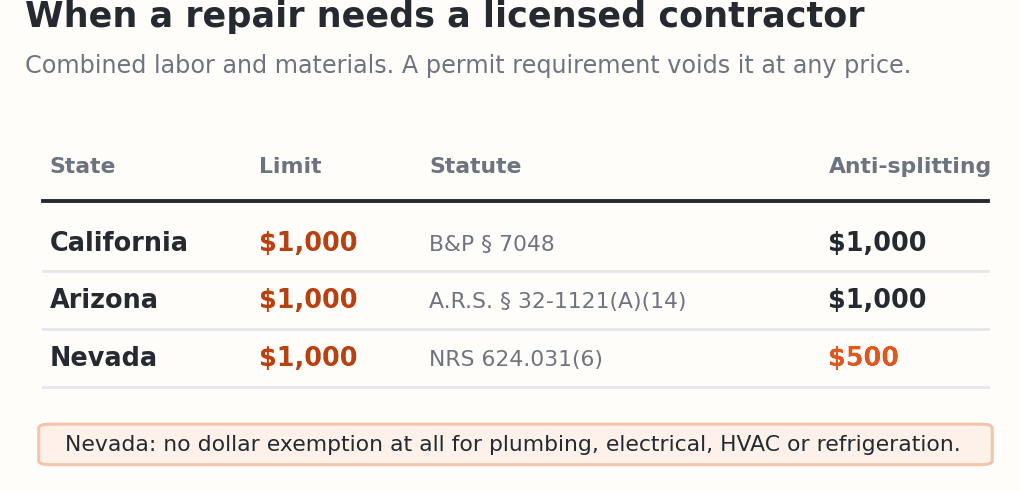
If you’re in California, the structure of the question is identical and only the agency changes. The Contractors State License Board handles licensing here instead of LARA, the threshold is $1,000 rather than $600, and your city building department still decides what gets a permit. Our services page lists what we take on, and the portfolio shows the commercial side.
If you’re in Michigan, use LARA’s verification tool and your local building department. That’s the honest answer.
Closing The Loop
Almost every fight under Michigan’s repair laws traces back to the same two questions, asked too late. Who’s licensed for this specific work, and who’s pulling the permit.
Ask them at the quoting stage and the answers cost you nothing. Ask them after the drywall is up and you’re negotiating from the worst possible position, because now somebody has to open a finished wall to find out.
Michigan isn’t alone in this gap. Texas has no state license for remodelers at all, and California’s renter repair rules work almost in reverse. For what it actually costs to get caught operating unlicensed, 14 arrests and $174,000 gone is the cautionary version.
Anyways….
Want a crew you don’t have to second-guess? We at The Handy Geeks handle repairs and maintenance for homes, rentals, and commercial properties across California, insured, documented, and used to working around real businesses.
📞 Call us
Last verified: September 2026. California licensing threshold per Business and Professions Code section 7048, as amended by AB 2622 (Chapter 240, Statutes of 2024).