


The Landlord’s Guide to Reducing Maintenance Costs
Most advice on cutting maintenance costs turns out to be advice on deferring them, which is a different thing wearing the same coat. The spending does not go away. It moves to a worse month and arrives with a multiplier attached.
Here is what the numbers actually support, based on our own pricing and the benchmarks facilities teams use.
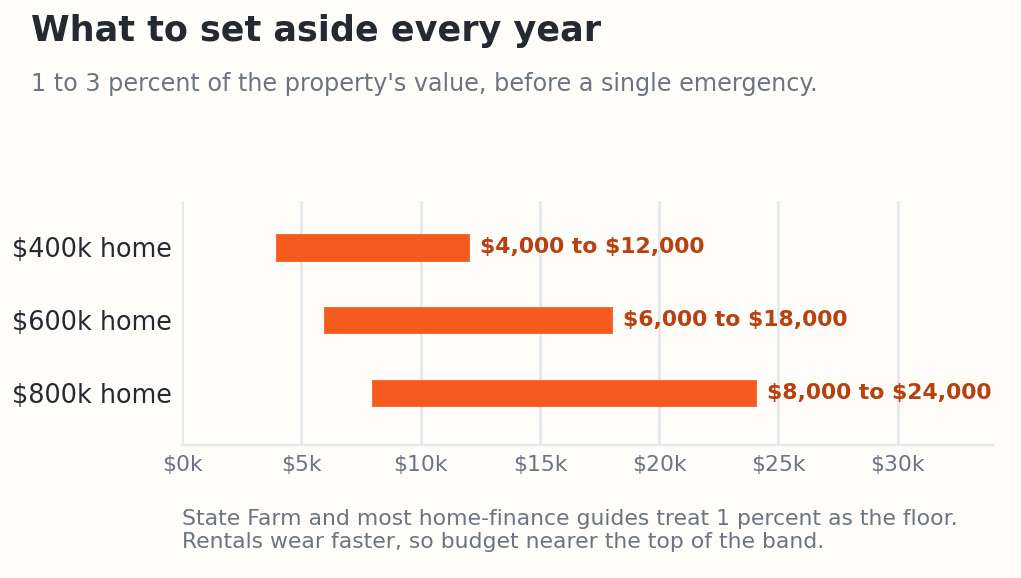
Short answer: Budget 1 to 3 percent of the property’s value a year, nearer 3 percent for rentals because they wear faster. Moving from mostly-reactive to planned-first work cuts total repair spending by around 40 percent in most facilities studies, which is a far bigger lever than negotiating rates.
For where each alarm should go, see our smoke detector placement diagram and code guide.
What Should A Rental Actually Cost To Maintain?
One to three percent of the property’s value every year, and rentals belong at the top of that band rather than the bottom. Tenant turnover, harder use and habitability deadlines all push the number up. On a $600,000 rental that is $12,000 to $18,000 a year once you sit in the upper half.
Run a second method alongside it as a sanity check. A dollar per square foot per year is the rough residential version, and for commercial space IFMA and BOMA benchmarking puts routine maintenance between $2.15 and $3.50 per square foot annually. If the two methods disagree by a wide margin, one of your inputs is wrong.
Why Does Planned Work Cost Less Than The Same Work Later?
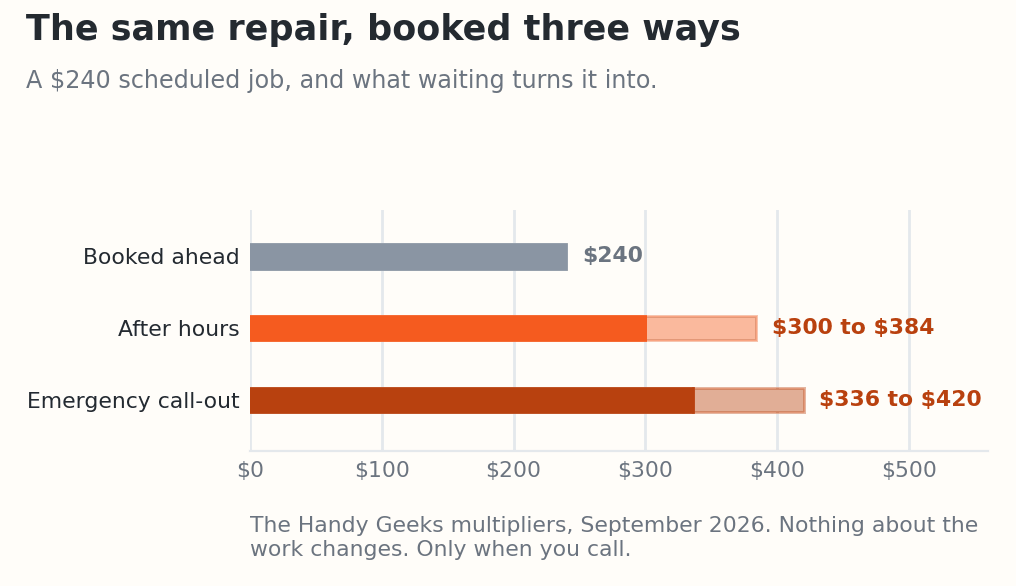
Because you control the timing, and timing is priced. Our after-hours rate runs 1.25x to 1.6x and emergency call-outs 1.4x to 1.75x. A $240 repair booked for next Tuesday becomes a $336 to $420 repair when a tenant calls at 9pm, and the work is identical.
Healthy commercial properties run somewhere near 70 to 80 percent planned work. If your ratio is inverted, the fix is not a cheaper vendor. It is a schedule, because a property spending 2 percent on scheduled work is in better shape than one spending 5 percent on emergencies.
Which Inspections Are Worth The Time?
The ones covering systems that fail expensively and quietly. Water first, because a slow leak runs a meter and rots a subfloor simultaneously. Then the envelope, then anything that carries a habitability obligation, because those come with legal deadlines rather than preferences.
| What to check | How often | Why it earns the visit |
|---|---|---|
| Under every sink, plus water heater base | Every 6 months | Slow leaks run a meter and rot subfloor before anyone sees a stain |
| Toilets, for a running flapper | Every 6 months | Up to 200 gallons a day, per EPA WaterSense |
| Roof, gutters, exterior caulking | Before the rainy season | Envelope failures let water in behind the finish, where repairs cost most |
| Smoke and CO alarms, GFCI outlets | Annually, and at turnover | Habitability, and the failure mode is not financial |
| HVAC filter and condensate line | Quarterly | A blocked condensate line floods a ceiling from above |
Nothing on that list is expensive on its own. The whole point is that it is cheap while it is still a checklist item.
How Do You Get Tenants To Report Early?
Make reporting cost them nothing. Most tenants delay because they expect friction, an inspection, or a conversation about who pays. One channel, a fast acknowledgement and no interrogation gets you the leak in week one instead of month three.
Tell them explicitly which things you want to hear about immediately, because “let me know if anything breaks” gets you nothing. Water, burning smells, buzzing outlets and anything that will not lock. Those four, any hour.
Where The Money Actually Goes
Bundle. One visit that clears eight small items beats eight separate call-outs, because every visit carries a minimum service charge of $110 to $210 in California and a trip charge of $20 to $95 on top. Eight trips means eight minimums.
Most small repairs across our four markets run between $95 and $475 a job in 2026. That figure is only meaningful if the jobs stay small, which is the entire argument for the rota above.
Spend upward where the material is doing the work: quality flooring at turnover, weather-resistant paint on the exterior, decent fixtures in the wet rooms. Those choices reduce visit frequency, which is the only saving that compounds.
Where The Legal Line Sits
California exempts work under $1,000 in combined labor and materials, and any permit requirement voids that exemption at any price. AB 2622 raised the figure from $500 on 1 January 2025, so older advice quoting $500 is out of date.
For a landlord this matters twice, because using an unlicensed operator above that line is a problem for you as well as them. We keep our own work inside the exemption and route anything larger to a licensed trade, and we say which is which before starting. The tenant-side version of this is in California renter repair laws.
Working With Us
We carry $2 million in general liability with the certificate sent before we book, and we write a scope in advance saying what we handle directly and what goes out to a licensed trade. For portfolios, one vendor across the whole list is usually what makes the rota above survive contact with a busy month.
The full service list is on our handyman services page, and fixture and repair plumbing sits under plumbing services. If you also hold commercial space, the budgeting maths is different and we worked it through in what a commercial maintenance budget should really be, alongside nine small commercial repairs that get expensive.
We cover Los Angeles, Long Beach and Pasadena, the San Fernando Valley around Woodland Hills and Calabasas, Irvine and Orange County, San Diego, the Bay Area and Sacramento, plus Phoenix, Scottsdale and the Las Vegas valley.
The Short Version
Set the number first, at 1 to 3 percent of value and nearer 3 for a rental. Then spend it on a schedule rather than on surprises, because the schedule is what keeps jobs inside the cheap column of that first chart.
Everything else is detail. Tenants who report early, materials that last, and one vendor who picks up.
Frequently Asked Questions
How much should a landlord budget for maintenance each year?
One to three percent of the property’s value, and nearer 3 percent for a rental because turnover and harder use push the number up. On a $600,000 property that is $6,000 to $18,000.
Is preventative maintenance actually cheaper?
Moving from mostly-reactive to planned-first work cuts total repair spending by around 40 percent in most facilities studies. Healthy properties run 70 to 80 percent planned work.
What does an emergency call-out cost compared to a booked visit?
Our after-hours rate runs 1.25x to 1.6x and emergencies 1.4x to 1.75x. A $240 booked repair becomes $336 to $420 as an emergency, for identical work.
How often should I inspect a rental property?
Plumbing and toilets every six months, the roof and exterior before the rainy season, alarms and GFCIs annually and at every turnover, HVAC filters quarterly.
What repairs can an unlicensed handyman legally do in California?
Work under $1,000 in combined labor and materials, provided no permit is required. AB 2622 raised that from $500 on 1 January 2025.
Is it cheaper to bundle repairs into one visit?
Yes. Every visit carries a minimum service charge of $110 to $210 in California plus a $20 to $95 trip charge, so eight separate call-outs means paying that eight times.
Last verified: September 2026. Commercial per-square-foot benchmarks from IFMA and BOMA. Leak figures from EPA WaterSense. California licensing threshold per Business and Professions Code section 7048, as amended by AB 2622 (Chapter 240, Statutes of 2024). Prices are The Handy Geeks published ranges.