

9 Small Commercial Repairs That Cost You Thousands Later
Small commercial repairs are the easiest thing in the world to put off, which is the entire reason they end up costing what they cost. A sticking back door doesn’t stop you opening on Monday. Neither does a mop sink that drips, or a chipped tile behind the host stand. So it goes on the list, and the list lives in a drawer, and then in March someone finally calls us and the sticking door has taken the frame with it.
We handle commercial handyman work and property maintenance across California, mostly restaurants, retail, offices and property managers around Long Beach, Los Angeles, Irvine and Orange County. After enough walkthroughs the same failures show up in roughly the same order every time. That’s what this list is.
tldr; the small commercial repairs that get expensive when ignored are water leaks, door hardware, drywall, flooring, restroom fixtures, exterior paint, loose shelving, failed caulking, and anything that’s been parked on your maintenance list for more than a quarter. Handle leaks and floors first, because those two carry water damage and liability exposure at the same time.
Why Commercial Buildings Wear Out Faster Than You Think
A front door on a house gets opened maybe twenty times a day. A retail entrance in a strip center gets opened a few hundred times before lunch, by people who don’t own the building and have no particular reason to be careful with it.
That difference compounds in ways owners rarely budget for. Hinges work loose, grout gives up, seals flatten, and the whole building is essentially running a wear test on itself every day you’re open. None of that is avoidable, and nobody’s suggesting you can maintain your way out of it. The only real variable is whether you find the problem at two hundred dollars or four thousand.
1. Small Water Leaks
Water goes first on any list like this, for one reason: it’s the only failure here that keeps working after you’ve locked up and gone home.
The leaks that cause the most damage are almost never dramatic. It’s a supply line weeping a few drops an hour behind a cabinet, or a flushometer that runs for ninety seconds after every use, or a ceiling tile with a faint tea-colored ring that’s been there since whenever. And water doesn’t stay where it starts. It runs along the top of a joist, down the back of the drywall, and shows up thirty feet away in a room with no plumbing in it, which is why the stain on your ceiling frequently has nothing to do with what’s directly above it.
The timing is what actually determines your cost. EPA guidance on mold and moisture puts the window at 24 to 48 hours: dry the material inside that window and in most cases mold never establishes. Past it, you’ve stopped doing a repair and started doing remediation, with the containment and air monitoring that come with it. For a kitchen, add a health department conversation you’d rather not have.
One tell worth knowing. If a ceiling stain reappears after you’ve painted over it, that’s not a paint failure. Something up there is still wet.
2. Damaged Doors and Door Hardware
Doors are the highest-cycle piece of hardware you own and they fail predictably. Hinges sag under their own weight, closers lose hydraulic oil, latches stop catching, and once the slab starts dragging the frame you’re no longer fixing a door, you’re fixing a door and a frame.
We went deep on one version of this already in why your door closer keeps slamming and how to fix it. The summary is that a slamming closer is usually a two-minute adjustment while it’s still an adjustment, and a full replacement about a year after that.
The part most owners miss is the compliance side. Opening force, closing speed and hardware operability on accessible routes are all specified in Section 404 of the 2010 ADA Standards for Accessible Design, and a door that’s slowly drifted out of adjustment can put you out of compliance without anyone noticing until the day somebody decides to make it an issue. Nobody complains about a heavy door for two years and then everybody does.
3. Cracked or Damaged Drywall
Plenty of drywall damage is genuinely cosmetic and you can leave it alone for a while without guilt. A dent at chair height, an old anchor hole where somebody’s shelf used to be, that kind of thing.
Cracks are different, because a crack is information. One running diagonally out of a door corner usually means movement somewhere. A patch that’s soft or discolored means moisture, not impact. And a crack you patched properly that reopens three weeks later isn’t telling you the patch was bad, it’s telling you whatever caused it is still happening, so patching it again is just a slower way of doing nothing.
Then there’s the appearance question, which owners tend to dismiss and shouldn’t. Nobody walks into a restaurant, notices four scuffed walls, and consciously decides the kitchen must be dirty. They just come away liking the place slightly less than they otherwise would, and you never find out.
Cost-wise the math is simple enough: one patch and a spot coat is a small ticket. Fifteen patches scattered across a dining room means repainting wall-to-wall, because spot coats over old paint never quite match sheen, and you’ll see every one of them under the pendant lights.
4. Damaged Flooring
Commercial flooring absorbs punishment residential flooring never sees. Pallet jacks, dropped sheet pans, chair legs dragged a thousand times a week, degreaser sitting in a grout line overnight.
A cracked tile or a lifted VCT seam is a trip hazard, and trip hazards move out of the maintenance budget and into the insurance conversation quickly. OSHA’s general requirement at 29 CFR 1910.22 is that walking surfaces stay free of hazards and in good repair, and it applies to the back of house exactly as much as the sales floor. In practice the back of house is where it gets ignored, since customers never see it.
There’s also a genuinely boring reason to move fast, which is availability. Replace a broken tile this quarter and it disappears into the floor. Wait three years and the run has been discontinued, so now you’re pulling and replacing a whole section to avoid a floor that looks patched.
5. Broken or Loose Bathroom Fixtures
Restroom fixtures fail faster than anything else in a commercial building, because the public treats a commercial restroom as something that belongs to nobody.
You know the specific list. Faucet base with play in it, toilet handle that needs a particular jiggle everyone’s learned, a partition that rocks when someone leans on it, a grab bar you can turn by hand. That last one isn’t a cosmetic issue and shouldn’t be treated like one.
For restaurants this whole category punches well above its weight, since people really do judge the kitchen by the bathroom, and the fact that it’s unfair doesn’t stop the review from getting written. Practically speaking, the expensive version of this is almost always the same: a loose supply connection under a sink weeping into the cabinet base for a couple of months, which turns a hundred-and-fifty dollar fix into cabinetry, flooring and a restroom you have to close during service.
6. Peeling Paint and Damaged Exterior Surfaces
Exterior paint is a coating first and a color second. Once it cracks and lifts, the substrate underneath starts taking moisture and UV directly, and stucco, trim, fascia and exterior doors all go downhill from there at their own pace. Coastal Southern California speeds this up; salt air is unkind to everything.
The difference in cost is mostly about scope. Prep and recoat is a maintenance ticket you can schedule around business hours. Scraping, patching, priming and replacing rotted trim is a project, with a timeline and a crew on site for days.
7. Loose Fixtures and Shelving
Anything mounted to a wall is slowly working its way off that wall.
Gondola runs, wire shelving in the stockroom, wall-mounted monitors, signage, counters, cabinet doors. The failure pattern is always the same, which is that a small amount of movement gets ignored, the movement gradually increases, and eventually something carrying two hundred pounds of inventory pulls its anchors out of the drywall.
Snugging up an anchor takes four minutes and no materials. Re-anchoring into blocking after the wall has torn out takes half a day, plus the drywall repair, plus whatever broke on the way down.
8. Damaged Caulking and Seals
Caulk is the cheapest item on this entire list and it protects some of the most expensive assemblies you own, which is a bad combination for how often it gets checked.
Look at the joint where the sink meets the counter, the base of every toilet, window and door perimeters, and any exterior penetration where a pipe or conduit passes through a wall. When a bead fails, water stops running down the face of the finish and starts going behind it. You won’t see anything for months. What you’ll eventually see is swollen particleboard and a soft spot in the floor, and by then the forty-dollar tube of sealant is no longer the relevant number.
9. The Repairs That Keep Getting “Put on the List”
This is the expensive one, and there’s no line item for it anywhere.
Deferred maintenance is what you get when eleven separate small problems all age simultaneously. Individually not one of them justified calling anybody. Collectively they’re a three-day punch list, and you’re now paying a mobilization cost you could have absorbed across four routine visits for less money. That’s before the part nobody tracks, which is that every one of those items has been sitting in a customer’s line of sight the entire time it was on the list.
We got into the money side of this more thoroughly in the true cost of ignoring minor repairs, and if you’re running multiple properties, the landlord’s guide to reducing maintenance costs covers budgeting for this rather than reacting to it.
What Should a Business Owner Fix First?
Fix anything actively leaking, actively unsafe, or blocking an entrance. Everything else can be scheduled. This is roughly the sort we use walking a property:
| Priority | Timeline | Examples |
|---|---|---|
| Red | Now | Active leaks, trip hazards, broken entry doors, restroom out of service, exposed wiring |
| Orange | This month | Drywall damage, failing door hardware, loose shelving, cracked tile, broken fixtures |
| Green | Next scheduled visit | Caulking, paint touch-ups, minor cosmetic wear, aging hardware |
The whole job is keeping the green and orange items from turning red, which sounds obvious and is still where most properties lose the money.
How Often Should Commercial Properties Be Inspected?
Quarterly covers most offices and retail. Restaurants and anything with heavy public traffic do better monthly, since restrooms and flooring move through those categories a lot faster than an office suite does.
Walk it with your phone and photograph anything that looks different from last time. Different, not broken. Different is what catches a leak while it’s still cheap.
Getting these handled
Unlike a lot of what’s out there, we don’t do the surprise-line-item thing. Our reviews are 5-star across the board, and that isn’t luck.
- Experienced Technicians: Everyone on the crew has done commercial work before. Nobody learns on your building.
- Quick and Reliable: We turn up when we said we would, which has somehow become a competitive advantage.
- 24/7 Emergency Repairs: Leaks don’t respect business hours, so neither do we.
- Tailored Solutions: We’ll walk the property, sort the list, and tell you straight which items can wait.
- 100% Satisfaction Guarantee: Insured in California to $2 million in general liability, certificate on request. You can check any contractor’s license through the CSLB, and honestly, you should check everyone’s.
You can look at our other service forms here, see past commercial work in the portfolio, or read more commercial property guides.

You should also check out our Google Maps page
And here’s our phone number : +1 818-835-0556.
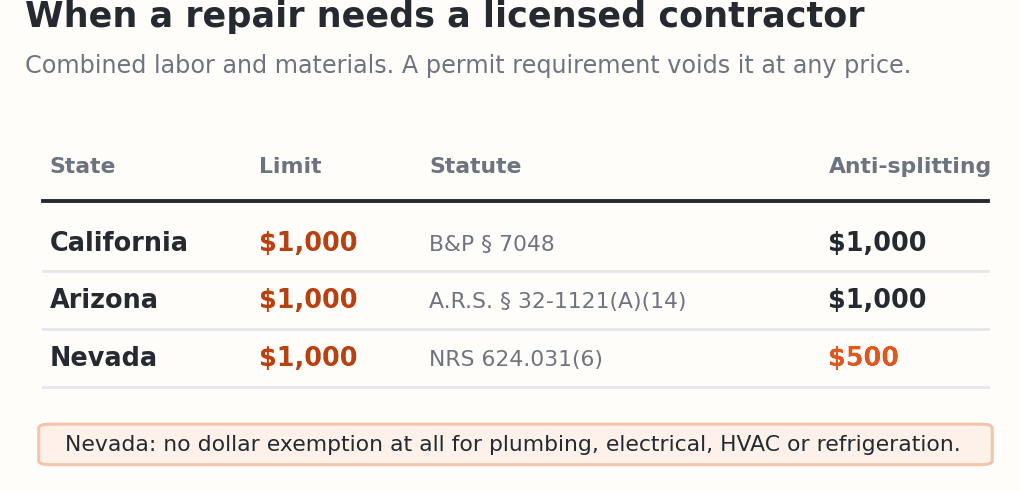
Short answer: Small commercial repairs are the ones that quietly become big ones — water leaks, failing door hardware, cracked drywall, damaged flooring, loose fixtures, and worn caulking all escalate if left on the list. Fix water and safety issues first. And know the rule: in California, any job totaling $1,000 or more in combined labor and materials requires a licensed contractor (AB 2622 raised that line from $500 in 2025).
Frequently Asked Questions
What counts as a small commercial repair?
Anything one person can finish in a single visit without pulling a permit or bringing in a licensed trade. Door adjustments, drywall patching, caulking, tightening fixtures, swapping a tile, paint touch-ups.
How much do small commercial repairs cost in Los Angeles?
Most single-item repairs land somewhere in the low hundreds. What moves the number is whether the original problem has already damaged something adjacent, which is why timing tends to matter more than the repair itself.
Which commercial repair should I fix first?
Active water leaks, every time. Water keeps causing damage overnight, and EPA guidance puts the mold prevention window at 24 to 48 hours after material gets wet.
Do I need a licensed contractor for minor commercial repairs?
In California, any job totaling $1,000 or more in combined labor and materials requires a licensed contractor. AB 2622 raised that line from $500 on 1 January 2025, and CSLB Industry Bulletin 24-07 spells out the conditions. License numbers are searchable at cslb.ca.gov, and it takes about a minute.
How often should I inspect a commercial property?
Quarterly for offices and retail, monthly for restaurants and high-traffic buildings.
Is deferred maintenance really more expensive?
Usually. A repair you do now stays one repair. A repair you defer becomes that same repair plus whatever it damaged while it was waiting, and often an after-hours rate on top.
If you manage commercial properties across multiple states, licensing rules vary significantly. See our commercial maintenance hub for the full breakdown, including the fact that Nevada requires a licence for plumbing and electrical at any dollar amount while Arizona allows minor work under $1,000.
Entrance doors belong on this list too. A closer that has drifted out of adjustment is cheap to fix and expensive to ignore, and our guide to storefront door compliance explains what the ADA and California actually require.
Where to start
The most expensive repair you pay for this year probably won’t be the one with the biggest quote on it. It’ll be the cheap one from last year that never got scheduled.
So when something breaks, skip past “can this wait.” The more useful question is what it costs if it does.
Anyway.
Need somebody to actually walk the property and sort the list? The Handy Geeks handles commercial handyman services and property maintenance for restaurants, retail stores, offices, HOAs and multi-location businesses across Long Beach, Los Angeles, Irvine and Orange County. Worth getting looked at while it’s still small.
📞 Call us
Last verified: September 2026. California licensing threshold per Business and Professions Code section 7048, as amended by AB 2622 (Chapter 240, Statutes of 2024).