

Handyman Certification in California: What the Law Requires
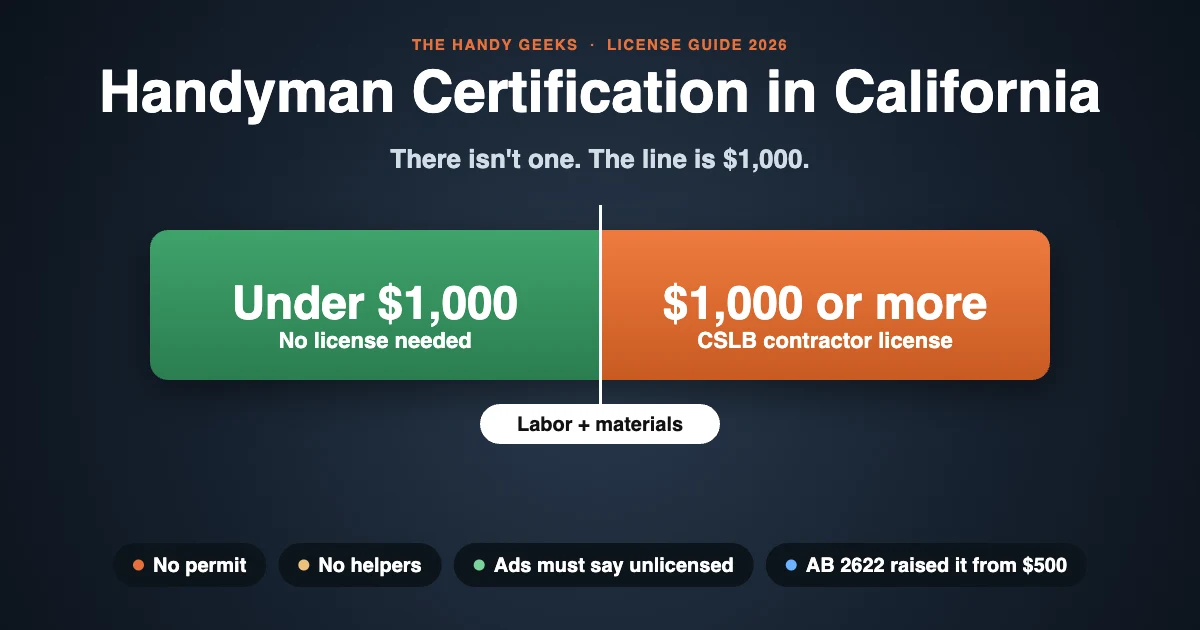
Short answer: California has no handyman certification and no handyman license. A handyman can legally take jobs under $1,000 in labor and materials with no license, as long as the work needs no permit. At $1,000 or more, or with a permit, the work requires a contractor license from the Contractors State License Board (CSLB).
People search for a handyman certification in California expecting a state exam or a badge. There is not one. What exists is a legal exemption for small jobs, a contractor license for everything bigger, and a few optional or federal credentials that sit on top. This guide covers each, in the order a working handyman runs into them.
Is There a Handyman License or Certification in California?
No. The CSLB licenses contractors by trade classification, and none of those classifications is “handyman.” Small jobs fall under the minor work exemption in Business and Professions Code 7048. The exemption lets an unlicensed person do limited work, but it does not give them a license, a certificate or a number to put on an ad.
In 2024, AB 2622 raised the exemption from $500 to $1,000, the first increase since 2005, according to Jet Surety’s summary of the bill. If you read an older handyman license guide that says $500, it is out of date.
What Is the $1,000 Handyman Limit in California?
The $1,000 handyman limit covers the total price of one job, labor and materials together. A person working under it must meet every condition at once:
- The total for labor, materials and everything else on the job is under $1,000.
- The work needs no building permit.
- The work is casual, minor and inconsequential.
- Nobody is hired to help. Employing a helper removes the exemption.
- The job is not a slice of a larger project, and a bigger job is not split into small invoices to stay under the cap.
Advertising has its own rule. Under Business and Professions Code 7027.2, an unlicensed person may advertise only for work under $1,000, and the ad must say they are not licensed. Calling yourself a contractor in an ad ends the exemption.
How Do You Get a Contractor License in California?
A handyman who wants to take jobs of $1,000 or more needs a CSLB contractor license. The CSLB lays out the steps on its licensed contractor steps sheet:
- Be at least 18 and have a Social Security number or ITIN.
- Show at least four years of journeyman-level experience in the trade within the last 10 years. The CSLB can select applications for experience verification.
- Submit the application with the $450 fee.
- Complete fingerprinting for the criminal background check after the application is reviewed.
- Pass the written law and trade exams, unless a waiver applies.
- Provide proof of insurance and post the required bond before the license issues.
- Price every job against the $1,000 total, including materials, before you quote it.
- Turn down permit work and anything structural, electrical or plumbing that would need one.
- Work alone. The first hire changes your legal status.
- Advertise only as an unlicensed handyman for work under $1,000, with the disclosure in the ad.
- Register locally. Most California cities require a business tax registration, and the rules differ by city.
- Carry liability insurance from day one.
- Plan the move to a CSLB license for when your average job crosses the limit.
Surety providers list the contractor bond at $25,000 and the initial license fee at $200 for a sole owner or $350 for other business types. Check the CSLB fee schedule before budgeting, because fees change.
The classification you apply under sets what the license lets you do, so choose it to match the work you actually take.
Which Certifications Help a Handyman?
None is a handyman certification, but two credentials matter in practice.
EPA lead-safe certification. Paid work that disturbs paint in homes built before 1978 can trigger EPA’s Renovation, Repair and Painting rule. It requires an EPA-certified firm and a certified renovator. The renovator course is one day, and certification lasts five years, per EPA’s rule summary. In older Los Angeles housing stock, this comes up on ordinary repair jobs.
Insurance. General liability and, if you ever hire help, workers’ compensation are not certifications, but property managers and many homeowners ask for proof of both before they will let you in the door.
How Do You Start a Handyman Business in California?
Starting a handyman business in California is legal without a license if you stay inside the exemption. The practical steps:
Materials count toward the cap, so a job with expensive fixtures can cross the line on its own. For what the work commonly pays, see our guide on how much a handyman charges per hour.
What Happens If You Work Above the Limit Without a License?
The risk lands on both sides of the invoice. Contracting without a license is a misdemeanor under Business and Professions Code 7028, and since 1 July 2026 the minimum civil penalty is $1,500. An unlicensed contractor can also lose the right to collect payment. For the hirer’s side, including workers’ compensation exposure, read our guide to unlicensed contractor liability in California.
How Do You Check a Handyman Before You Hire?
For any job near or over $1,000, ask for the CSLB license number and look it up on the CSLB website or call 800-321-CSLB. For smaller jobs, no license exists to check, so confirm the scope: a quote under $1,000 total, no permit needed, and no crew. Our California handyman services page lists what we handle and what we send to a contractor instead.
Frequently Asked Questions
Is there a handyman license in California?
No. California issues no handyman license. Small jobs can be done without a license under the minor work exemption in Business and Professions Code 7048, which is a legal exemption, not a credential.
Do you need a license to be a handyman in California?
Not for jobs under $1,000 in labor and materials, as long as the work needs no permit, is casual and minor, and you hire nobody to help. At $1,000 or more, or with a permit, you need a CSLB contractor license.
How do you get a contractor license in California?
You must be 18, show four years of journeyman-level experience in your trade within the last 10 years, pass the CSLB law and trade exams, submit fingerprints, pay the $450 application fee, and post a bond and show insurance before the license issues.
Can a handyman advertise in California without a license?
Yes, but only for work under $1,000, and the ad must state that the handyman is not licensed. Advertising as a contractor removes the exemption.
Is lead-safe certification required for handyman work in California?
If paid work disturbs paint in a home built before 1978, EPA’s lead-safe rules can apply. They require an EPA-certified firm and a certified renovator, trained in a one-day class valid for five years.
How can I check a handyman or contractor before hiring?
Look up the license number on the CSLB website or call 800-321-CSLB. A person working under the $1,000 exemption will have no license, so the job size and scope are what you verify.
Compare California with Nevada and Arizona in our handyman license requirements guide. Rules change, and this guide is general information, not legal advice. Check the CSLB for current requirements. Questions about a repair? Call us at +1 818-835-0556.