

Do You Need a Handyman License? Rules for California, Nevada and Arizona
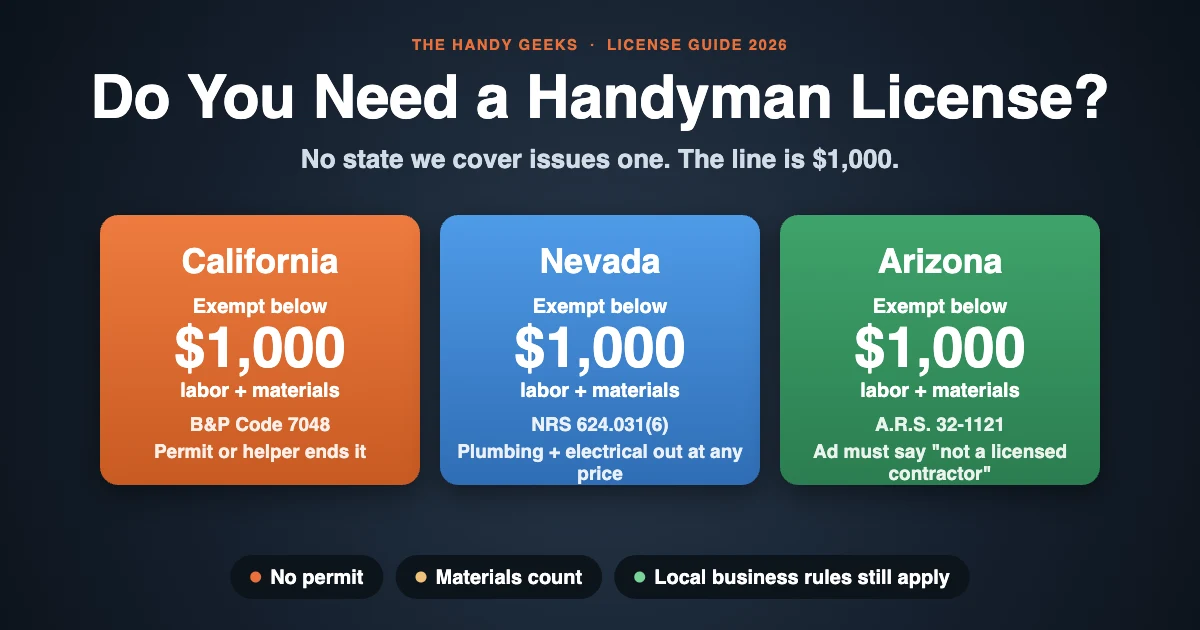
Short answer: California, Nevada and Arizona do not issue a handyman license. Each allows unlicensed handyman work on jobs under $1,000 in labor and materials, as long as the job needs no building permit. At $1,000 or more, or when a permit is required, you need a state contractor license.
Most pages on this topic say “it depends on your state” and stop there. This one gives the actual numbers for the three states The Handy Geeks works in, side by side. Rules are current as of October 2026. Confirm with your state licensing board before you rely on them for a specific job.
Is There a Handyman License?
No. A handyman license does not exist in California, Nevada or Arizona. Each state licenses contractors by trade classification instead, and each carves out a narrow exemption for small repair jobs. People searching for a handyman license are usually looking for that exemption, which is a legal limit, not a credential.
Handyman License Requirements by State
| State | Exemption limit (labor + materials) | Statute | Permit voids it? | Trade work excluded at any price? | Advertising rule |
|---|---|---|---|---|---|
| California | Under $1,000 | B&P Code 7048 | Yes | No, permits decide | Ad must say you are not licensed (B&P 7027.2) |
| Nevada | Under $1,000 | NRS 624.031(6) | Yes | Yes: plumbing, electrical, heating, air-conditioning, refrigeration | Not covered here |
| Arizona | Under $1,000 | A.R.S. 32-1121(A)(14) | Yes | Gas and fuel connections and some fire-safety work | Ad must say “not a licensed contractor” |
California
California’s limit is the total price of one job under $1,000, labor and materials together. AB 2622 raised it from $500 in the 2024 session, the first increase since 2005. The exemption disappears if the job needs a permit, if the work is more than casual and minor, or if you hire anyone to help. For the full California breakdown, including contractor license steps, read our guide to handyman certification in California.
Nevada
Nevada also uses a $1,000 limit, but it is the strictest of the three. NRS 624.031(6) removes plumbing, electrical, refrigeration, heating and air-conditioning work from the exemption at any price, so a $60 faucet cartridge is treated like a $6,000 repipe. The exemption also fails if the job is part of a larger project worth $500 or more. Nevada added a restricted B-7 contractor license for home remodels up to $7,000, which the state board began accepting applications for in March 2026.
Arizona
Arizona’s limit is less than $1,000 in total, so a job priced at exactly $1,000 does not qualify. A required local permit defeats the exemption at any price, and public advertising must include the words “not a licensed contractor.” Work that connects to natural gas, propane or other fuel lines is excluded. Local business, tax, permit and inspection rules still apply on top of the state exemption.
What Counts Toward the $1,000 Limit?
Everything on the job counts: labor, materials and all other items, added together for the whole undertaking. A $400 labor charge with $650 in fixtures is a $1,050 job, which is over the line in all three states. Splitting a larger project into several smaller invoices to stay under the cap does not work, because the exemption excludes work that is part of a larger operation.
Handyman Business License vs. Contractor License
A handyman business license and a contractor license are different things. A business license, or business tax registration, is local. Many cities require one for any business, licensed or not. A contractor license is issued by the state board and lets you take jobs above the exemption. Holding a city business license does not raise your $1,000 limit, and the state exemption does not waive your city’s registration.
When Do You Need a Contractor License?
You need a state contractor license when any of these is true:
- The job is $1,000 or more in labor and materials (or $500 or more as part of a larger project in Nevada).
- The job needs a building permit.
- The work falls in an excluded trade, such as electrical or plumbing in Nevada.
- You hire a helper in California, where employing anyone voids the exemption.
California applicants need four years of journeyman-level experience, the law and trade exams, fingerprinting, a bond and insurance. Nevada’s new B-7 route asks for two years of trade experience and a business course. Details on both are in our state guides.
What Happens If You Work Without a License?
Unlicensed contracting is a crime in both California and Arizona. California treats it as a misdemeanor and set a $1,500 minimum civil penalty from 1 July 2026. Arizona treats it as a class 1 misdemeanor with minimum fines of $1,000 for a first offense. The risk also travels to whoever hired the work. See our guide to unlicensed contractor liability in California for how it reaches property owners and managers.
How Do You Check Your State’s Rule Before a Job?
Ask the state board three questions, in writing if the job is close to the line. What is the dollar limit and does it include materials? Which trades are excluded regardless of price? What must an ad say? The boards are the California CSLB (800-321-CSLB), the Nevada State Contractors Board and the Arizona Registrar of Contractors. For what the work itself costs once you are inside the rules, see how much a handyman charges per hour.
Frequently Asked Questions
Do you need a handyman license?
Not in California, Nevada or Arizona, because none of them issues one. Each lets an unlicensed person do small jobs under $1,000 in labor and materials if the work needs no permit. At $1,000 or more, or with a permit, you need a state contractor license.
How do you get a handyman license?
You cannot, because no state we cover has a handyman license category. You either work inside the small-job exemption or apply for a contractor license from the state board: the CSLB in California, the NSCB in Nevada or the ROC in Arizona.
Do you need a handyman business license?
A local business registration is a different thing from a state contractor license. Many cities require a business tax registration, and the exemption covers only the state contractor license, not local business, tax or permit rules. Check with your city.
Can an unlicensed handyman advertise?
Yes, with a disclosure. California requires ads for under-$1,000 work to say the person is not licensed, and Arizona requires the words “not a licensed contractor.” Advertising as a contractor can void the exemption.
Can a handyman do plumbing or electrical work?
It depends on the state. Nevada bars plumbing, electrical, heating, air-conditioning and refrigeration work from the exemption at any price. California and Arizona mostly decide through permits, so minor no-permit swaps under $1,000 can fall inside the exemption.
What happens if a handyman does licensed work without a license?
Penalties are real. California set a $1,500 minimum civil penalty from 1 July 2026 and treats unlicensed contracting as a misdemeanor. Arizona treats it as a class 1 misdemeanor with minimum fines of $1,000 for a first offense.
Is the $1,000 limit per job or per invoice?
Per job. It covers the total price of the whole undertaking, labor and materials together. Splitting a bigger project into smaller invoices to stay under the limit does not qualify.
This guide is general information, not legal advice. Questions about a repair in Los Angeles, Las Vegas or Phoenix? Call us at +1 818-835-0556.