

Commercial Handyman Services: 2026 Rates, Quotes and NTE Rules
Commercial handyman services across Los Angeles, SoCal, and the Bay Area run $105 to $220 an hour in 2026. Most property managers never lose money on the hourly rate itself. Instead, they lose weeks waiting for a general contractor to bid a $220 door closer. Or they hire an uninsured tech who gets turned away at the loading dock by mall security. If you run retail stores or offices, our commercial retail maintenance page explains how multi-site coverage works. Below, we cover real 2026 labor rates and what belongs in a written handyman quote. We also break down California’s $1,000 licensing limit and how Not-to-Exceed (NTE) work orders finish repairs in one trip.
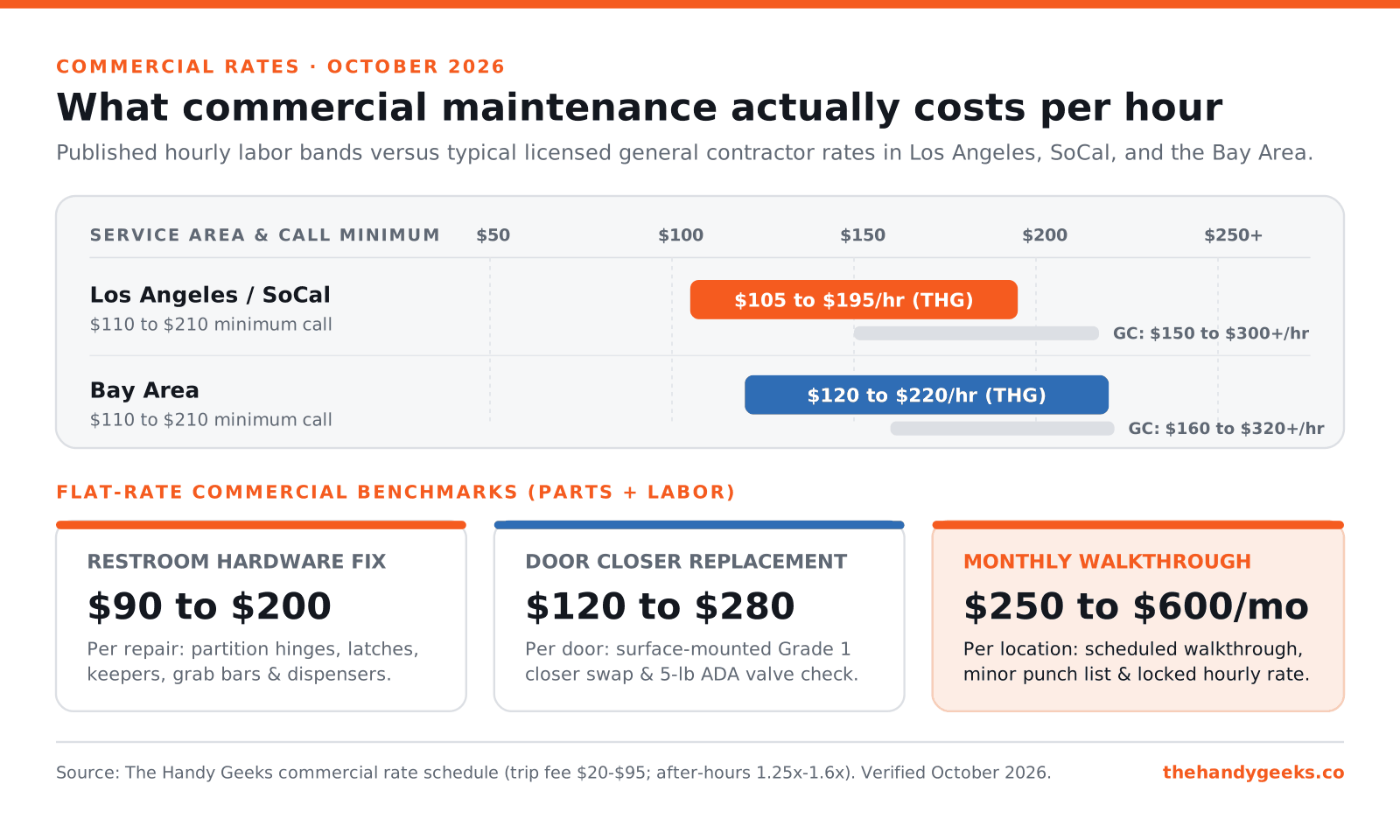
Short answer: Commercial handyman services from The Handy Geeks cost $105 to $195/hr in Los Angeles and SoCal, and $120 to $220/hr in the Bay Area. Flat-rate hardware fixes run $90 to $280. Every commercial job includes a written handyman quote, a same-day $2M COI, and Net-30 billing.
Last verified: October 2026
How Much Do Commercial Handyman Services Cost in 2026?
Commercial handyman services cost $105 to $195 per hour in Los Angeles and SoCal, and $120 to $220 per hour in the Bay Area, where crew wages, parking, and bridge tolls push labor costs higher. Minimum call-out charges run $110 to $210 per visit in both regions. Repeat commercial fixes like door closer replacement ($120 to $280) and restroom partition hardware repair ($90 to $200) get quoted as flat line items up front.
Why do commercial rates sit above residential rates ($50 to $180 an hour)? Paperwork and access windows drive the difference. A commercial visit requires ACORD 25 certificate endorsements, after-hours dock clearance, timestamped closeout photos, and Net-30 invoicing. Residential calls need none of that overhead.
| Service or Billing Item | Los Angeles / SoCal Rate | Bay Area Rate | Typical GC Comparison |
|---|---|---|---|
| Standard commercial labor | $105 to $195/hr | $120 to $220/hr | $150 to $320+/hr |
| Minimum service call | $110 to $210 | $110 to $210 | $350 to $750 minimum |
| Trip charge (in written quote) | $20 to $95 | $20 to $95 | Often 2-hr mobilization |
| Door closer swap (parts + labor) | $120 to $280/door | $120 to $280/door | $350 to $600/door |
| Restroom stall hardware fix | $90 to $200/repair | $90 to $200/repair | Rarely taken standalone |
| Drywall patch and paint (per area) | $85 to $250 | $85 to $250 | $300 to $650 minimum |
| Retail display or fixture install | $150 to $500 | $150 to $500 | $400 to $900+ |
| Monthly maintenance walkthrough | $250 to $600/mo | $250 to $600/mo | $750 to $1,500+/mo |
| Scheduled after-hours / weekend | 1.25x to 1.6x | 1.25x to 1.6x | 1.5x to 2.0x overtime |
| Same-day urgent commercial call | 1.4x to 1.75x | 1.4x to 1.75x | Double time + dispatch fee |
Table: Published commercial handyman services pricing from The Handy Geeks across Los Angeles, SoCal, and the Bay Area, current as of October 2026. Flat-rate repairs and billing multipliers are the same in both regions; only the base hourly labor rate differs.

Want to compare residential and commercial labor bands in detail? Read our guide to handyman hourly rates in Los Angeles and the Bay Area. Also, booking a $250 to $600 monthly walkthrough beats paying three separate minimum call-out fees in the same quarter. We lock that rate for the contract term.
What Should a Commercial Handyman Quote Include?
A reliable commercial handyman quote states four numbers up front. Those are the hourly rate or flat task price, the minimum service fee, the trip charge, and any after-hours multiplier. It also specifies commercial-grade materials and confirms that the total job stays inside California’s $1,000 licensing limit.
Most invoice disputes happen because a vendor gives a loose verbal estimate over the phone. Later, they pad the bill with supply-house runs and surprise mobilization fees. When you request a handyman quote for a store or office, require seven items before issuing a purchase order.
- Labor-and-material split in writing. Your accounting team needs this to verify that the job stays under the $1,000 statutory cap.
- Exact commercial part specs, such as ANSI/BHMA Grade 1 surface closers, 5/8-inch Type X drywall, or stainless through-bolts.
- Trip charge ($20 to $95) and minimum fee ($85 to $210) stated on the written estimate first.
- Confirmed access window, so everyone knows whether regular hours (8:00 AM to 6:00 PM) or after-hours multipliers (1.25x to 1.6x) apply.
- Pre-approved Not-to-Exceed (NTE) dollar cap, allowing the technician to finish small repairs on the first trip.
- ACORD 25 certificate of insurance naming your company, property manager, and landlord as additional insured under a $2M policy.
- Timestamped before-and-after photos attached to a Net-30 invoice matching your PO or Worksmith, ServiceChannel, or Corrigo ticket number.
Our internal engineering team built an automated quoting engine called the Handy Selector (detailed on our technical operations lead’s portfolio). Send the site address, a short punch list, and two photos. You get a written scope and price back before a truck rolls.
How Do Not-to-Exceed (NTE) Work Orders Cut Store Downtime?
A Not-to-Exceed (NTE) work order lets a commercial handyman crew diagnose and finish a repair on the first visit. The total cost simply has to stay below a pre-set cap, usually $350, $500, or $950. If the repair costs more, the tech pauses and sends a written quote.
Without an NTE cap, a simple $160 restroom latch fix drags out for two weeks. First, a technician drives out, inspects the stall, and emails an estimate. Next, a regional manager approves that quote four days later. Then the tech drives back out the following week to turn two screws. Meanwhile, an “Out of Order” sign sits taped to the restroom door over two busy weekends.
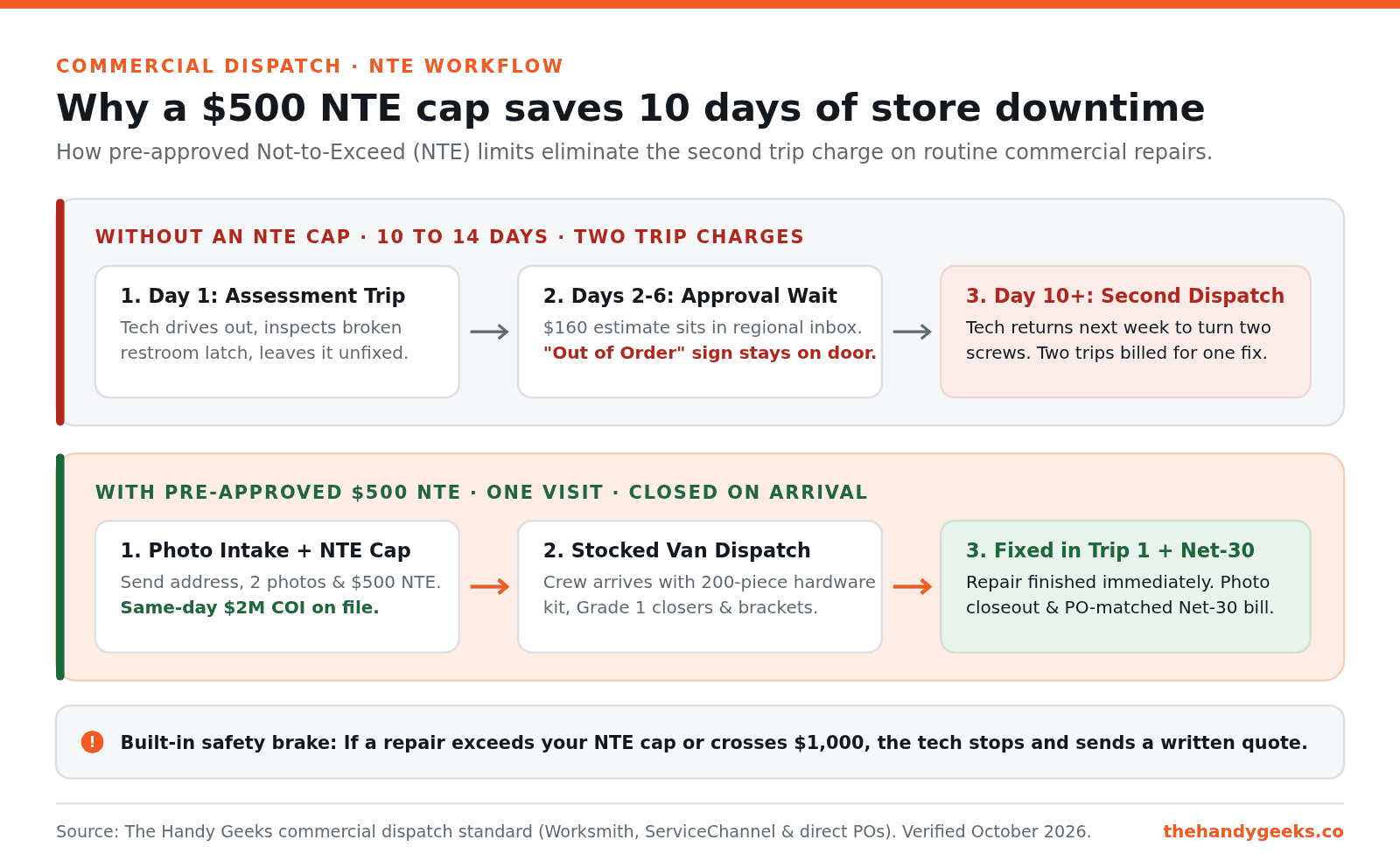
Setting a $500 NTE ceiling eliminates that second trip fee entirely. Our vans carry 200-piece commercial hardware kits, Grade 1 door closers, and partition brackets. Consequently, most single-item tickets get closed on arrival. That first-trip closeout speed is why retail brands like Chanel, Pandora, AMIRI, Lovisa, and MOSCOT use our dispatch desk. The Reality Ventures case study on The Handy Geeks documents how our automated board scaled this workflow 7x across multi-site retail portfolios.
Where Is the Legal Line Between a Commercial Handyman and a General Contractor?
In California, the legal line between minor handyman work and licensed contracting sits at $1,000. That $1,000 cap covers combined labor and materials per job, provided no building permit is needed. Cross $1,000 or pull a permit, and a licensed contractor is required.
Property managers take on serious legal risk when a vendor claims they can “build anything” without a license. California attaches strict conditions to its $1,000 minor-work exemption. Hiring an unlicensed crew outside those boundaries exposes the building owner to stop-work orders and uninsured injury claims.
| State Market | Statutory Exemption Cap | Governing Statute & Board | Permit Allowed? | Critical Trade & Staffing Restrictions |
|---|---|---|---|---|
| California (LA / SoCal / Bay Area) | Under $1,000 (labor + materials) | CA B&P Code § 7048 (CSLB Bulletin 24-07) | No | Work must be casual or minor; zero hired helpers allowed on exempt work; splitting one project into multiple sub-$1,000 invoices is illegal. |
Table: California’s statutory minor-work exemption, verified October 2026.
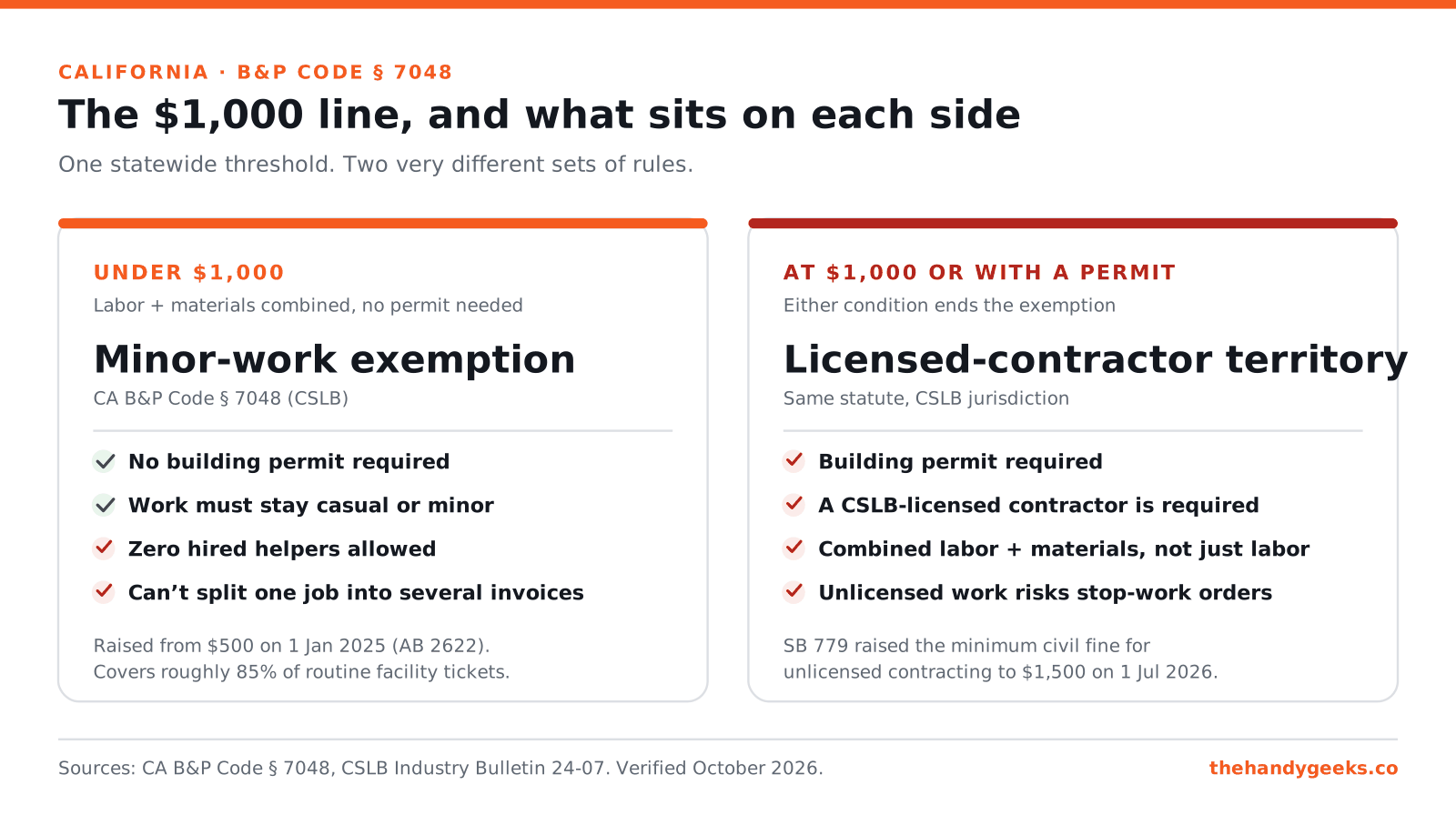
Check California’s rules carefully. AB 2622 lifted the handyman cap from $500 to $1,000 on January 1, 2025 (CSLB Industry Bulletin 24-07). However, the law bars the handyman from hiring a helper on that exempt job. Also, SB 779 raised the minimum civil fine for unlicensed contracting to $1,500 on July 1, 2026.
How The Handy Geeks Scopes Work Under the $1,000 Rule
We scope every commercial visit to stay inside California’s sub-$1,000, no-permit exemption, backed by $2M in general liability insurance. In practice, that lane covers roughly 85% of routine commercial facility tickets. It covers swapping a leaking door closer, re-anchoring a loose partition pilaster, patching drywall, or resetting retail fixtures. When a project will cross $1,000 or needs a permit, we tell you before any work begins, so you can route that portion of the job however works best for your property.
Which ADA Hardware Fixes Fit Inside a Sub-$1,000 Work Order?
Four common commercial ADA hardware fixes fit cleanly inside the $1,000 minor-work limit when no structural framing or permit applies. Those are door closer tension adjustments, lever handle swaps, restroom grab bar mounting, and tactile Braille signage installation. Each repair resolves accessibility citations in a single visit.
California retail stores and restaurants get hit with frequent inspection notices over small hardware failures. For example, hydraulic fluid inside a surface closer thickens during cold weather and makes the door hard to pull. Under California Building Code Section 11B-404.2.9 and the US Access Board Chapter 4 Door Guidelines, interior hinged doors must open with 5 pounds of force or less. Furthermore, the closer sweep must take at least 5 seconds from 90 degrees open to 12 degrees from the latch. Turning two hex valves or swapping a blown closer ($120 to $280) fixes the issue on the spot.
Accessible restroom stalls must meet equally tight specs under the US Access Board Chapter 6 Toilet Room Standards. Stall doors must self-close, carry pulls on both sides, and mount latch hardware 34 to 48 inches above the floor. That latch must work with one hand without tight grasping, pinching, or twisting. Grab bars must sit 33 to 36 inches above the floor with 1.5 inches of knuckle clearance. Across our California handyman service areas, our techs test pull force with a gauge and photograph every measurement.
Frequently Asked Questions
How much do commercial handyman services cost per hour in Los Angeles?
The Handy Geeks charges $105 to $195 per hour for commercial handyman services across the Los Angeles metro, and $120 to $220 per hour in the Bay Area. Short calls carry a $110 to $210 minimum fee, plus a $20 to $95 trip charge in the written quote.
Can you provide a same-day Certificate of Insurance (COI) and W-9?
Yes. We carry $2M in commercial general liability insurance ($1M per occurrence, $2M general aggregate). We issue ACORD 25 certificates naming your company, property manager, and building landlord as additional insured. Because our broker templates our commercial endorsements, your COI and W-9 are usually ready the same day.
Do you accept Net-30 billing and NTE work orders for commercial properties?
Yes. Approved commercial accounts get Net-30 invoicing and can submit pre-approved Not-to-Exceed (NTE) work orders up to $1,000 for permit-free repairs. Every invoice includes timestamped before-and-after photos and references your purchase order or facility platform ticket number.
Can your crews work after hours so our store or office stays open?
Yes. Most retail and office maintenance happens before opening or after closing so your staff and customers never dodge ladders. Scheduled evening and weekend visits bill at 1.25x to 1.6x our standard rate. Urgent same-day commercial calls bill at 1.4x to 1.75x, and we typically confirm scheduling within two to four hours.
What happens when a commercial repair quote exceeds $1,000?
We tell you before anyone picks up a tool. Under California B&P Code § 7048, jobs over $1,000 or needing a permit require a licensed contractor. We never split invoices to bypass the law. We flag that portion of the job clearly so you can route it however works best for your property.
Can one project manager handle multiple locations across Los Angeles and the Bay Area?
Yes. Multi-location retail and property management accounts get one dedicated project manager, one insurance file, and one consolidated invoice format. That single point of contact covers Los Angeles, SoCal, and the Bay Area, so you are not chasing separate vendors for each site.
Book a Commercial Walkthrough or Request a Written Quote
Good commercial maintenance stays out of your way. You send the property address, a short punch list, and a couple of photos. In return, we send a same-day COI and a written handyman quote that respects California’s licensing rules. Then a uniformed tech finishes the job on schedule.
Need to clear a backlog of storefront door closers, restroom partition repairs, or tenant turnover punch lists? Call our commercial dispatch line at +1 818-835-0556 or book online to set up your vendor file across Los Angeles, SoCal, and the Bay Area.