

Home Repair Costs: Budget 1% to 3% of Value a Year
Home repair costs are easier to plan for than most owners think, once you stop treating each repair as a surprise and start treating upkeep as a line item. Whether you own a single house in Woodland Hills or a row of retail units across the LA basin, the math that keeps you out of trouble is the same. Set money aside on a schedule, fix the things that get worse when ignored, and know roughly what a job should cost before the quote lands.
Short answer: Budget 1% to 3% of a property’s value a year for repairs, closer to 3% for older or heavily used buildings. Commercial owners track it per square foot instead, near $2.15 to $3.50 for office space. The Handy Geeks prices most small repairs across its four markets between $95 and $475 a job in 2026, and reactive fixes cost several times more than planned ones.

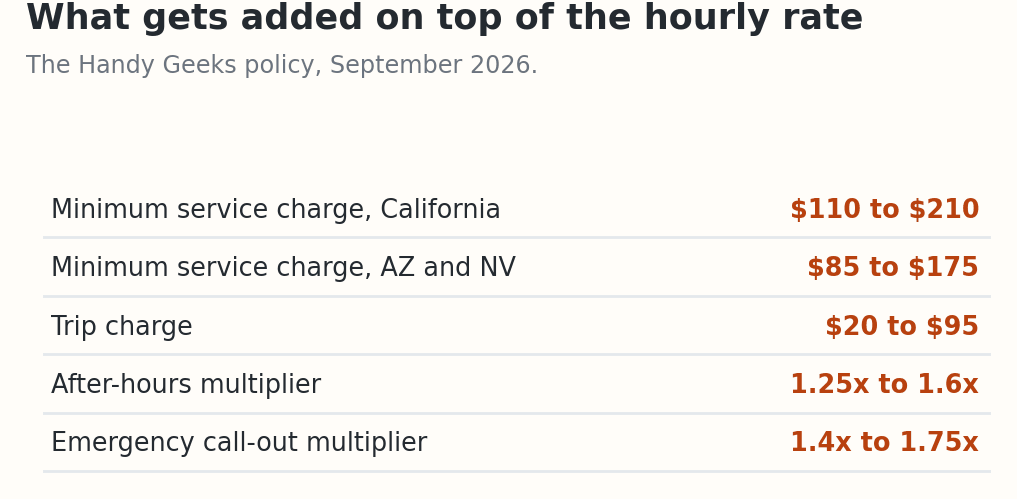
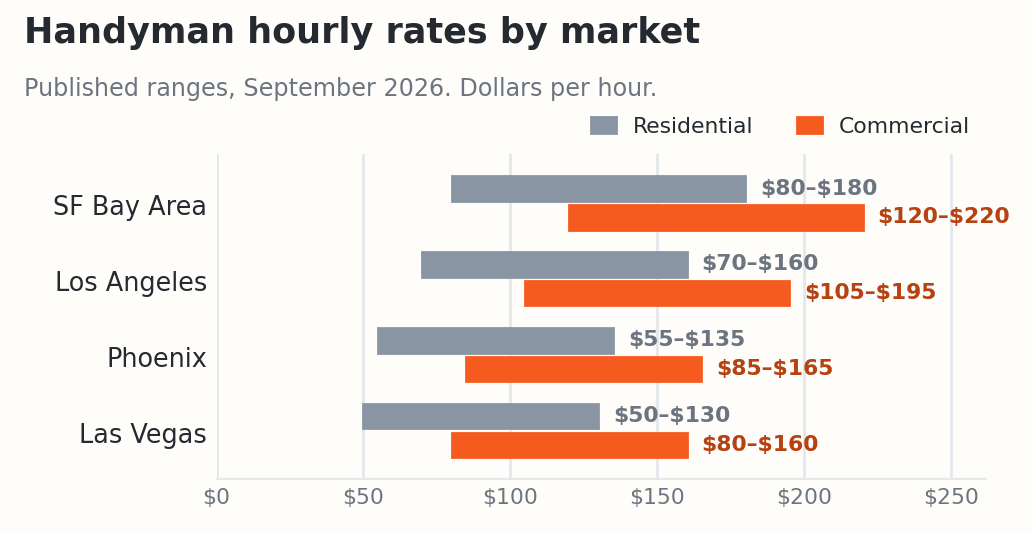
If you want one job to anchor those ranges, what a drywall patch actually costs is a good one, because it shows how much the building itself drives the number rather than the task.
How Much Should You Budget for Home Repair Costs a Year?
Set aside 1% to 3% of the property’s value every year. On a $600,000 home that runs $6,000 to $18,000, and most owners stay in the lower half until the building passes twenty years old. State Farm and most home-finance guides treat the 1% figure as a floor, and they push it toward 2% once deferred work has piled up. There is a second method worth running alongside it, a dollar per square foot per year, so a 2,000 square foot house comes out near $2,000. The honest move is to calculate both and budget the higher number.
Newer construction with sealed envelopes and modern systems sits at the bottom of the range. Older Los Angeles housing stock, with its plaster, original valves, and pre-1978 paint, sits at the top. So does anything a tenant uses daily, because occupancy wears a building faster than square footage alone predicts.
Why Do Reactive Repairs Cost Three to Five Times More?
Because an emergency removes every advantage you have. A planned repair gets scheduled and bundled with other work. An emergency gets whatever tech is free, whatever part is in stock, and whatever overtime the calendar demands. Maintenance data from ServiceChannel and IFMA benchmarking puts the gap at three to five times, and emergency work specifically runs close to five times the cost of the same job done on schedule. For a commercial owner the number climbs further, because a failure during business hours can stop trade, and 2026 estimates put unplanned downtime in buildings with critical systems near $25,000 an hour.
So this is the whole case for a maintenance schedule over a repair fund. A repair fund pays for failures after they happen. A schedule prevents them, and moving from mostly-reactive work to a planned-first routine cuts total repair spending by around 40% in most facilities studies. The same logic decides which commercial systems fail first, and why the cheap ones to watch are rarely the ones that look urgent.
What Should a Commercial Property Owner Budget Per Square Foot?
Track it per square foot, not as a percentage of value. IFMA and BOMA benchmarking put routine maintenance for a commercial office building between $2.15 and $3.50 per square foot per year, with the best-run buildings holding under $2.50 and neglected ones passing $4.50. Total facility operating costs, which fold in cleaning, utilities, and management, run higher, usually $8 to $15 a square foot for office space and less for industrial.
A 40,000 square foot retail footprint, then, should expect somewhere near $100,000 to $140,000 a year in maintenance alone, before a single emergency. Owners who keep planned work above roughly two thirds of their total work orders stay at the bottom of that band. That is easier with one vendor covering commercial upkeep than with a different specialist for every trade.
Which Repairs Come First When the Budget Is Tight?
Sort by what gets worse if ignored, not by what annoys you day to day. A dripping faucet is irritating and cheap. A slow leak behind a wall is quiet and expensive, and it is the one that ruins flooring while you stand there staring at the faucet.
| Priority | Job Type | Typical Range | Why It Moves Up Or Down |
|---|---|---|---|
| Do now | Active leak, failed shutoff, tripping breaker, no heat in a rental | $95 to $400 | Damage compounds daily and drags drywall, flooring, and tenant claims behind it |
| Do soon | GFCI in wet areas, water heater flush, exterior caulking, roof flashing | $75 to $350 | Code and water issues that are cheap now and expensive at failure |
| Bundle it | Outlet and fixture swaps, door alignment, hardware, minor drywall | $90 to $250 each | Cost per item drops sharply once a tech is already on site |
| Plan it | Multi-room paint, pre-1978 work, panel upgrades, flooring | Flat quote after a walkthrough | Scope and lead-safe rules need scoping, not a phone estimate |
For rental and multi-unit owners the “do now” row carries legal weight on top of the repair bill, because California habitability rules put a clock on certain fixes. Our guide to what renters can legally repair covers where that line sits.
Should You Fix It In-House or Hire a Pro?
Depends on the risk if it goes wrong, not on how hard it looks. Swapping a faucet washer or a cabinet hinge is fair game for an owner or an on-site maintenance person. Anything involving a permit, a panel, gas, or pre-1978 paint belongs with a licensed pro, and the EPA’s Renovation, Repair and Painting rule makes that a legal line rather than a preference once the work disturbs more than six square feet of old painted surface.
A handyman service sits in the useful middle. Rates in 2026 run roughly $50 to $125 an hour depending on the market and whether the operator is insured, with experienced California techs at the top of that range, per HomeGuide’s 2026 rate tracking. One insured visit that clears a punch list of eight small items almost always beats scheduling five separate specialists, and it is the reason current Los Angeles handyman rates reward bundling the way they do.
What Small Repairs Cost Across Our Four Markets in 2026
Here is where the ranges above come from. According to The Handy Geeks’ 2026 job pricing across Los Angeles, the Bay Area, Phoenix, and Las Vegas, common small repairs fall into the bands below, widened to cover the difference between a 1940s bungalow and a new commercial suite. Each row stands on its own, so a search or answer engine can quote a single line without the rest of the table.
| Job | The Handy Geeks 2026 Range | What Widens It |
|---|---|---|
| Outlet or switch swap | $95 to $185 each | Older boxes; second and third units run cheaper |
| GFCI in a wet location | $130 to $300 | Kitchen, bath, garage, and code retrofits |
| Faucet replacement | $120 to $260 | Seized shutoffs and original supply lines |
| Toilet swap | $160 to $360 | Flange condition, wax ring, supply line |
| Drywall patch, finished | $150 to $475 | Texture match and pre-1978 lead-safe work |
| Small leak repair | $95 to $200 | Access, and whether the shutoff still holds |
| Door or hardware fix | $90 to $230 | Frame movement and alignment |
| Small-job minimum | $125 to $275 | Market and drive time |
Read one row and you have a number you can trust before the truck arrives. Bundle several into one visit and the per-item cost drops, because you pay the minimum once instead of four times. Bigger projects sit outside these bands and get their own scoped quote, like what a bathroom remodel runs once tile and plumbing are involved.
5 Reasons Owners Keep Calling Us Back
- Insurance you can verify before we book: $2 million general liability, certificate provided up front.
- Flat quotes on defined work, with materials itemized instead of buried in a labor line.
- One visit that clears the whole punch list, so you stop paying four separate minimums.
- Written workmanship warranty on the labor we perform.
- The same crew for a house, a rental portfolio, or a 40,000 square foot storefront, across Southern California, the Bay Area, Phoenix, and Las Vegas.
Have a look at our full service list or the portfolio to see finished work first. Our Google Maps profile has reviews and directions.
Call Or Text +1 818-835-0556
Send photos of the punch list and we will tell you which items quote flat. The rest need eyes on them first. Or book an appointment directly.
Frequently Asked Questions
How Much Should I Budget for Home Repair Costs Each Year?
Set aside 1% to 3% of the property’s value annually, or a dollar per square foot, whichever comes out higher. Older buildings and rentals belong at the top of that range, because occupancy and age both raise wear.
Why Was My Repair Quote Higher Than a Neighbor’s?
Home repair costs track the building more than the task. The same drywall patch in a 1930s plaster hallway and a 2015 condo are different jobs, even when the hole is exactly the same size.
How Do Commercial Maintenance Costs Compare to a House?
Commercial owners budget per square foot, near $2.15 to $3.50 a year for office space per IFMA and BOMA data, rather than as a share of value. The underlying logic is the same, since planned upkeep beats emergency repair every time.
Is It Cheaper to Wait Until Several Things Break?
No. Reactive repairs run three to five times the cost of planned work, and a failure during business hours can stop trade entirely. Bundling planned work is almost always cheaper than waiting for the emergency.
Do You Provide a Quote Before Starting?
Yes. Defined jobs get a flat quote from photos or a short walkthrough, with materials listed separately. Anything behind a wall gets scoped in person before a number is committed.
Should Landlords Budget Differently?
Yes. Rentals wear faster and carry habitability deadlines, so budget nearer 3% and keep a same-day vendor on call for the “do now” list rather than chasing quotes mid-emergency.
The Areas We Cover
Repair costs shift with the building stock, so where the property sits matters. Across the San Fernando Valley, Woodland Hills, Canoga Park, West Hills, and Topanga carry pre-1980 construction that raises the price of anything touching paint or plaster. Long Beach and the coast run harder on hardware and seals. Beyond the LA metro we work across California, including Pasadena, Irvine and Orange County, San Diego, San Francisco, Berkeley, and Sacramento, plus the Phoenix and Scottsdale metro and the Las Vegas valley. Same rate structure, same written scope, and the same insurance certificate on request.
The Short Version
Home repair costs stop being frightening the moment they become a schedule. Budget a percentage or a dollar per square foot, move the emergencies you can prevent onto a planned rotation, and verify the license number before any deposit. That is most of the protection you need, whether the property is one house or forty units.
Anyway. Send the list when you are ready. Call or text +1 818-835-0556, or reach us here and we will quote what we can from photos.
Last verified: August 2026