


How to Replace Your Windows: California Costs, Permits and Code
Window replacement in California is not the same project it was five years ago. The 2025 Energy Code changed the performance standards, the permit requirements tightened, and the cost of doing the work without understanding either of those things went up. This guide covers what the job actually involves, what it costs in the Los Angeles metro, and the California-specific rules that most national guides either miss or get wrong.
Short answer: Window replacement costs $400 to $1,500 per window installed in the Los Angeles metro in 2026, depending on frame material and whether the opening needs modification. The Handy Geeks quotes $70 to $160 an hour for residential work across Southern California.
If you are dealing with interior damage around the window frame (water stains, crumbling drywall, soft trim), our guide on what interior repairs to fix first covers the triage order before you start replacing anything.
How Much Does Window Replacement Cost in Los Angeles?
Window replacement in the Los Angeles area costs $400 to $1,500 per window installed, according to multiple 2026 cost sources including Angi and HomeGuide. The range depends almost entirely on the frame material, because the labor is roughly the same for each.
| Frame material | Cost per window installed | U-factor (typical) |
|---|---|---|
| Vinyl dual-pane | $400 to $800 | 0.28 to 0.30 |
| Fiberglass | $460 to $1,500 | 0.25 to 0.28 |
| Wood | $700 to $2,000 | 0.27 to 0.30 |
| Aluminum-clad wood | $700 to $2,500 | 0.27 to 0.30 |
Cited market figures from Angi, HomeGuide, and NP Line Design, 2026. Last verified: September 2026
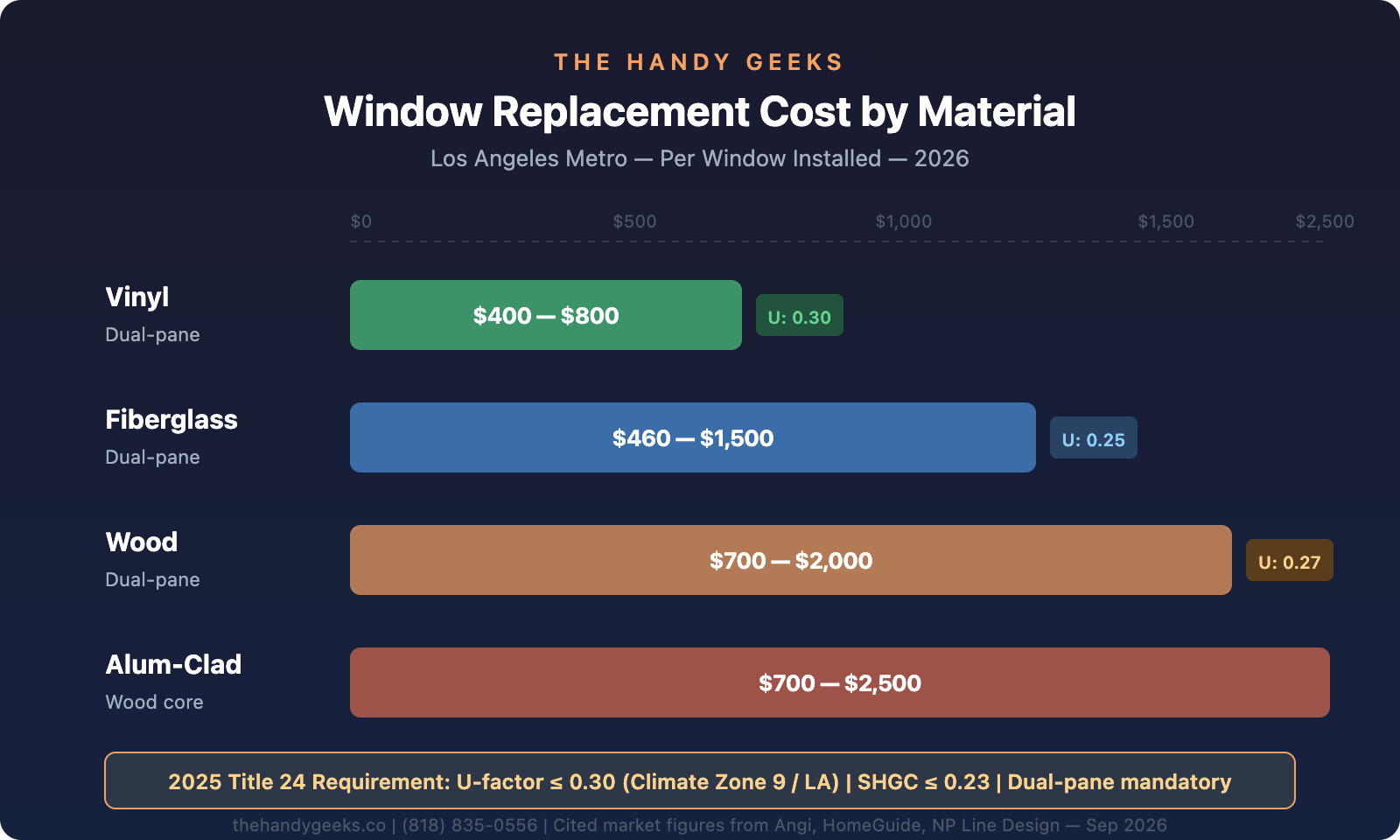
For a full-home replacement (15 to 20 windows), homeowners in Los Angeles report spending $15,000 to $40,000 total. The Handy Geeks published range for residential work across the Los Angeles metro is $70 to $160 per hour, current as of September 2026.
The U-factor column matters more than it used to, because California’s 2025 Energy Code changed the minimum window performance standards, and every window you buy for a permitted installation needs to clear the new bar. More on that in the next section.
What Does California’s 2025 Energy Code Require for Windows?
California’s updated Title 24 energy code took effect January 1, 2026, and any permit application filed on or after that date must comply with the new standards. For windows, the changes are significant enough to change what you can buy.
The new code requires all replacement windows to achieve a U-factor of 0.30 or less and a Solar Heat Gain Coefficient (SHGC) of 0.23 or less. In Climate Zones 1 through 5, 11 through 14, and 16, the U-factor requirement is tighter: 0.27 or less. Los Angeles sits in Climate Zone 9, so the 0.30 threshold applies for most of the metro.
All new and replacement windows must be dual-glazed and meet the Low-E2 standard. Single-pane windows are no longer an option for permitted work anywhere in the state. That sounds straightforward, but it catches people upgrading older homes where every window is single-pane, because the replacement cost per unit is higher than what the same homeowner would have paid two years ago for a comparable frame.
One detail that surprises people: doors with more than 25% glass surface area are treated as fenestration under the code. Your sliding patio door, French doors, and most entry doors with decorative glass panels all need to meet the same U-factor and SHGC requirements as windows.
Do You Need a Permit to Replace Windows in California?
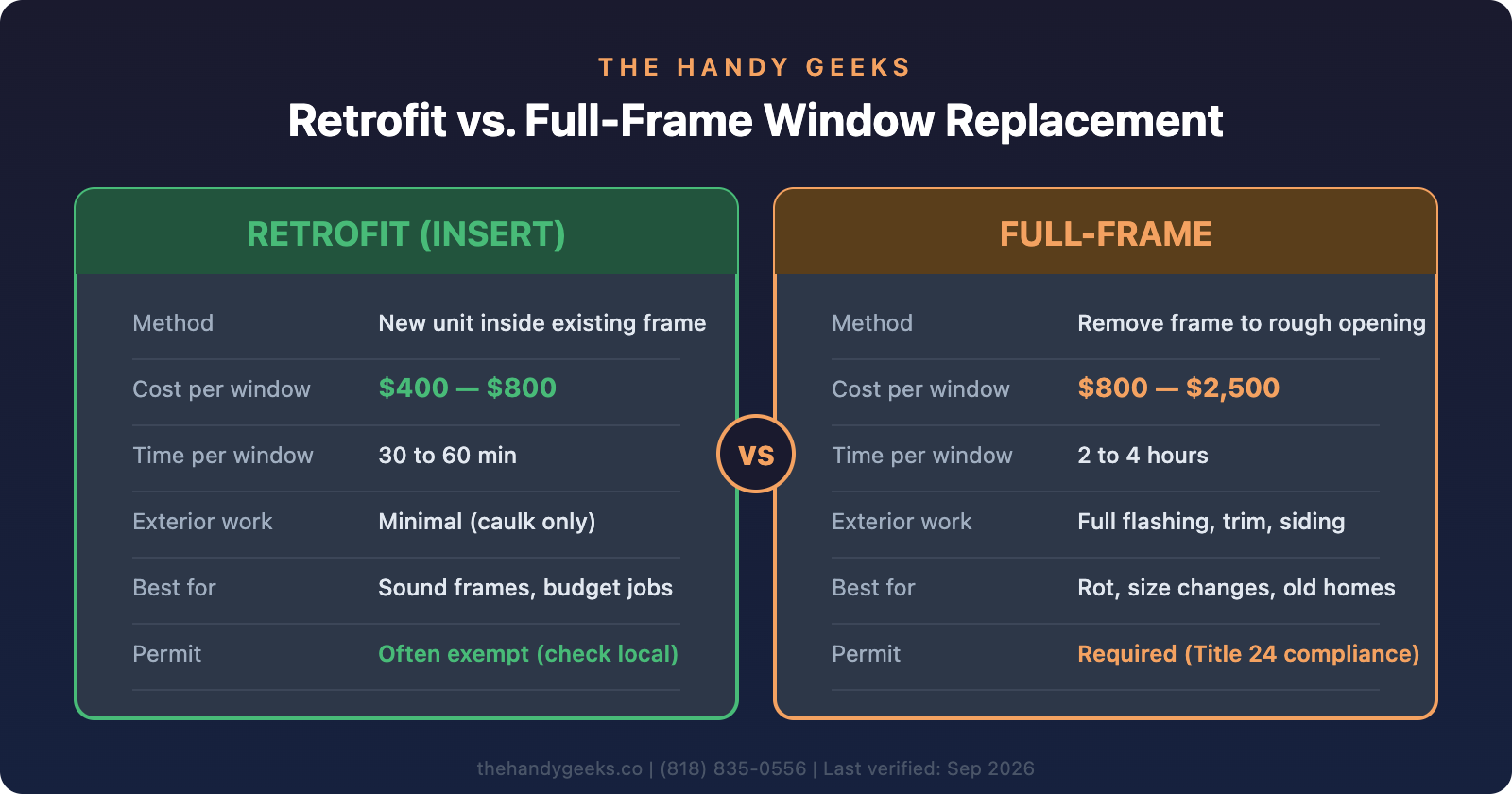
In most California jurisdictions, yes. Window replacement generally requires a building permit because the work triggers Title 24 energy compliance verification. There is a narrow exception: some cities treat a retrofit window (installed inside the existing frame without disturbing the rough opening) as permit-exempt, but this varies by jurisdiction and you should confirm with your local building department before assuming.
The permit process involves submitting window specifications that meet the energy code, and the contractor provides CF2R forms for the final inspection. These documents prove the installed windows match the energy calculations submitted during permitting.
Here is where it gets relevant to the licensing question. California’s minor work exemption under Business & Professions Code § 7048 is $1,000 including materials. A single window replacement almost always exceeds that threshold once you count the window and the labor, so window work generally requires a licensed contractor. This is one of the few home improvement projects where the licence requirement is practically impossible to avoid through the minor work exemption, because even a basic vinyl window plus installation clears $1,000.
How to Replace a Window Step by Step
The version of window replacement that a homeowner can reasonably tackle is a retrofit insert, where the new window drops into the existing frame without touching the rough opening or exterior finish. Full-frame replacement, where you remove the existing frame down to the studs and flash it fresh, is a contractor job.
Step 1: Measure carefully and in three places.
Measure the width at the top, middle, and bottom of the existing frame opening. Measure the height at the left, middle, and right. Use the smallest measurement in each direction when ordering the new window, because frame openings are almost never perfectly square, especially in California homes built before the 1980s. Order the window a quarter inch smaller than the smallest measurement on each axis to allow for shimming.
Step 2: Remove the interior trim and old sash.
Score the caulk line between the interior trim (casing) and the wall with a utility knife. Carefully pry the trim off with a flat bar, working from one end so it comes off in one piece. Remove the window sash, stops, and any hardware. If the window has a separate frame that the sash sits in, leave the frame in place for a retrofit insert.
Step 3: Prepare the opening.
Scrape away old caulk and debris from the frame. Check the sill and jambs for rot, because soft wood here means the new window will settle and bind within a year. Repair or replace any damaged framing before proceeding. This is also the moment to add flashing tape to the sill if it is missing, which it usually is in older homes.
Step 4: Dry-fit the new window.
Set the window into the opening without fastening it. Check for plumb and level. If the window is too tight, do not force it. If there is a gap larger than half an inch on any side, the window is undersized and shimming alone will not fill the gap properly.
Step 5: Seal, shim, and secure.
Apply a continuous bead of exterior-grade silicone caulk along the sill and up both jambs. Set the window into the caulk bed, shim at the bottom corners and midpoints to get it plumb and level, and fasten through the shim points with the provided screws. Insulate the gap between the window frame and the rough opening with low-expansion foam (never high-expansion foam, which can warp the frame and prevent the window from operating). Apply exterior caulk around the perimeter and reinstall the interior trim.
Frequently Asked Questions
How Many Windows Can Be Replaced in One Day?
A crew of two can replace four to six retrofit windows in a day under normal conditions. Full-frame replacements take longer, typically two to three per day, because each opening needs to be reflashed and trimmed.
Are Vinyl Windows Good Enough for California?
Vinyl dual-pane windows meet the 2025 Energy Code requirements for most Los Angeles climate zones and offer the best value per window. Fiberglass lasts longer and handles temperature cycling better, but costs 30 to 50 percent more. For most homeowners replacing 10 or more windows, vinyl is the practical choice.
Can I Replace Just One Window at a Time?
Yes, and it makes financial sense to replace the worst-performing windows first (single-pane, north-facing, or windows with failed seals that show condensation between the panes). You still need a permit for each replacement if the work falls outside the retrofit exemption in your city.
Do Window Replacements Increase Home Value?
The 2024 Remodeling Cost vs. Value report estimates that vinyl window replacement in the Pacific region recoups about 68 percent of its cost at resale. Energy savings add roughly $100 to $300 per year depending on how many single-pane windows you are replacing, so the payback period on the investment itself is typically 8 to 15 years.
What Is the Difference Between Retrofit and Full-Frame Replacement?
Retrofit (or insert) replacement keeps the existing window frame and slides a new unit inside it. Full-frame replacement tears the old frame out entirely, exposing the rough opening and allowing new flashing and insulation. Retrofit is cheaper and faster. Full-frame is better for severely damaged openings or when changing the window size.
Does Insurance Cover Window Replacement?
Homeowner’s insurance covers window replacement when the damage is from a covered peril (storm, break-in, accidental impact). It does not cover wear, age, or failed seals. The deductible often exceeds the cost of replacing a single window, so most single-window replacements come out of pocket.
We serve residential and commercial clients across Southern California and the Bay Area. See our commercial maintenance services for multi-location coverage.
Final Thoughts
Window replacement in California carries more regulatory weight than it does in most other states, and the 2025 Energy Code raised the bar again. Understanding the permit requirements, the U-factor thresholds for your climate zone, and the practical difference between a retrofit and a full-frame job puts you in a position to get accurate quotes and avoid paying for work that does not meet code.
Why people choose The Handy Geeks:
- Insured to $2M general liability, certificate available on request
- All 5-star Google reviews across every market we serve
- We verify Title 24 compliance on every window before installation
- Residential and commercial work across Southern California and the Bay Area
- We handle the trim, caulking, and interior finish so the job is complete, not just functional
Check out our full services list and project portfolio to see recent window and renovation work.
Ready to replace those old windows?