

Storefront door drags on the threshold: hinge wear, pivot wear or closer arm?
A dragging storefront door is diagnosed by checking hinge or pivot wear and closer arm position before anyone quotes a new door. Lift the door at the handle edge: vertical play means worn hinge pins, bushings or pivot, and no play points to the closer or to a threshold that has shifted.
Dragging doors come back when the first visit treated the symptom instead of the hardware. A vendor trial plan for commercial property maintenance shows how to test whether a vendor diagnoses, photographs and closes out a door repair before you hand over the whole portfolio.
How do you tell hinge wear from pivot wear on a storefront door?
Hinge wear shows as a sag at the latch side of a butt-hinged door, while pivot wear drops the bottom corner of a pivot-hung door. Lift the door at the handle edge: vertical play means worn pins, bushings or pivot, and the repair is hardware, not a new door.
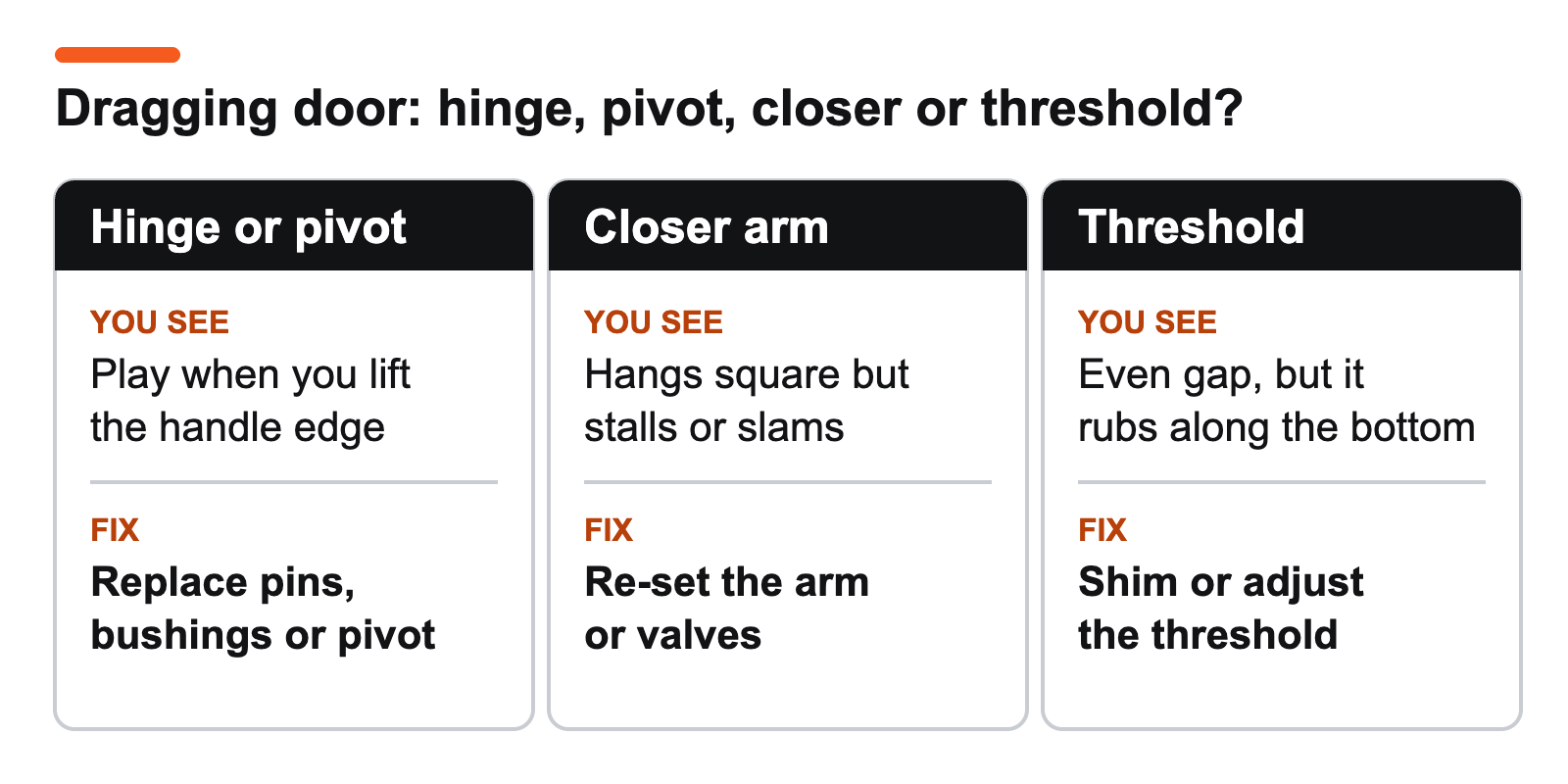
| What you see | Likely cause | Quick check | Fix class |
|---|---|---|---|
| The door rubs at the bottom corner on the latch side, and the top gap is wider on that side | Worn hinge pins or bushings, or a worn floor pivot | Lift at the handle edge and feel for vertical play | Replace pins, bushings or pivot, then re-hang |
| The door stalls, slams or fails to latch although it hangs square | Closer arm position or closer valve settings | Watch the full swing; check the arm for bends and the valves for drift | Re-set the arm or valves; replace a bent arm |
| The gap is even, but the door rubs along the bottom | Threshold or floor has shifted | Measure the bottom gap at both ends | Shim or adjust the threshold |
What does a documented door repair look like on a work order?
A documented door repair lists the diagnosis, the part replaced, the closer settings and a photo of the door hanging square. The 2010 ADA Standards set closer timing at 5 seconds minimum from 90 degrees open to 12 degrees from the latch, so the closeout note should record the measured closing time.
Our published Los Angeles range for a door closer swap is $120 to $280, and the written quote sets the cap before work starts. The ADA storefront door requirements guide covers the full door checklist, and the standard itself is the 2010 ADA Standards for Accessible Design (section 404.2.8).
How do you adjust a commercial door closer?
A commercial door closer is adjusted at its valves, not by guesswork: one sets the main swing speed, one sets the final latching speed, and some units add a backcheck. Under Bernard Toth, our crew turns one valve a quarter turn at a time, re-times the door after each change, and records the result.
- Check that the door hangs square first; a closer cannot cure worn hinges or a worn pivot.
- Time the swing with a stopwatch from 90 degrees open to 12 degrees from the latch.
- Turn the sweep valve a quarter turn, then time the door again.
- Set the latch valve so the door seats firmly without slamming.
- Write down the final closing time and photograph the settled door for the closeout note.
Never back a valve out completely, because the closer can leak oil. A closer that will not hold its setting is worn out, and replacing it costs less than another adjustment visit.
Lock work on the same door is often booked outside business hours; see how to schedule a rekey before an 8 AM opening. If the damage began with a fixture, the same hardware-first logic applies to a kiosk enclosure that will not lock.
Send the address, the scope and a few photos through the quote and work-order form, or call or text +1 818-835-0556. We serve Southern California and the Bay Area, and dispatch and office hours are Monday through Sunday, 8 AM to 6 PM.
Prices reflect The Handy Geeks published commercial rates reviewed October 2026. Standards information is a general summary, not legal advice.