

How to Install a Dishwasher the Right Way
Installing a dishwasher sounds like a weekend project until you realize it involves plumbing, electrical, and carpentry all in the same two-square-foot space under your countertop. In California, the job also intersects with permit rules and the state’s minor work exemption in ways that are worth understanding before you start pulling out the old unit.
Short answer: A dishwasher installation costs $150 to $300 in labor for a straightforward replacement on existing hookups in the Los Angeles metro. The Handy Geeks quotes $70 to $160 an hour for residential work across Southern California, and a standard swap runs about two hours.
If your installation involves broader kitchen or plumbing work, our guide to what commercial plumbing actually fails first covers the plumbing side in more detail.
What Does Dishwasher Installation Cost in California?
Dishwasher installation in the Los Angeles area costs $150 to $300 for labor when you are replacing an existing unit on hookups that are already there. First-time installations, meaning a kitchen that has never had a dishwasher, run $300 to $700 or more because someone needs to tap into the water supply, add a drain line, and run a dedicated 120V circuit.
The Handy Geeks published range for residential work across the Los Angeles metro is $70 to $160 per hour, current as of September 2026. A replacement swap typically takes 1.5 to 2.5 hours.
| Installation type | Labor cost (LA metro) | Time estimate |
|---|---|---|
| Replace existing unit, same hookups | $150 to $300 | 1.5 to 2.5 hours |
| Replace with modifications (new valve, longer drain) | $250 to $450 | 2.5 to 4 hours |
| First-time install, no existing hookups | $300 to $700+ | 4 to 6 hours |
| Haul away old unit | $25 to $75 | Included or add-on |
Cited market figures from Angi and HomeGuide, 2026. Last verified: September 2026
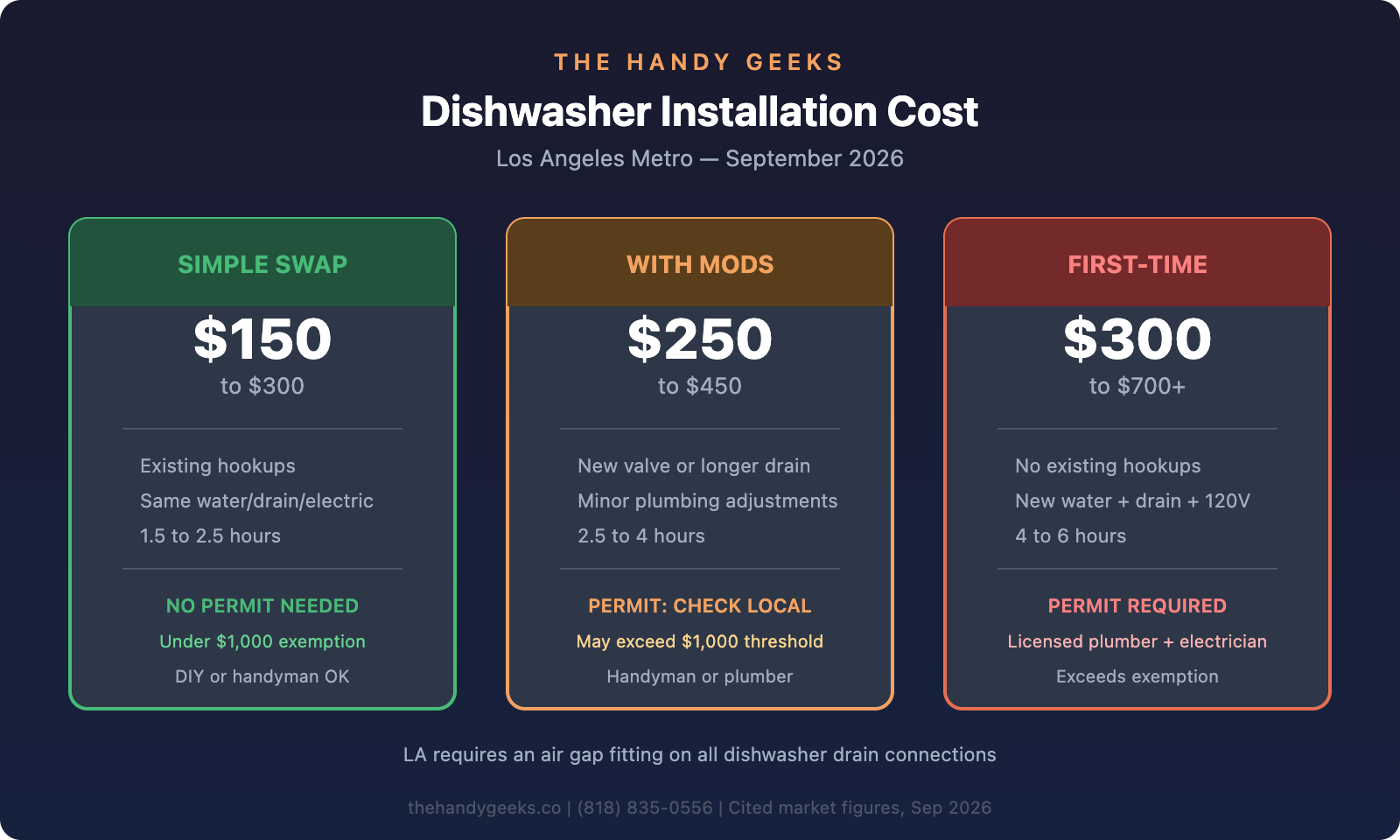
One number worth knowing: California’s minor work exemption under Business & Professions Code § 7048 is $1,000 including materials. A straightforward dishwasher swap almost always falls under that threshold, which means it does not require a contractor’s licence when no permit is needed. Once you start adding new plumbing lines or electrical circuits, the math changes.
How to Install a Dishwasher Step by Step
The process below assumes you are replacing an existing dishwasher with a new one in the same location, on the same water supply, drain, and electrical connections. If any of those do not exist, skip to the section on hiring a pro.
Step 1: Prepare the space and shut everything off.
Turn off the water supply valve under the sink (it is usually the hot water valve). Switch off the breaker that feeds the dishwasher circuit. Confirm the power is dead with a voltage tester at the junction box behind the old dishwasher. Lay a towel under the front of the unit because the drain line will drip when you disconnect it.
Step 2: Remove the old dishwasher.
Remove the kickplate at the bottom. Disconnect the water supply line from the solenoid valve using an adjustable wrench, and have a shallow pan ready for residual water. Disconnect the drain hose from the disposal or drain tailpiece under the sink. Open the junction box at the base of the unit and disconnect the wiring (black, white, ground). Remove the screws securing the unit to the underside of the countertop, then carefully slide the dishwasher out. Go slowly, because the leveling feet catch on flooring more often than not.
Step 3: Check the connections before installing the new unit.
This is the step most guides skip and where most problems start. Inspect the water supply valve. If it is a gate valve (round handle, multiple turns), consider replacing it with a quarter-turn ball valve while you have access, because gate valves fail at a much higher rate, usually by seizing open. Check the drain connection point under the sink. If the garbage disposal has a knockout plug blocking the dishwasher inlet, punch it out now, not after you have connected the drain line and are wondering why the dishwasher is flooding the cabinet.
Step 4: Install the new dishwasher.
Thread the water supply line, drain hose, and power cable through the appropriate holes in the cabinet opening. Slide the unit into position carefully, adjusting the leveling feet to clear the floor. Connect the water supply braided hose to the inlet solenoid. Connect the drain hose to the disposal or drain tailpiece, securing it with a hose clamp. Wire the junction box: black to black, white to white, ground to ground. Replace the junction box cover.
Step 5: Level, secure, and test.
Adjust the front leveling feet until the dishwasher sits level and the door opens and closes freely without rubbing the countertop. Secure the unit to the underside of the counter with the provided mounting brackets and screws. Turn the water supply back on and check every connection for leaks. Restore power at the breaker. Run a full cycle and watch the area under the sink for any dripping during the drain phase.
Three Mistakes That Turn a Simple Swap Into a Service Call
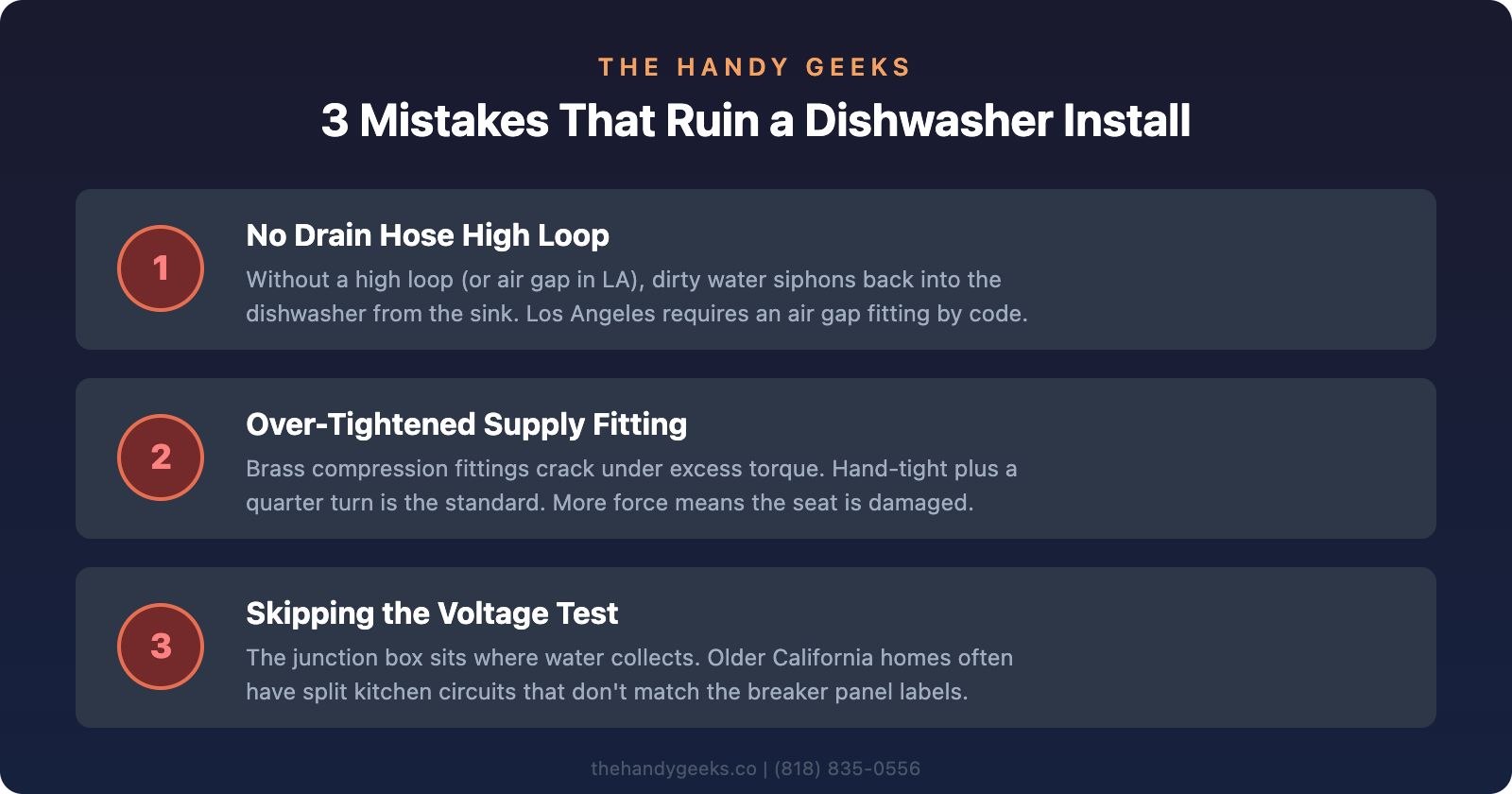
Most dishwasher installations go fine. The ones that go badly tend to fail in the same three places, and two of them are avoidable.
Not checking the drain hose height. The drain hose needs a high loop, mounting it as high as possible under the countertop before it drops down to the disposal connection. Without that loop, dirty water from the sink can siphon back into the dishwasher. Some California jurisdictions require an air gap fitting instead of a high loop, so check your local plumbing code. Los Angeles requires an air gap.
Over-tightening the water supply connection. Brass compression fittings crack when overtightened. Hand-tight plus a quarter turn with a wrench is the standard. If you need to crank harder than that to stop a leak, the fitting is cross-threaded or the seat is damaged, and torque will not fix it.
Skipping the voltage test. The junction box at the base of the dishwasher sits in a space that gets wet. Assuming the breaker is off because you flipped a switch is not the same as confirming it with a tester. In older California homes, particularly in the Valley and parts of East LA, kitchen circuits were sometimes split across multiple breakers in ways that do not match the panel labels.
When Should You Call a Pro?
A dishwasher swap on existing connections is a solid DIY project for someone comfortable with basic plumbing and wiring. There are a few situations where calling a professional is the smarter move.
You should hire a pro if there are no existing hookups and the kitchen needs new plumbing and electrical work. That is permit-required work in California and exceeds what most homeowners should tackle. Similarly, if the old unit was hardwired instead of plugged in and you are not comfortable working in a junction box, a handyman or electrician should handle the connection. Finally, if the new dishwasher is a different width than the old one (going from a standard 24-inch to an 18-inch compact, for instance), the countertop and cabinetry may need modification.
Our team handles dishwasher installations across the Los Angeles metro through our handyman services, including the supply-valve upgrades and air-gap installations that make the job last.
Frequently Asked Questions
Do I Need a Permit to Install a Dishwasher in California?
For a like-for-like replacement on existing hookups, most California jurisdictions do not require a permit. If you are adding new plumbing or electrical for a first-time installation, a permit is typically required. Check with your city’s building department, because local rules vary.
Can a Handyman Install a Dishwasher in California?
Yes, for a standard replacement that falls under the $1,000 minor work exemption (B&P § 7048) and does not require a permit. New plumbing or electrical work beyond a simple swap may require a licensed plumber or electrician depending on the scope.
How Long Does It Take to Install a Dishwasher?
A replacement on existing connections takes 1.5 to 2.5 hours. First-time installations with new plumbing and electrical work take four to six hours, sometimes spread across two visits if an inspection is required.
What Tools Do I Need to Install a Dishwasher?
An adjustable wrench, screwdriver set, voltage tester, pliers, a level, Teflon tape, and a shallow pan for catching water. Most new dishwashers come with a supply hose, drain hose, and mounting hardware, though you should check the box before the old unit is out.
Does a Dishwasher Need Its Own Circuit?
Yes. The National Electrical Code requires a dedicated 120V, 15-amp or 20-amp circuit for a dishwasher. Sharing a circuit with a garbage disposal or other kitchen appliance is a code violation, even though it was common in older homes.
Is It Cheaper to Install a Dishwasher Yourself?
You save $150 to $300 in labor on a straightforward swap. That savings is real as long as nothing goes wrong. If you overtighten a fitting and crack a valve, or cross-thread the supply connection and create a slow leak inside the cabinet, the repair bill usually exceeds what the installation would have cost.
We serve residential and commercial clients across four markets. See our commercial maintenance services for multi-location coverage, or check rates for Phoenix, South Florida, and Las Vegas.
Final Thoughts
Dishwasher installation is one of the more approachable appliance jobs if you are working with existing connections and take the time to inspect each one before you start connecting the new unit. The California-specific details (air gap requirements in LA, the $1,000 minor work exemption, circuit dedication) are the parts most national guides leave out, and they matter.
Why people choose The Handy Geeks:
- Insured to $2M general liability, certificate available on request
- All 5-star Google reviews across every market we serve
- We replace supply valves and install air gaps as part of the job, not as expensive add-ons
- Residential and commercial work across Southern California, Phoenix, and Las Vegas
- Transparent per-job pricing, no hourly surprises
Check out our full services list and project portfolio to see recent appliance and plumbing work.
Need a dishwasher installed?