


Drain Unclogging Solutions That Will Not Wreck Your Pipes
Most drain unclogging solutions get ranked by how fast they work. That is the wrong order. The fastest option on the shelf is also the one most likely to leave you with a rougher pipe, a worse clog in six months, and a repair that costs more than the plumber you were avoiding.
So here they are ranked by what they do to the pipe, which is the ranking that matters if you plan to keep the house.
Short answer: The safest drain unclogging solutions are mechanical. A plunger, then a bent wire hook, then a hand snake clears most household clogs without touching the pipe. Chemical cleaners belong last, because they roughen the pipe interior and make the next clog more likely. The Handy Geeks handles drain work across Los Angeles and the Bay Area.
What Actually Causes a Slow Drain?
Almost always a build-up on the pipe wall rather than a single object stuck in the middle. That distinction changes which tool works.
In a bathroom sink or shower, it is hair bound together with soap scum, collecting on the tailpiece and the first bend. In a kitchen sink it is fat, oil and grease that went down warm as a liquid and cooled into a solid coating a few feet along the horizontal run. Neither is a plug you push through. Both are a lining you have to scrape off or dissolve.
That is why a plunger sometimes works brilliantly and sometimes does nothing at all. Plungers move water, and moving water shifts a loose obstruction. Against a hard grease collar bonded to the pipe wall, water pressure alone just flexes past it.
A drain that has been getting slower for months is almost always build-up. A drain that stopped suddenly, on a day nothing changed, is more often an object.
Why Chemical Drain Cleaners Cause the Next Clog
This is the part worth understanding before you pour anything down a sink.
Most supermarket drain cleaners are either caustic, built on sodium hydroxide, or acidic, built on sulfuric acid. Both dissolve organic matter. Both also attack the pipe carrying it.
Caustic cleaners react with water exothermically, which means they generate real heat inside the line. PVC starts losing pressure resistance above roughly 140°F and deforms under sustained heat, so a caustic cleaner sitting in a plastic trap is working on the trap as well as the clog. Acidic cleaners do their damage by corrosion instead, stripping the zinc coating off galvanized pipe and leaving bare steel to rust.
Here is the part nobody mentions on the bottle. That corrosion leaves the pipe interior pitted and rough. A rough interior catches hair and grease far more readily than a smooth one, so the treated drain clogs again sooner, and the next clog sits tighter. You are not solving the problem, you are buying a shorter interval.
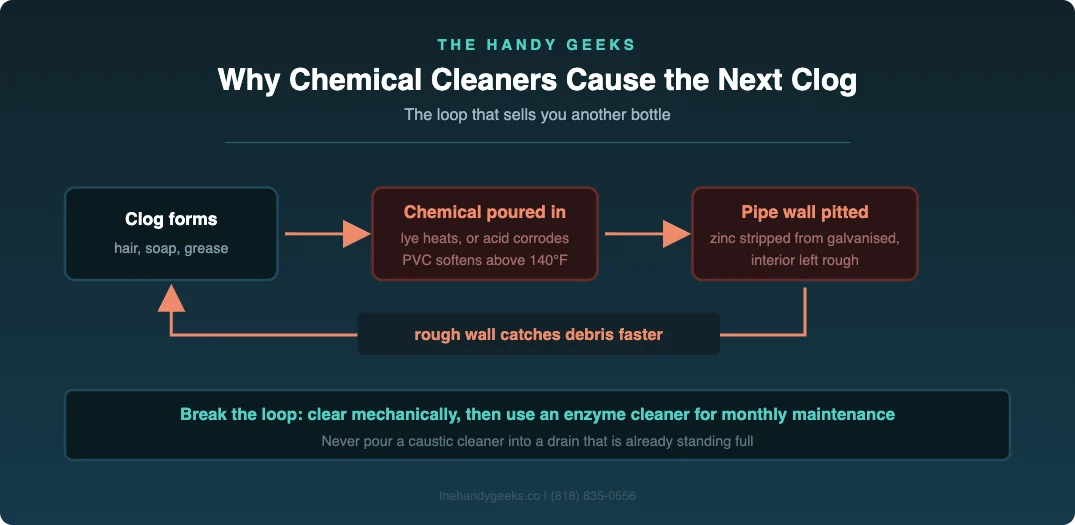
Worst case is a fully blocked drain. The product cannot reach the clog, so it pools in the trap and works on the pipe for hours. Plumbers are close to unanimous on this one: never pour a caustic cleaner into a drain that is already standing full.
There is a safety dimension too. The National Capital Poison Center notes that non-enzymatic drain cleaners cause serious burns and permanent tissue damage. The Consumer Product Safety Commission has recalled sodium hydroxide drain products repeatedly, over packaging and labelling failures. Poor trade for a job a $15 hand snake does better.
Drain Unclogging Solutions Ranked by Risk to the Pipe
Work up the ladder, cheapest and gentlest first. Most household clogs give up somewhere in the first three rungs.
| Method | Works on | Risk to pipe |
|---|---|---|
| Boiling water (metal pipes only) | Light grease, soap film | None on metal, avoid on PVC |
| Plunger | Loose obstructions, partial blocks | None |
| Bent wire or zip-it tool | Hair at the tailpiece and first bend | None |
| Hand-crank drain snake | Build-up further along the run | Minimal |
| Removing and cleaning the P-trap | Anything caught in the trap | None, just messy |
| Enzyme cleaner (slow, overnight) | Organic build-up, maintenance | None |
| Chemical caustic or acid cleaner | Organic clogs | Real, and cumulative |
Last verified: September 2026.
Boiling water deserves a caveat. It is genuinely effective on a greasy kitchen line with metal pipes, and it is a bad idea on PVC, where repeated near-boiling water softens joints over time. If you do not know what your pipes are, use hot tap water instead and accept it works more slowly.
How Do You Clear a Drain Without Chemicals?
Pull the hair out first. Of all the drain unclogging solutions here, this is the one people skip and the one that most often works. In a bathroom sink or shower it resolves the majority of slow drains, and it takes about two minutes.
Lift the stopper, or unscrew it if it is the push-button kind, and pull whatever is wrapped around the underside. Then run a bent wire or a cheap plastic zip-it tool down past the crosshair and hook out what sits in the first bend. That first bend catches most of it.
If the drain is still slow, the build-up is further along and you need a hand snake. Feed it in until you meet resistance, then crank slowly rather than shoving. You are trying to bore through and then scrape the wall on the way out, so the useful part of the job happens as you withdraw it, turning the whole time.
For a kitchen sink, opening the P-trap is often faster than snaking. Put a bucket underneath, unscrew both slip nuts by hand, and tip the trap out. Grease collars are visible and come out with a rag and a bottle brush.
Enzyme cleaners are the one bottled product worth keeping. They use bacteria to digest organic matter rather than burning it, so they do nothing to the pipe. They are also slow, which is why they suit monthly maintenance rather than an emergency.
So the honest summary: the drain unclogging solutions that work are mostly physical. They cost under twenty dollars. And they live in a drawer rather than under the sink.
Telling a Clog From a Main Line Problem
One fixture running slow is a clog. Several fixtures running slow at once is the main line, and that is a different job.
The tell is where the water goes. If flushing a toilet makes the shower gurgle, or running the washing machine backs water into a floor drain, air is being displaced somewhere it should not be, which points at a blockage downstream of both fixtures. Snaking one sink will not touch that.
Repeated clogs in the same fixture are also worth reading as a signal. A line that clogs every few months usually has a slope problem, a partial collapse, or root intrusion, and clearing it again just resets the clock. Our guide to what fails first in commercial plumbing covers the diagnostic order, and it applies to houses too.
What Does Drain Clearing Cost?
A single fixture is usually inside a minimum service call. Residential rates at The Handy Geeks run $70 to $160 an hour in the Los Angeles metro and $80 to $180 in the Bay Area, with a California minimum service charge of $110 to $210.
The Handy Geeks published residential ranges, current as of September 2026.
Main line work is priced differently because it needs different equipment, and in Nevada it needs a licensed plumbing contractor regardless of the amount, since NRS 624.031 exempts no plumbing work at any dollar value. We will tell you when a job crosses that line rather than proceed.
What Never Goes Down a Drain
Prevention is duller than unclogging and considerably cheaper. The recurring offenders:
- Cooking fat, oil and grease. Liquid in the pan, solid in the pipe. Wipe the pan with a paper towel before washing it.
- Coffee grounds. They do not dissolve and they pack down into a dense sludge.
- Rice and pasta. Both keep absorbing water and swelling after they are in the line.
- Flushable wipes. They are not. They pass the toilet and then snag on anything rough downstream.
- Eggshells. Grind into gritty fragments that bind with grease.
- Paint and joint compound. Cure inside the pipe exactly as they would anywhere else.
A hair catcher in the shower and a grease jar by the hob prevent most of what we get called out for. Prevention beats every drain unclogging solution on this list, because nothing you pour or push is as cheap as the clog that never formed.
Frequently Asked Questions
Do Chemical Drain Cleaners Damage Pipes?
Yes. Caustic cleaners generate heat that can deform PVC, which loses pressure resistance above roughly 140°F, and acidic cleaners strip the zinc from galvanized pipe and leave bare steel to rust. Both leave the interior rough, which catches debris and makes the next clog more likely.
What Is the Safest Way to Unclog a Drain?
Mechanical removal. Pull the hair from the stopper and first bend, then use a hand-crank drain snake if the build-up is further along, cranking as you withdraw so the tool scrapes the pipe wall. Opening the P-trap is often faster on a kitchen sink and carries no risk to the pipe.
Why Does My Drain Keep Clogging After I Clear It?
Usually because the build-up was scraped rather than removed, or because the pipe interior is pitted from previous chemical use and catches debris. Repeated clogs in the same fixture can also indicate a slope problem, partial collapse or root intrusion, none of which clearing resolves.
Can I Pour Boiling Water Down a PVC Drain?
Avoid it. PVC softens under sustained heat and repeated near-boiling water can weaken joints over time. Boiling water is effective on greasy kitchen lines with metal pipes. If you do not know what your pipes are, use hot tap water and accept a slower result.
What Does It Mean When Multiple Drains Are Slow?
It points at the main line rather than a single fixture. The clearest tell is air moving where it should not: flushing a toilet makes the shower gurgle, or the washing machine backs water into a floor drain. Snaking one fixture will not fix a main line blockage.
Are Enzyme Drain Cleaners Worth Using?
For maintenance, yes. They use bacteria to digest organic matter instead of burning it, so they do nothing to the pipe. They work slowly, usually overnight, which makes them a good monthly habit and a poor emergency fix.
Final Thoughts
The useful shift is to stop ranking drain unclogging solutions by speed. A bottle that clears a sink in ten minutes and roughens the pipe on the way through has not saved you anything. It has moved the cost somewhere you cannot see yet.
Mechanical first, enzymes for maintenance, a plumber when more than one fixture is involved. That order costs less over the life of the house than the hardware store shelf does.
Why homeowners call The Handy Geeks for drain work:
- Insured to $2M general liability, with a certificate available the same day
- All 5-star Google reviews across every market we serve
- We clear mechanically rather than chemically, so the pipe is not worse afterwards
- We tell you when it is a fixture clog and when it is the main line
- Straight answers about which work requires a licensed contractor and which does not
If other things around the house need attention, our guide to which interior repairs to tackle first sets a sensible order. Full scope and booking sits on our California handyman services page. Anyway, the hair catcher costs about four dollars.
Drain still slow after you have tried the gentle options?