

TV mounting height calculator for offices, lobbies and stores
Short answer: Mount a TV so the center of the screen sits at the viewer’s eye level, about 42 inches off the floor for seated viewers. This TV mounting height calculator works out the center, top and bottom edge heights for your screen size, the tilt needed if it goes higher, and the right size for your viewing distance.
Last verified: October 2026
Most mounting mistakes come from hanging the screen where it looks good from the doorway instead of where people actually sit or stand. In a conference room that means neck strain by the second hour. In a lobby or store it can mean a screen nobody reads, or one that sticks into a walkway. Enter your screen and room below and the calculator gives you drill-ready numbers.
TV mounting height calculator
Turn the estimate into a written quote. Send the address, your calculator numbers and a few photos. We reply with a written scope and price, and a certificate of insurance if you need one. Prefer the phone? Call or text +1 818-835-0556.
How high should you mount a TV?
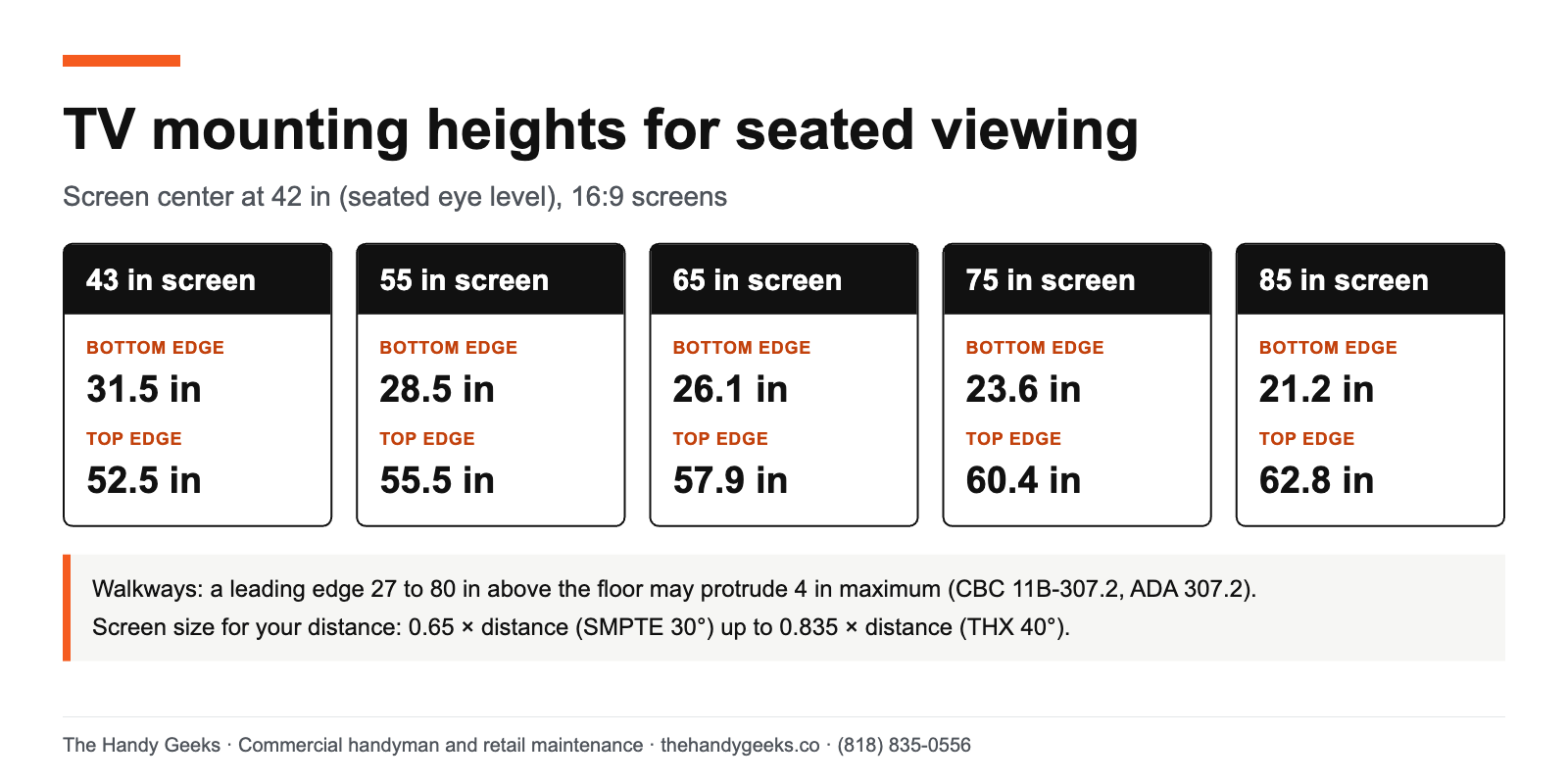
Put the center of the screen at the eye level of the people watching. From a seated position eye level is generally about 42 inches off the floor, so the center of a seated-viewing TV lands near 42 inches and the bottom edge sits lower or higher depending on screen size.
The bottom edge height is the center height minus half the screen height. A 16:9 screen is about 0.49 times its diagonal tall, so a 65 inch TV is roughly 32 inches tall. Centered at 42 inches, its bottom edge sits about 26 inches off the floor and its top edge about 58 inches. If furniture, a fireplace or a counter forces the screen higher, tilt it down toward the viewers. The calculator shows the angle.
| Screen size | Screen height (16:9) | Bottom edge if centered at 42 in | Top edge if centered at 42 in |
|---|---|---|---|
| 43 in | 21.1 in | 31.5 in | 52.5 in |
| 55 in | 27.0 in | 28.5 in | 55.5 in |
| 65 in | 31.9 in | 26.1 in | 57.9 in |
| 75 in | 36.8 in | 23.6 in | 60.4 in |
| 85 in | 41.7 in | 21.2 in | 62.8 in |
What size screen fits your viewing distance?
SMPTE recommends a 30 degree field of view for mixed use, which works out to a screen size of about 0.65 times the viewing distance in inches. THX recommends about 40 degrees for an immersive picture, or 0.835 times the distance.
At 9 feet (108 inches) that is about a 70 inch screen for mixed use and up to a 90 inch screen for an immersive setup. For conference rooms, the SMPTE number is usually the better fit, because people need to read slides and spreadsheets without turning their heads.
How high should screens go in a store, lobby or restaurant?
Screens that standing customers read, like menu boards and lobby displays, are mounted with the center near standing eye level, so measure from the floor to the eyes of a typical viewer and enter that number. Anything beside a walkway also has to meet the California protrusion limit.
California Building Code section 11B-307.2, like section 307.2 of the 2010 ADA Standards, says objects with leading edges more than 27 inches and not more than 80 inches above the floor can protrude no more than 4 inches into a circulation path. A slim screen on a flat mount often fits under 4 inches; a tilting or articulating mount usually does not. The fix is to mount the screen higher than 80 inches at the bottom edge, recess it, or place it out of the walking path. Check the code with your building owner or designer before you finalize the location.
What affects the cost of mounting a TV in a commercial space?
Commercial TV and display mounting with The Handy Geeks is billed at $105 to $195 an hour in Los Angeles, with a $110 to $210 minimum visit and a $20 to $95 trip charge. Wall type, screen weight, cable routing and after-hours scheduling move the time.
- Wall type: many offices and stores have metal studs, which need the right anchors or added blocking for heavy screens. Concrete and brick need masonry anchors.
- Cable routing: surface raceway is quick; fishing cables inside the wall takes longer.
- Power: adding or moving an outlet behind the screen is electrical work, and in many cities it needs a permit. Our commercial electrical team can quote it with the mount.
- Timing: mounting before opening or after close bills at 1.25 to 1.6 times standard.
Mounting mistakes cost more than the mount. Our guide to TV mounting errors to avoid covers the anchor and stud problems we fix most often, and the drywall repair cost guide covers what a pulled-out mount costs to patch.
Who does the work?
Display and fixture installs are part of the in-store maintenance our crews do under CEO Bernard Toth for retail brands such as Chanel, Pandora, AMIRI, Lovisa and MOSCOT: mounting and leveling screens and signage, re-hanging fixtures after resets and patching the old holes so the wall is clean. Crews are dispatched from 6020 S La Brea Ave, Los Angeles, and we carry $2M in general liability with same-day certificates of insurance.
TV mounting height calculator FAQ
How high should a 65 inch TV be mounted?
For seated viewing, center a 65 inch TV at about 42 inches. The bottom edge then sits about 26 inches off the floor and the top edge about 58 inches.
Should the TV be at eye level when seated or standing?
Match whoever watches longest. Living rooms and conference rooms use seated eye height, about 42 inches. Menu boards, lobby screens and retail displays use standing eye height.
How far should you sit from a 75 inch TV?
Using the SMPTE 30 degree guideline, about 115 inches, or 9.6 feet. Using the THX 40 degree guideline, about 90 inches, or 7.5 feet.
Can a TV stick out into a hallway?
Under California Building Code 11B-307.2 and ADA 307.2, an object whose leading edge is between 27 and 80 inches above the floor can protrude at most 4 inches into a circulation path.
How much does it cost to have a TV mounted in an office?
With us, commercial mounting is billed at $105 to $195 an hour with a $110 to $210 minimum visit. A single screen on a standard wall is usually a short visit; metal studs, in-wall cables and new power add time.
Other calculators
- Office renovation cost calculator: price a full office refresh, from painting to door closers.
- Drywall repair cost calculator: price patches by size and estimate sheets and joint compound.
Want it mounted right the first time? Request a written quote or call +1 818-835-0556.
Seated eye height guideline from SANUS; viewing angle guidance from SMPTE and THX; protrusion limits from California Building Code 11B-307.2 and the 2010 ADA Standards 307.2. Rates are The Handy Geeks’ published 2026 ranges. Reviewed by The Handy Geeks operations team, October 2026.