

Loose grab bar in an occupied restroom: re-anchor or replace?
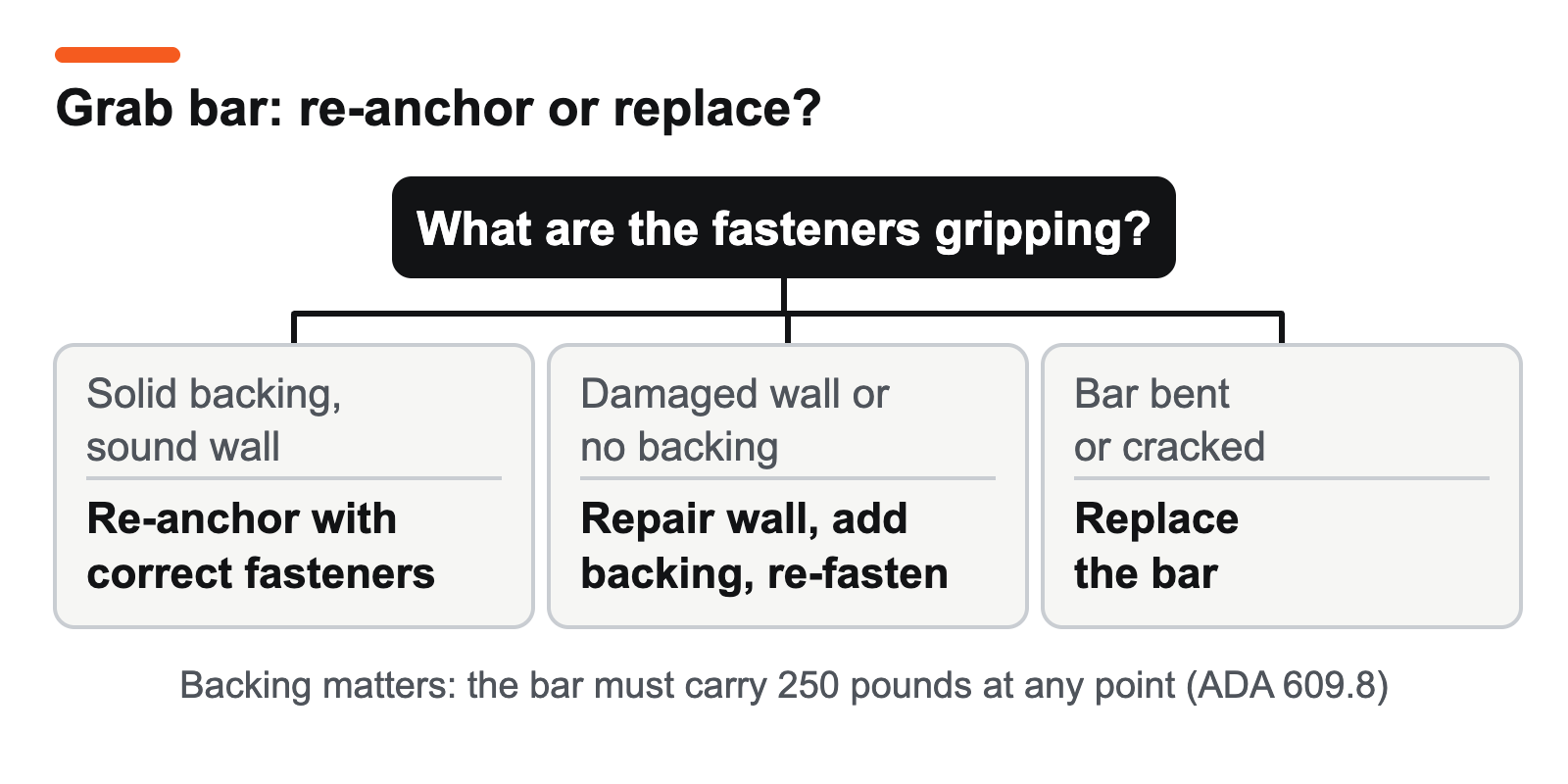
A loose grab bar is a safety item: re-anchor it into solid backing when the wall is sound, replace the mount when the wall behind it is damaged. Take that stall out of service until the bar is secure, and record what the fasteners were gripping when the bar came loose.
A loose grab bar deserves a same-week visit and a photo record. Before you assign it, ask the vendor for three numbers: first contact, lead time and arrival for commercial property maintenance.
How do you decide whether to re-anchor or replace a grab bar?
Check what the fasteners grip. If they hold in solid backing, such as blocking or a stud, and the wall is sound, re-anchor with the correct fasteners. If the wall is crumbled, cracked or hollow behind the bar, repair the wall and locate or add backing before reinstalling the mount.
| What you find | Likely cause | Action |
|---|---|---|
| The bar rotates or wobbles and the screws spin | Stripped holes, or no backing behind the wall surface | Open the wall locally, locate or add backing, re-fasten |
| The flange pulled away with the wall surface | The wall surface failed under load | Repair the wall, then re-fasten the flange into backing |
| The bar is solid but the flange cover is loose | Cover or set screw only | Tighten the set screw or replace the cover |
| The bar is bent or cracked | Overload or a defective part | Replace the bar |
What load must a grab bar carry?
Section 609.8 of the 2010 ADA Standards requires a grab bar, its fasteners, its mounting device and its supporting structure to withstand 250 pounds of vertical or horizontal force at any point without exceeding allowable stresses. A re-anchored bar must meet the same load, which is why backing matters.
Put the fastener type, the backing you found and before-and-after photos in the closeout note. The standard is the 2010 ADA Standards for Accessible Design; our ADA storefront door requirements guide covers the entrance side of accessibility.
How does our team re-anchor a loose grab bar?
A loose grab bar comes out of use first and gets fixed second. Led by Bernard Toth, our crew tags the stall, finds out what the old fasteners gripped, re-anchors the bar into solid backing or repairs the wall behind it, and confirms it holds under a firm pull before reopening.
- Tag the stall out of service and photograph the loose bar and the wall around the flange.
- Remove the flange cover and look at what the fasteners were holding.
- Locate blocking or a stud; if there is none, open the wall locally and add backing.
- Re-fasten with the correct hardware and confirm the bar sits 33 to 36 inches above the floor.
- Pull firmly along the bar, record that it did not move and send before-and-after photos.
If the repair needs framing work or a permit, we tell you before we quote it.
Small safety items share one habit, which is a photo record before and after. See how to handle a water-stained ceiling tile without hiding the source, and a missing kiosk latch without replacing the kiosk.
Send the address, the scope and a few photos through the quote and work-order form, or call or text +1 818-835-0556. We serve Southern California and the Bay Area, and dispatch and office hours are Monday through Sunday, 8 AM to 6 PM.
Prices reflect The Handy Geeks published commercial rates reviewed October 2026. Standards information is a general summary, not legal advice.