

Tenant says the vendor never showed: how to audit arrival windows
A no-show complaint is settled by three timestamps: assignment, first tenant contact and technician arrival. Pull all three from the work order before calling the vendor, compare them with the arrival window confirmed in writing, and decide whether the miss belonged to dispatch, the vendor or site access.
When a tenant says the vendor never showed, the property manager needs timestamps for assignment, first contact and arrival. The three response moments in commercial property maintenance give the audit a standard to measure against.
Which three timestamps settle a no-show complaint?
Three timestamps settle a no-show complaint: when the work order was assigned, when the vendor first contacted the tenant, and when the technician arrived or was turned away. Compare each with the confirmed window. A late assignment points to your dispatch handoff; a late contact or arrival points to the vendor.
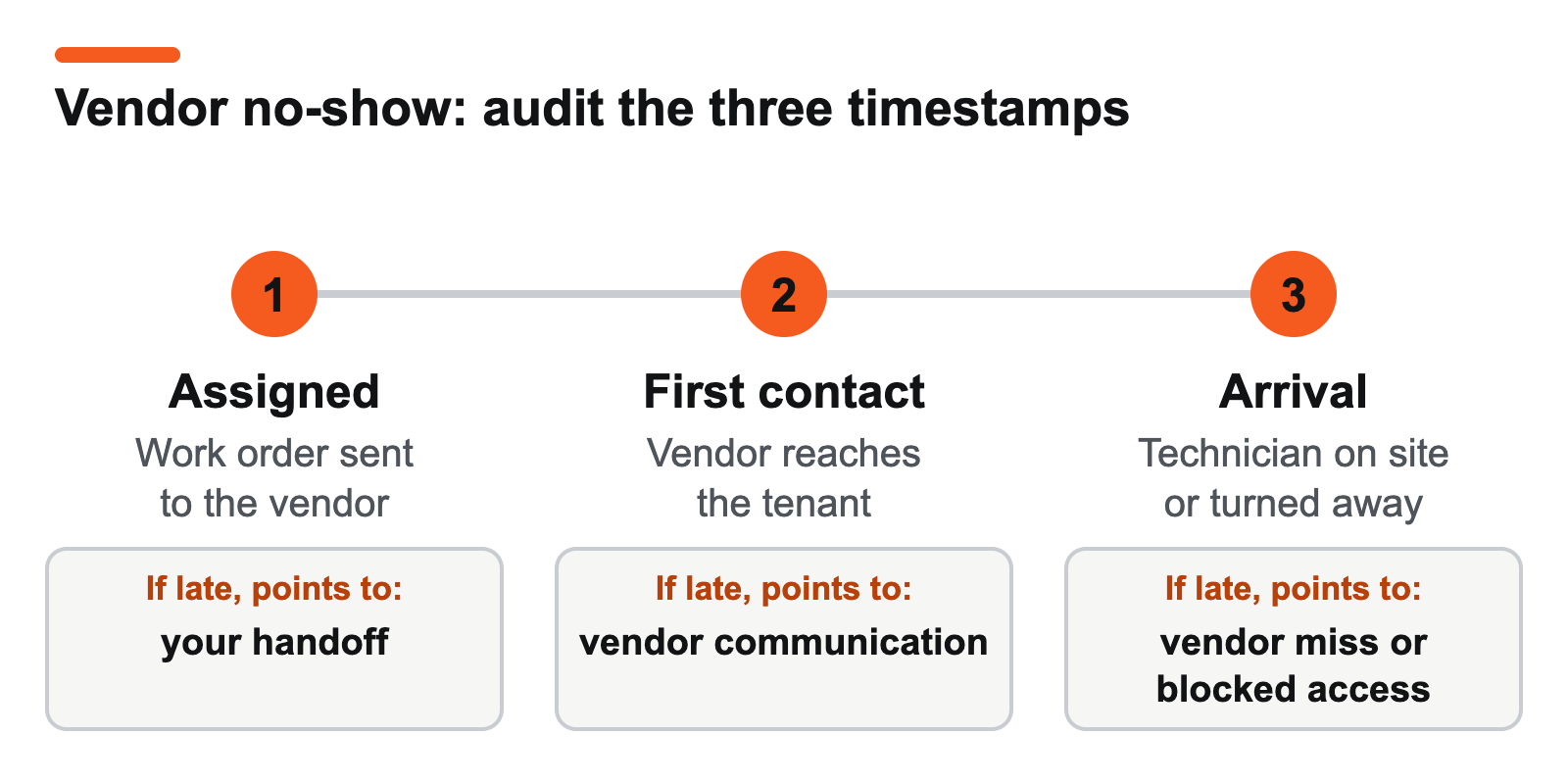
| Timestamp | Where to find it | Compare with | If it is late |
|---|---|---|---|
| Assignment | Your work order system, or the email sent to the vendor | The time the tenant reported the problem | A handoff delay on the manager side |
| First tenant contact | The vendor message log or call record | The vendor first-contact standard | A vendor communication gap |
| Arrival or attempted access | Technician check-in, photo timestamp or building access log | The confirmed arrival window | A vendor miss, or access blocked on site |
Our published standard for urgent commercial calls for account clients is a scheduling confirmation within two to four hours, and we confirm the arrival window in writing.
What should you ask the vendor after an audit finds a miss?
After an audit finds a miss, ask the vendor for three things in writing: what happened, the corrected arrival window and what changes on the next work order. A vendor that answers with timestamps and a fix is worth keeping; one that answers with excuses has shown you the next miss.
Keep the audit table with the work order so the pattern is visible after three or four visits, not one.
How do we prevent a vendor no-show on our own jobs?
We confirm the arrival window in writing and keep three timestamps for every work order: assignment, first contact and arrival. That record means a property manager never has to rely on a verbal account of a missed visit, because the work order shows what happened and when.
Each work order records four things:
- Assignment: the time the request reaches us.
- First contact: when we reach the tenant or site contact; for urgent calls on account clients we typically confirm scheduling within two to four hours.
- Arrival: technician check-in, backed by timestamped photos on site.
- Access problems: if nobody can let the technician in, we log the attempt and the time.
The same record answers a tenant complaint in minutes instead of days.
Under Bernard Toth, every work order is built to carry that record, so a property manager can answer a tenant from the file rather than from memory.
Response standards belong in the paperwork from day one; see what to collect when a vendor has no certificate on file. A monthly walkthrough report also shows whether misses repeat.
Send the address, the scope and a few photos through the quote and work-order form, or call or text +1 818-835-0556. We serve Southern California and the Bay Area, and dispatch and office hours are Monday through Sunday, 8 AM to 6 PM.
Prices reflect The Handy Geeks published commercial rates reviewed October 2026.